

On this page
Common salt is the textbook example of an ionic bond, and the clearest way to see why ionic bonds form at all. Instead of a list to memorise, here are the three conditions as an energy balance you can check with real numbers, so you can explain the answer in a board exam and reason through a JEE Main or NEET-UG question you have not seen before.
What are the conditions for formation of an ionic bond?
The NCERT Class 11 Chemistry chapter on chemical bonding says that ionic bonds form more easily between elements with comparatively low ionisation enthalpies and elements with a comparatively high negative electron gain enthalpy. The same chapter adds a third factor: the energy released when the ions pack into a crystal. Put together, the conditions are:
Low ionisation enthalpy of the metal. Removing an electron, M(g) → M⁺(g) + e⁻, always costs energy, so the smaller that cost, the better.
High negative electron gain enthalpy of the non-metal. Adding an electron, X(g) + e⁻ → X⁻(g), should release as much energy as possible.
Large lattice enthalpy. The ions must give out enough energy when they come together in a solid to pay for whatever the first two steps did not cover.
NCERT defines lattice enthalpy as the energy required to completely separate one mole of a solid ionic compound into its gaseous ions (NCERT, section 4.2.1). Forming the lattice releases that same amount of energy.
Why does NaCl form if making the ions costs energy?
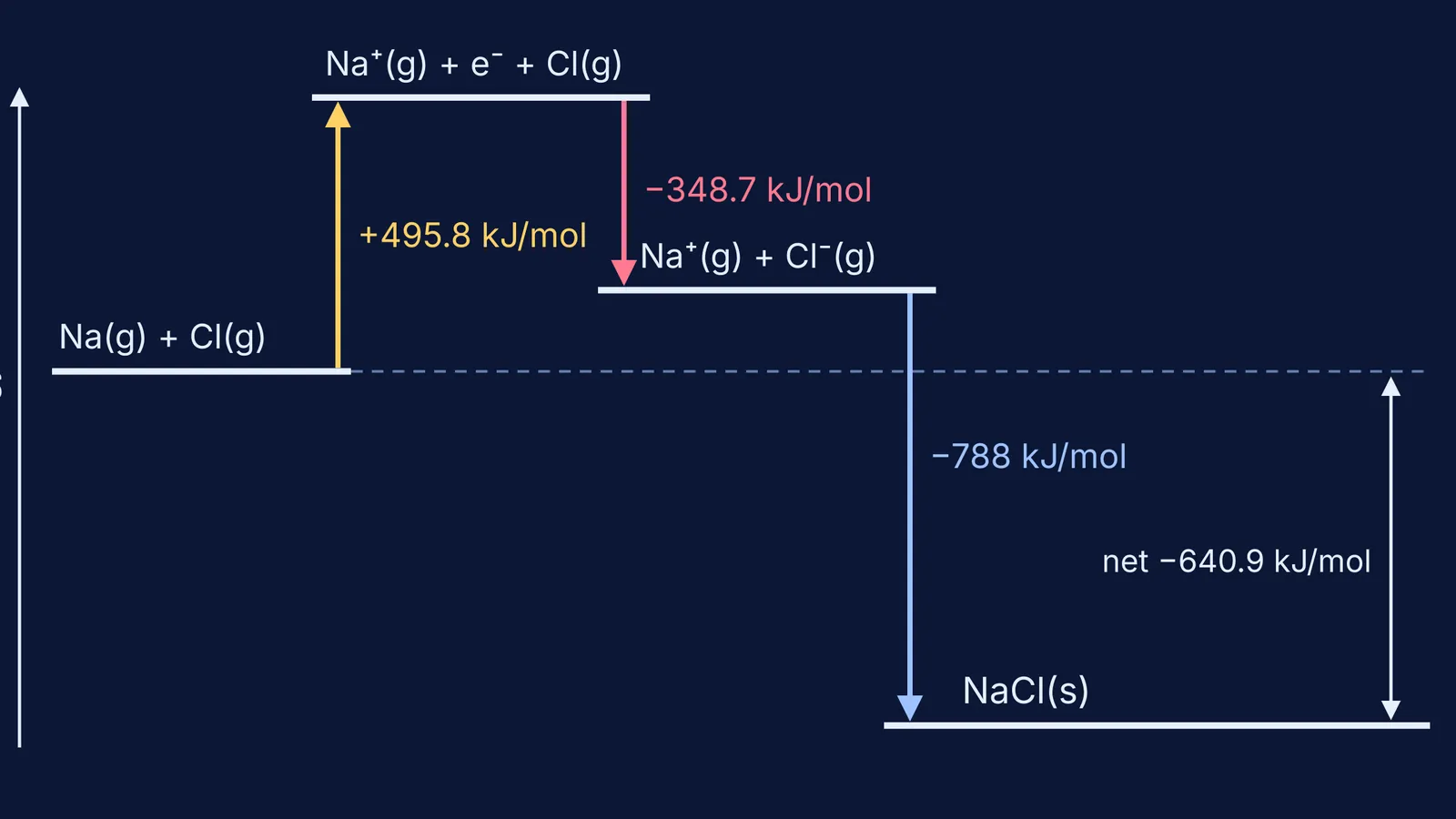
Here are NCERT's numbers for sodium chloride, from the same chapter. Work through them in order.
Ionise sodium: Na(g) → Na⁺(g) + e⁻ needs +495.8 kJ/mol.
Give the electron to chlorine: Cl(g) + e⁻ → Cl⁻(g) has an electron gain enthalpy of −348.7 kJ/mol.
Add the two: 495.8 − 348.7 = +147.1 kJ/mol. Making a pair of separate gaseous ions is still uphill.
Pack the ions into the crystal: the lattice enthalpy of NaCl is 788 kJ/mol, so forming the solid releases 788 kJ/mol.
Net change from gaseous atoms to solid: 147.1 − 788 = −640.9 kJ/mol. The ionic solid sits far lower in energy than the separate atoms.
Step 3 is the one students skip. Even for sodium and chlorine, a near-ideal pair, electron transfer on its own does not pay for itself. The lattice makes the difference. These steps start from gaseous atoms; a full Born–Haber cycle also includes vaporising solid sodium and splitting Cl₂ molecules, which NCERT leaves out at this point.
What makes lattice enthalpy large?
Lattice energy can be estimated with an equation derived from Coulomb's law: it rises with the charges on the ions and falls as the ions get bigger, as OpenStax Chemistry 2e, section 7.5 explains. OpenStax gives 1023 kJ/mol for LiF and 3900 kJ/mol for MgO, nearly four times as large, because both ions in MgO carry double the charge. Small, highly charged ions therefore make the third condition easiest to meet.
Our guide to how ion charge and size decide lattice energy goes through that trend in detail, and the electron dot diagrams for MgCl₂ and Na₂O show the electron transfer itself step by step.
How do you check the three conditions in an exam question?
Use this four-question check whenever you are asked whether two elements will form an ionic compound:
Is one element's first ionisation enthalpy low? Group 1 and 2 metals usually pass.
Is the other element's electron gain enthalpy strongly negative? Halogens and oxygen usually pass.
Will the ions be small and highly charged enough to give a large lattice enthalpy?
Does the energy balance come out negative, as it did for NaCl?
Try it on NCERT's own data. Exercise 3.31 in the Class 11 chapter on periodicity lists six unnamed elements. Element II has a first ionisation enthalpy of 419 kJ/mol and element III has an electron gain enthalpy of −328 kJ/mol, while element V has a first ionisation enthalpy of 2372 kJ/mol and an electron gain enthalpy of +48 kJ/mol.
Element II is the natural cation and element III the natural anion, so the pair passes the first two conditions. Element V fails both: it neither loses nor gains an electron easily, so it is no candidate for an ionic bond.
Ionic and covalent are two ends of a scale, not two boxes. Our post on why an electronegativity difference of 1.7 is only a rough guide explains the grey zone between them.
If the terms themselves feel shaky, the Fermi Concept Library gives every chemistry concept its own lesson and its place in the map. When you want practice, the Fermi Problem Library has worked problems with a step-by-step solver that explains the reasoning rather than printing an answer, so you can see where your energy balance goes wrong.
Next time you write that sodium gives an electron to chlorine, write the three numbers beside it: +495.8, −348.7 and −788.


