

On this page
When atoms interact, they strive for stability. For many elements, this means achieving a full outer shell of eight electrons, known as an octet. Metals achieve this by giving away their few outer electrons, while non-metals fill their shells by taking them in. This permanent handover of electrons creates an ionic bond.
What makes a bond ionic?
The nature of a chemical bond depends on electronegativity—an atom's ability to attract shared electrons. If the difference in electronegativity between two atoms is large enough, one atom pulls the electron entirely away from the other.
According to the Pauling scale, a large electronegativity difference/Physical_Properties_of_Matter/Atomic_and_Molecular_Properties/Electronegativity) generally indicates an ionic bond. Metals like magnesium and sodium have low electronegativities (1.2 and 0.9, respectively), making them eager to shed electrons. Non-metals like oxygen (3.5) and chlorine (3.0) have high electronegativities and strongly pull electrons toward themselves.
If you are ever unsure whether a compound is ionic or covalent, calculating the percentage ionic character from its dipole moment can provide a more precise answer.
How does MgCl₂ form an ionic bond?
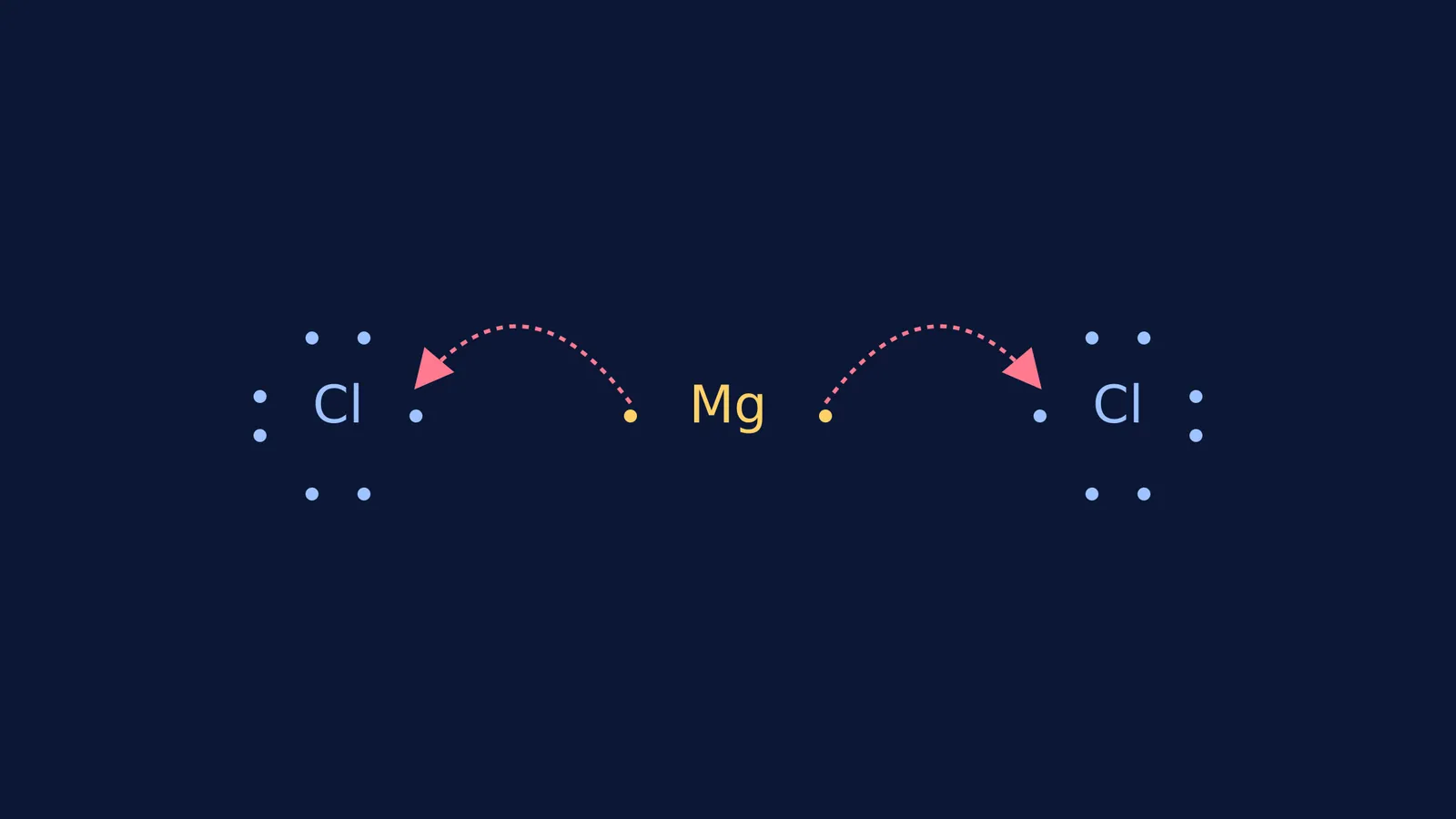
Magnesium (Mg) has an atomic number of 12, giving it an electron configuration of 2,8,2. To achieve a stable octet, it needs to lose its two outermost valence electrons. Chlorine (Cl), with an atomic number of 17, has a configuration of 2,8,7. Each chlorine atom needs exactly one electron to complete its outer shell.
Because magnesium must lose two electrons but a single chlorine atom can only accept one, one magnesium atom reacts with two chlorine atoms.
The magnesium atom transfers one electron to the first chlorine atom and its second electron to the second chlorine atom.
Magnesium becomes a doubly positive ion (Mg²⁺) because it has lost two negative charges.
Each chlorine atom becomes a singly negative chloride ion (Cl⁻) because it has gained one negative charge.
The strong electrostatic attraction between the Mg²⁺ cation and the two Cl⁻ anions forms the ionic lattice of magnesium chloride (MgCl₂).
How does Na₂O form an ionic bond?
The formation of sodium oxide follows the same principle but in reverse proportions. Sodium (Na, atomic number 11) has an electron configuration of 2,8,1. It wants to lose one electron. Oxygen (O, atomic number 8) has a configuration of 2,6. It needs two electrons to complete its octet.
Since one sodium atom can only supply one electron, oxygen requires two sodium atoms to fulfill its need.
Two sodium atoms each transfer their single valence electron to one oxygen atom.
Both sodium atoms become Na⁺ ions.
The oxygen atom, having gained two electrons, becomes an O²⁻ oxide ion.
These oppositely charged ions lock together to form Na₂O. If you are preparing for board exams, mastering these electron dot structures in Class 10 is essential for scoring well in chemistry.
What properties do these ionic bonds create?
Because the electrostatic forces between Mg²⁺ and Cl⁻, or Na⁺ and O²⁻, are incredibly strong, these compounds share distinct physical traits. The ions arrange themselves into a rigid, repeating 3D crystal lattice rather than existing as isolated molecules.
This tightly bound structure means ionic compounds have high melting and boiling points; it takes a massive amount of thermal energy to break the electrostatic attractions. For instance, anhydrous magnesium chloride melts at 714 °C. Furthermore, while they are solid insulators, ionic compounds conduct electricity when melted or dissolved in water, because the ions are finally free to move and carry a current.
A 3-step checklist for electron dot diagrams
To master the formation of ionic bond in MgCl₂ and Na₂O electron dot diagrams, you must track the valence electrons accurately. Use this checklist every time you need to map out an ionic transfer:
Count the valence electrons: Write the electronic configuration for the metal and the non-metal. Note how many the metal must lose and how many the non-metal must gain.
Match the ratio: If the metal gives away two electrons but the non-metal only takes one (as in MgCl₂), you need two non-metal atoms. If the non-metal needs two but the metal only gives one (as in Na₂O), you need two metal atoms.
Draw the transfer: Use dots or crosses for the valence electrons of the neutral atoms. Draw arrows showing the electrons moving from the metal to the non-metal. Finally, draw the resulting ions inside square brackets, with their new charges clearly marked outside the top right corner.
Working through chemical bonding can sometimes feel abstract. If you are stuck on a difficult valency concept, the Fermi Concept Library breaks down the foundation step by step. When you need more direct help, Fermi's AI tutor can work out what you already know and build a plan for the session, drawing the figures and writing on a board alongside you to ensure the idea clicks.


