

On this page
Where does the 1.7 rule come from?
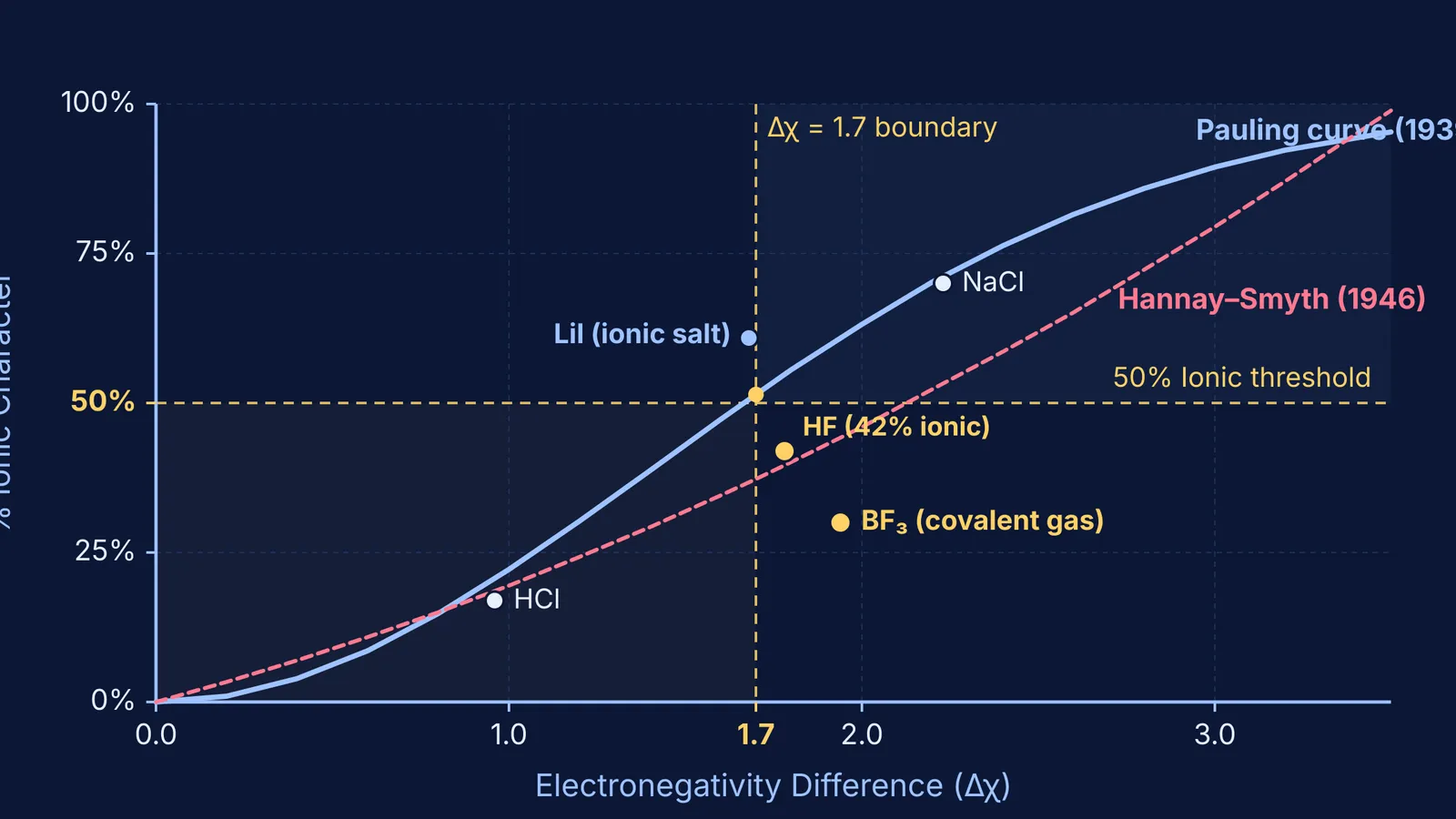
In introductory chemistry, students preparing for CBSE Class 11, JEE Main, or NEET-UG learn a standard test: if the electronegativity difference (Δχ) between two atoms exceeds 1.7, the bond is classified as ionic; below 1.7, it is classified as covalent. This benchmark originates in Linus Pauling's 1932 paper in the Journal of the American Chemical Society, which established the thermochemical scale of electronegativity. In his 1939 work, Pauling modeled ionic character with the equation % ionic character = (1 − e^(−(Δχ)² / 4)) × 100. Setting Δχ = 1.7 yields 51.5% ionic character, rounded to the 50% midpoint between ionic and covalent bonding. As seen in Linus Pauling's work on the chemical bond, this threshold was meant as a continuum, not a rigid boundary.
In 1946, N. Bruce Hannay and Charles P. Smyth revised this relation in the Journal of the American Chemical Society, measuring dipole moments to propose % ionic character = 16(Δχ) + 3.5(Δχ)². On their curve, Δχ = 1.7 gives only 37.3% ionic character, pushing the 50% ionic mark to Δχ ≈ 2.1.
Which molecules break the 1.7 threshold?
Real molecules routinely break the 1.7 rule in both directions.
Hydrogen fluoride (HF) is the classic exception. With hydrogen at 2.20 and fluorine at 3.98 on the Pauling scale, Δχ is 1.78. Yet HF is a volatile liquid boiling at 19.5 °C that forms discrete molecules rather than an ionic lattice. In Hannay and Smyth's dipole study in the Journal of the American Chemical Society, the measured 1.82 D dipole moment of HF across its 91.7 pm bond length revealed an observed ionic character of only 41% to 43%. As shown in our guide on calculating percentage ionic character from dipole moment, HF is a polar covalent molecule, not an ionic lattice.
Boron trifluoride (BF3) breaks the rule even further. With Δχ = 1.94, BF3 is a non-polar covalent gas with a boiling point of −100 °C, documented in the NIST Chemistry WebBook. Forming a B³⁺ ion would demand 6,887 kJ/mol across boron's first three ionization energies, an energetic penalty that lattice enthalpy cannot repay. Boron instead forms sp² hybrid covalent bonds strengthened by pπ–pπ back-bonding. Silicon tetrafluoride (SiF4), with Δχ = 2.08, is likewise a covalent gas.
Conversely, lithium iodide (LiI) has an electronegativity difference of 1.68, falling below the 1.7 threshold. Yet according to data in the NIST Chemistry WebBook, LiI forms an ionic rock-salt crystal melting at 469 °C (742 K) that conducts electricity readily when molten. Sodium sulfide (Na2S) similarly forms an ionic antifluorite crystal lattice despite a Δχ of only 1.65.
Why does electronegativity difference alone mislead us?
The fundamental flaw of the 1.7 rule is that it reduces bonding to a single subtraction. In a 2001 study in the Journal of Chemical Education, chemist Gordon Sproul evaluated 258 binary compounds across 14 scales and found that the 1.7 Pauling cutoff misclassified 16% of them.
Sproul showed that predicting bond type requires two parameters: electronegativity difference (Δχ) and average electronegativity (χ_avg). As William B. Jensen explained in the Journal of Chemical Education, these coordinates define the van Arkel–Ketelaar triangle:
Electronegativity difference (Δχ) reflects how unevenly the bonding electrons are shared.
Average electronegativity (χ_avg) reflects how strongly the bonded pair holds onto valence electrons.
When two non-metals bond, both atoms possess high electronegativities, giving a high χ_avg (for HF, χ_avg = 3.09). Because both atoms hold electrons tightly, neither yields completely to form an ion; they form a polar covalent bond instead. Ionic bonding requires both a large Δχ and a low-electronegativity metal willing to release electrons.
Furthermore, small cations distort anion electron clouds. As outlined in Fajans' rules for covalent character in ionic compounds, high cation charge density introduces strong covalent character into nominally ionic bonds.
To explore how bonding principles connect to broader periodic properties, the Fermi Concept Library covers each concept in chemistry with its own lesson and its place in the map.
How should you determine bond character in exams?
For questions in CBSE Class 11, JEE Main, or NEET-UG, replace the 1.7 cutoff with a four-step diagnostic sequence:
Identify the elements: If both atoms are non-metals (such as H–F, B–F, C–O, or P–Cl), classify the bond as polar covalent regardless of Δχ.
Check physical state: Ionic compounds form high-melting crystalline solids that conduct in the molten state, whereas covalent compounds form gases, liquids, or low-melting molecular solids.
Use Δχ for metal–nonmetal pairs: For a metal and a non-metal, Δχ > 1.7 reliably indicates an ionic lattice (such as NaCl, where Δχ = 2.23).
Apply Fajans' rules to high-charge cations: Small cations with high positive charge (such as Be²⁺, Al³⁺, or Sn⁴⁺) polarise anions heavily, producing covalent character. According to phase transition data in the NIST Chemistry WebBook, anhydrous AlCl3 sublimes at 180 °C as covalent dimers, whereas AlF3 forms a high-melting ionic network.
If you are practicing tricky classification problems, the Fermi Problem Library provides worked problems with a step-by-step solver that explains the reasoning rather than printing an answer.


