

On this page
Lattice energy measures how strongly ions pull on one another in a solid crystal. It is the energy needed to take one mole of a solid ionic compound and separate it into gaseous ions.
When you study chemical bonding for exams like JEE Main and NEET-UG, lattice energy ranking questions show up frequently. Instead of memorising values, you can solve these problems quickly by looking at just two things: the charges on the ions and the distance between them.
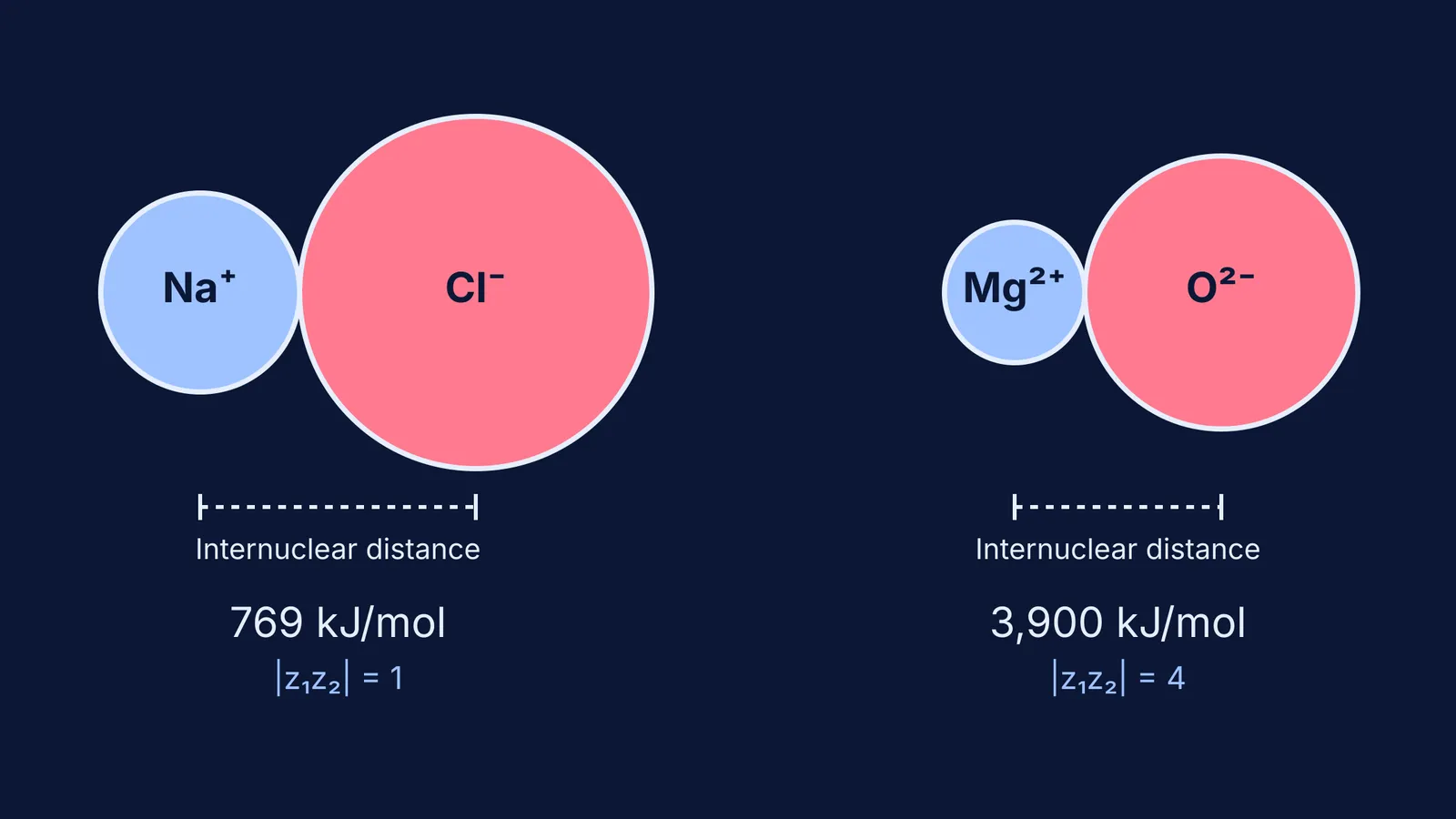
Why does MgO have a higher lattice energy than NaCl?
To understand lattice energy, you have to look at Coulomb's law. The attractive force between two ions depends directly on the product of their charges, and inversely on the distance between their centres.
Sodium chloride (NaCl) consists of Na⁺ and Cl⁻ ions, giving a charge product of 1 × 1 = 1. Its lattice energy is 769 kJ/mol (OpenStax Chemistry 2e).
Magnesium oxide (MgO) is made of Mg²⁺ and O²⁻ ions. Here, the charge product is 2 × 2 = 4. Because the electrostatic attraction is so much stronger between doubly charged ions, the lattice energy of MgO jumps to 3,900 kJ/mol (OpenStax Chemistry 2e).
Charge is the dominant factor. Whenever you see a +2/-2 compound, its lattice energy will be roughly four times that of a +1/-1 compound, assuming the ion sizes are somewhat similar.
How does ion size affect lattice energy down a group?
If the charge products of two compounds are identical, you must look at the size of the ions. The smaller the ions, the closer their centres can get. A smaller distance in the denominator of Coulomb's law yields a larger attractive force.
As you go down a group in the periodic table, atoms and ions gain extra electron shells, making them larger. This means the internuclear distance increases and the lattice energy drops.
Consider the magnesium halides. They have a charge product of 2 (+2 cation, -1 anion). However, their lattice energies decrease as the halide anion gets larger (OpenStax Chemistry 2e):
MgF₂: 2,957 kJ/mol
MgI₂: 2,327 kJ/mol
The fluoride ion is smaller than the iodide ion, so it can get closer to the magnesium ion, giving MgF₂ a stronger lattice than MgI₂. The same trend appears when comparing Enthalpies of atomisation, sublimation and phase change compared, where bond strength also relies on size.
How do you solve lattice energy ranking questions quickly?
Exam questions often ask you to rank a mixed list of compounds, such as LiF, NaCl, MgF₂, and MgO, by their lattice energy.
Here is the fastest way to find the answer:
Calculate the charge product (|z₁z₂|): Group the compounds by the product of their charges. A larger charge product always wins over a smaller one.
NaCl: 1 × 1 = 1
LiF: 1 × 1 = 1
MgF₂: 2 × 1 = 2
MgO: 2 × 2 = 4
Rank the groups: MgO will be the highest, followed by the +2/-1 compound (MgF₂), and finally the +1/-1 group.
Break ties using size: Within each group, look at the ionic radii.
LiF vs NaCl: Lithium is smaller than sodium, and fluorine is smaller than chlorine. Both ions in LiF are smaller than those in NaCl, so LiF > NaCl (1,023 vs 769 kJ/mol) (OpenStax Chemistry 2e).
The final order is: MgO > MgF₂ > LiF > NaCl.
For further examples of estimating electrostatic properties, you can read our guide on Percentage ionic character from dipole moment: a worked example.
If you are unsure why a particular ranking behaves the way it does, Fermi's AI tutor can build a plan to walk you through the size trends in the periodic table. And when you need to practice, the Fermi Problem Library explains the reasoning for each step rather than printing an answer, helping you spot your mistakes immediately.


