On this page
The water at the beach slides out, far past the lowest tide anyone remembers. That retreat can be the first part of a tsunami, and it is the moment to leave.
Why does the sea go back before a tsunami hits?
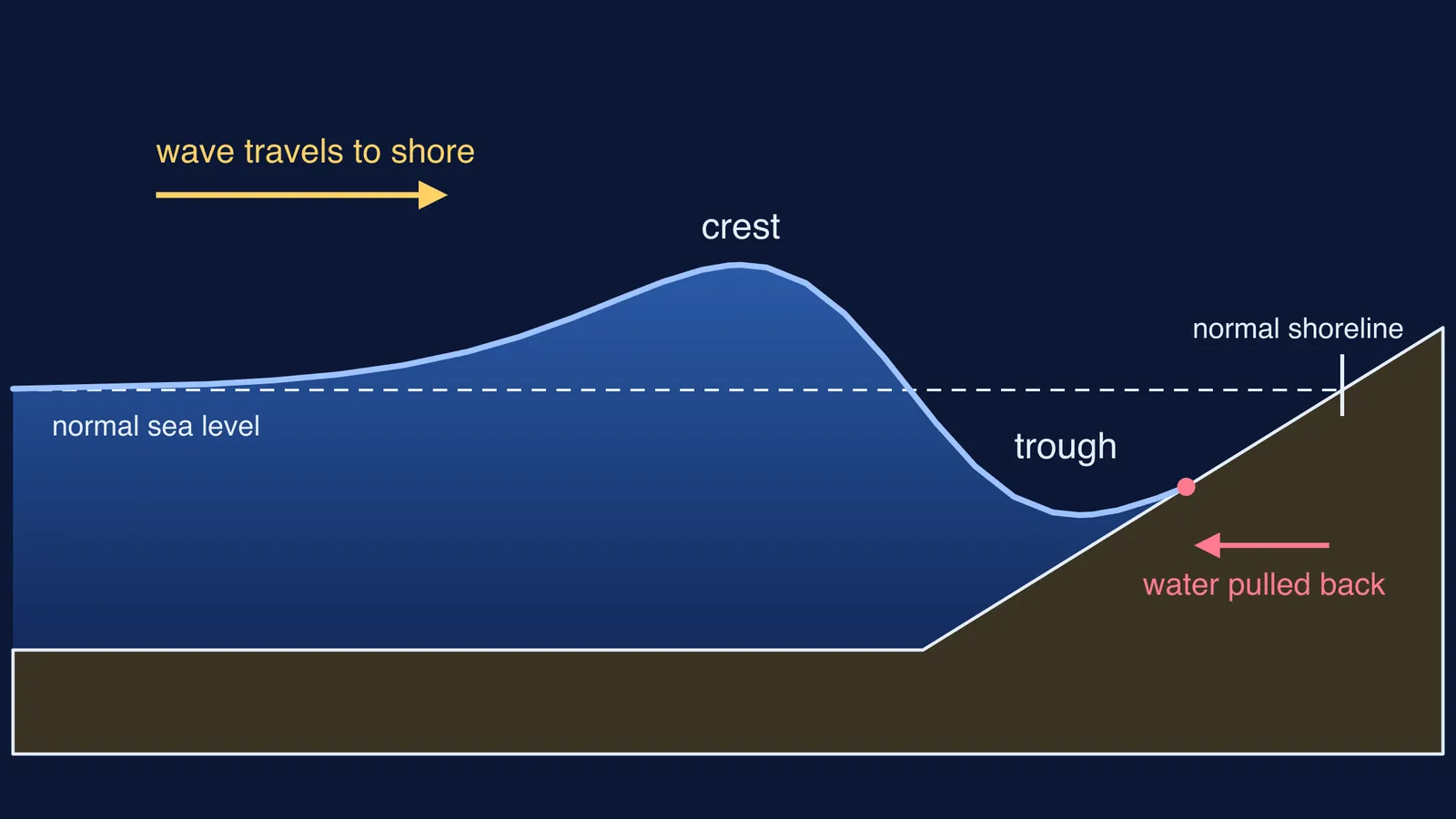
A tsunami is a wave, and every wave has a crest (the high part) and a trough (the low part). If the trough reaches a coast first, the water there drops before it rises.
A University of Washington tsunami course glossary, hosted by NOAA's Center for Tsunami Research, defines a leading-depression wave as one whose "initial tsunami wave is a trough, causing a draw down of water level". A crest follows it.
The US tsunami warning service says that sometimes, before the water rushes on land, it will suddenly recede, "showing the ocean floor, reefs, and fish like a very low, low tide". As with any wave, half a wavelength separates a crest from the next trough.
Why does the trough arrive first at some coasts and not others?
The same glossary says thrust earthquakes, where rock above a gently sloping fault is pushed up, are the most common source of damaging tsunamis. When the sea floor moves, the surface above it gets a hump and a dip, and both spread outward. A coast that meets the dip first sees the water fall; one that meets the hump first sees it rise.
So a retreat is not guaranteed: the glossary also defines a leading-positive wave, where the crest comes first. Because scientists cannot predict earthquakes, and the warning service lists a strong or long earthquake as a natural tsunami warning, shaking near the coast is reason enough to move, even if the sea has not pulled back.
Srinivas Tadepalli and Costas Synolakis studied these waves in a 1994 paper in the Proceedings of the Royal Society of London. They noted that eyewitness accounts often describe the shoreline receding before the run-up, for waves caused by earthquakes close to shore. Their theory showed that leading-depression N-waves run up higher than leading-elevation N-waves. A retreat does not mean a small wave.
How fast does the crest follow the trough?
NOAA gives tsunami speed as the square root of gravity times water depth, which is almost 765 km/h in 4,600 metres of water. Near land the waves slow to about 20 or 30 mph (roughly 30 to 50 km/h), and the time between crests ranges from about five minutes to two hours.
Here is a worked example with v = √(gd) and g = 9.8 m/s²:
Deep ocean, d = 4,000 m: v = √(9.8 × 4,000) ≈ 198 m/s, about 713 km/h. Out there the wave is rarely more than three feet high, so ships do not normally notice it.
Near the coast, d = 10 m: v = √(9.8 × 10) ≈ 9.9 m/s, about 36 km/h, faster than almost anyone can run.
For a simple wave, lowest water to highest water takes about half the period. For a 10-minute period that is about 5 minutes; for a 5-minute period, two and a half.
The same slowing is why the waves grow taller near the coast.
Eyewitnesses of the 1964 Alaska tsunami near the Cove at Seaside, Oregon, saw the ocean withdraw into a trough-like depression about 1,200 yards (1.1 km) off the beach before large waves surged in, according to the Seaside, Oregon Tsunami Pilot Study; surges continued for at least 12 hours.
What should you do if the sea suddenly pulls back?
Tsunami.gov advises going to high ground at least 100 feet (about 30 m) above sea level or a mile (about 1.6 km) inland, not waiting for an official warning, and remembering that the first wave may not be the last or the largest. The Andaman and Nicobar Directorate of Disaster Management says that if the water recedes noticeably from the shoreline, move away immediately, go inland to higher ground and stay there, and never go down to the beach to watch a tsunami come in.
A plan for a family day at the beach:
When you arrive, pick a route to high ground and a meeting point on it.
If the ground shakes hard or long, or the sea drops away fast, leave on foot at once. Do not go back for bags.
Stay up there until officials say it is safe, even if the water looks calm again.
What to say, in one breath: "The sea is going out. That can mean a tsunami. Leave everything and walk uphill with me now."
How can you picture a wave's crest and trough moving?
Draw one wave on paper and slide it towards a line that marks the shore. Whichever part touches it first, crest or trough, decides whether the water rises or falls first. The Fermi Simulation Lab has interactive simulations for the ideas that are easier to see than to read.
Next time you stand at the shore, you will know what the water may be telling you.