

On this page
Why do tsunamis travel so fast in deep water?
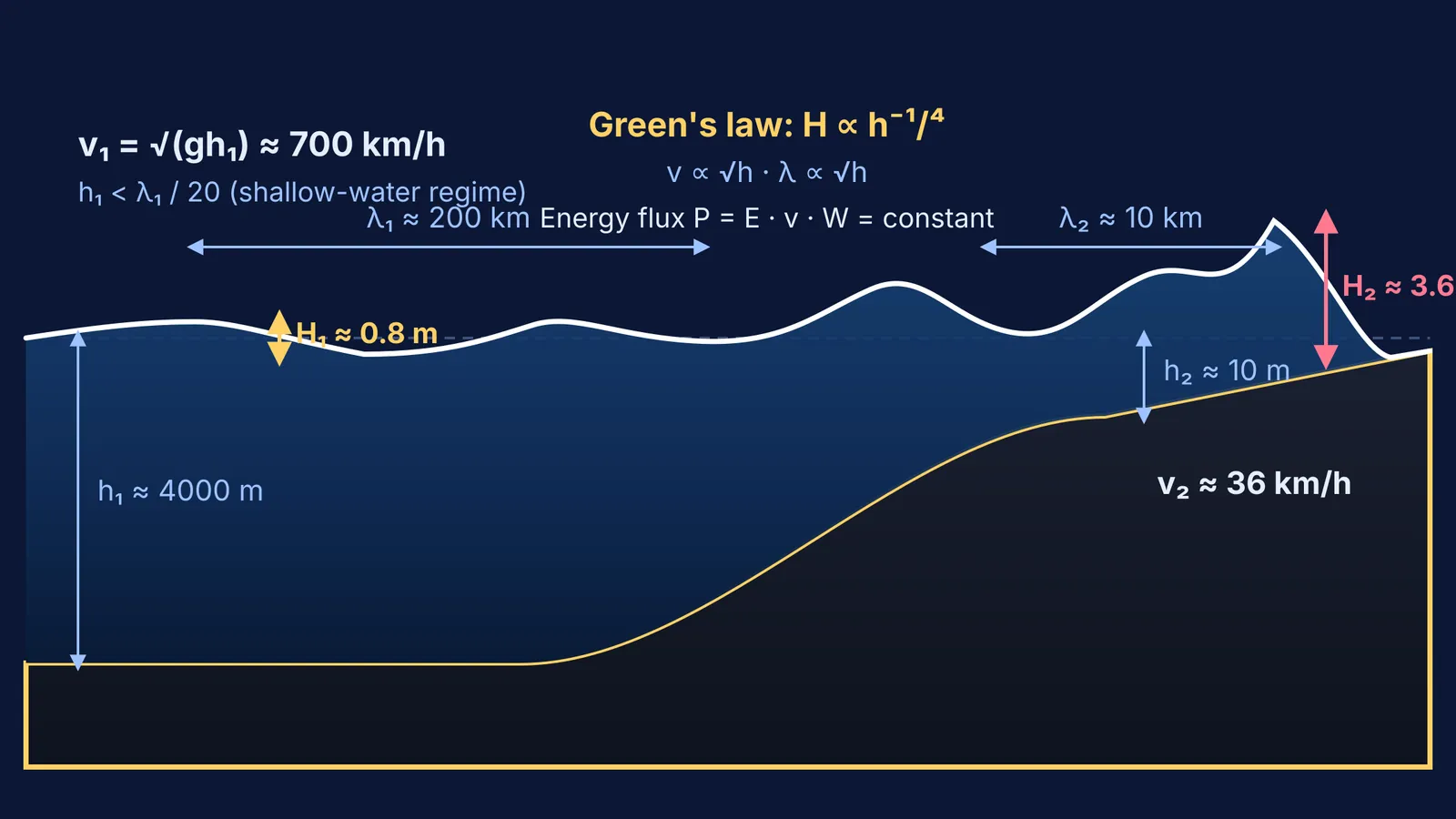
In ocean physics, waves are classified by the ratio of water depth (h) to wavelength (λ). A wave enters the shallow-water regime when depth is less than one-twentieth of its wavelength (h < λ / 20). Tsunamis, generated by seafloor earthquakes, have wavelengths of 100 to 500 kilometres. Even in ocean basins 4,000 metres deep, the depth-to-wavelength ratio is 0.04 to 0.01—well beneath the 0.05 threshold (Bandyopadhyay, Manna, and Maji 2021, DOI: 10.1007/s10236-021-01454-z). Tsunamis therefore propagate as shallow-water waves everywhere.
Because tsunamis remain in the shallow-water regime across the ocean, their speed depends strictly on water depth:
v = √(gh)
At 4,000 metres depth with g ≈ 9.8 m/s², wave speed is v = √(9.8 × 4,000) ≈ 198 m/s (713 km/h). Stretched across a 200-kilometre wavelength, this energy produces an open-ocean displacement under one metre, passing ships unnoticed. To connect wave speed to wave equations, see the travelling wave equation guide.
How does shallow water slow a tsunami down?
As a tsunami approaches the continental slope, depth decreases from thousands of metres to tens of metres, altering wave transmission (George, Ketcheson, and LeVeque 2019, DOI: 10.1007/s00024-019-02316-y). Because speed scales as v = √(gh), the wave front slows immediately while the trailing crest in deeper water continues advancing at hundreds of kilometres per hour.
Wave frequency (f) and period (T = 1/f) remain constant. Just as how light changes wavelength when slowing down in glass leaves frequency unchanged, tsunami wave frequency is set by the initial seismic event. Because v = f × λ, reducing speed forces wavelength to compress:
λ ∝ v ∝ √h
When depth drops from 4,000 metres to 10 metres, wave speed drops by a factor of √(4,000 / 10) = 20, from 713 km/h to 36 km/h. This compresses a 200-kilometre deep-sea wavelength into just 10 kilometres near shore, packing water into the coastal margin.
How does Green's law calculate wave growth?
Horizontal wave compression and vertical growth in shallow water is called shoaling. Because internal friction is negligible in open water, total wave energy flux (P)—the rate wave energy crosses a vertical plane—is conserved.
For a linear surface gravity wave, mechanical energy density is E = (1/2) ρ g A², where ρ is seawater density and A is amplitude. Energy flux P across crest width W is:
P = E × v × W = (1/2) ρ g A² √(gh) W
In 1837, George Green showed that conserving energy flux along a shoaling channel requires A² h^(1/2) = constant. Known as Green's law, this derivation proves that wave amplitude scales inversely with the fourth root of depth:
A ∝ h^(-1/4)
A₂ / A₁ = (h₁ / h₂)^(1/4)
Synolakis (1991, DOI: 10.1063/1.858107) confirmed that Green's law provides the exact linear asymptotic solution for long waves over sloping topography. When studying how speed, wavelength, and shoaling interact, seeing the wave profile evolve dynamically helps students grasp what static formulas describe; the Fermi Simulation Lab offers interactive simulations for ideas that are easier to see than to read.
How do you calculate tsunami wave growth in a worked example?
To see how these principles apply in numericals, consider a tsunami entering a coastal shelf, calculated using shallow-water equations (NOAA) and Green's law:
Deep-water parameters: Depth h₁ = 4,000 m, initial amplitude A₁ = 0.4 m (wave height H₁ = 0.8 m), and wave period T = 1,200 s (20 minutes).
Deep-water speed and wavelength: Using v₁ = √(9.8 × 4,000) ≈ 198 m/s, wavelength is λ₁ = v₁ × T = 198 m/s × 1,200 s ≈ 237.6 km.
Coastal shelf speed: At depth h₂ = 10 m, speed drops to v₂ = √(9.8 × 10) ≈ 9.9 m/s (35.6 km/h).
Coastal wavelength: Compressed wavelength is λ₂ = v₂ × T = 9.9 m/s × 1,200 s ≈ 11.9 km.
Coastal wave amplitude: By Green's law, A₂ = A₁ × (4,000 / 10)^(1/4) = 0.4 m × (400)^(1/4) ≈ 1.79 m. Peak-to-trough height swells from H₁ = 0.8 m to H₂ = 2 × 1.79 m ≈ 3.58 m.
When practicing wave mechanics and energy transport calculations, the Fermi Problem Library provides worked problems with a step-by-step solver that explains the reasoning rather than printing an answer.
What happens when linear wave theory breaks down?
Green's law assumes gentle slopes and small amplitudes relative to depth (A << h). Near shorelines where depth drops below 5 metres, linear assumptions break down (Knowles and Yeh 2018, DOI: 10.1017/jfm.2018.395).
Nonlinear convective acceleration and dispersion alter shallow waveforms. For solitary waves, energy conservation causes amplitude to scale closer to A ∝ h^(-1) in extreme shallows, accelerating amplification before the wave breaks into a bore. V-shaped bays also focus energy horizontally, driving run-up heights beyond 15 to 30 metres. To explore wave superposition and shoaling visually, see learning wave mechanics with simulations.
In India, tracking these transformations is the responsibility of the Indian Tsunami Early Warning Centre (ITEWC) at the Indian National Centre for Ocean Information Services (INCOIS) in Hyderabad. Operational since October 2007 under the Ministry of Earth Sciences, the centre monitors real-time pressure signals from bottom pressure recorders and tide gauges to forecast shoaling before waves reach settlements.


