

On this page
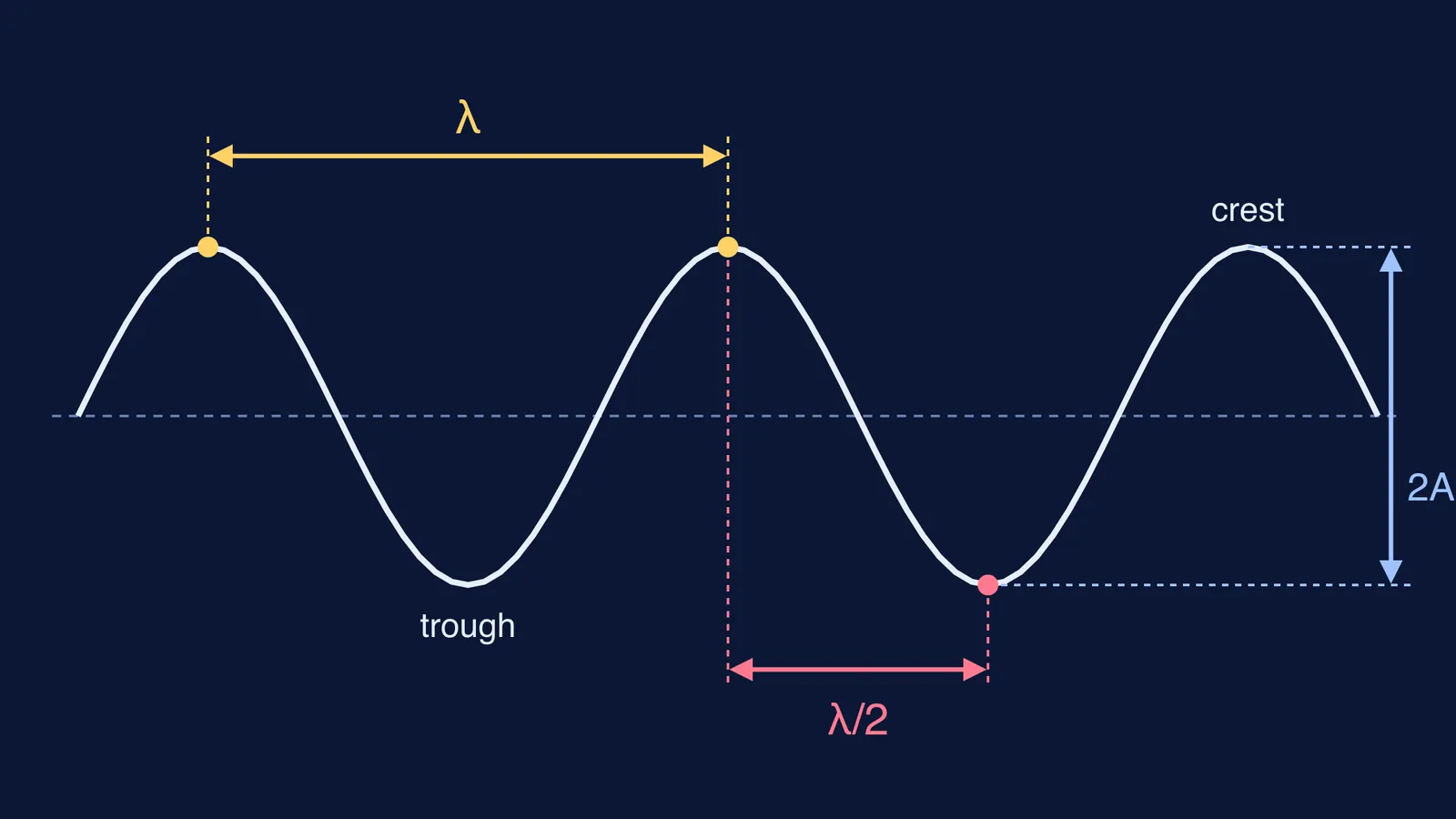
If a question asks for the distance between a crest and the adjacent trough, the answer is half a wavelength, λ/2. It is easy to get wrong in wave questions and in the ripple tank practical, because a crest and a trough look like a natural pair to measure between.
What is the distance between a crest and the adjacent trough?
NCERT's Class 11 physics textbook defines the wavelength as the minimum distance between two points having the same phase, which is the distance between two consecutive crests or two consecutive troughs (NCERT Class 11 Physics, Chapter 14: Waves). The same chapter defines the crest as the point of maximum positive displacement and the trough as the point of maximum negative displacement.
Now take the wave y = a sin kx at one instant. A crest sits where kx = π/2, and the next trough where kx = 3π/2. The gap between them is Δx = π/k. NCERT gives k = 2π/λ, so Δx = λ/2.
In words: a crest and the adjacent trough are half a cycle apart (a phase difference of π), so they are half a wavelength apart.
The vertical version comes from OpenStax College Physics, which notes that the total vertical distance between the top of a crest and the bottom of a trough is twice the amplitude (OpenStax College Physics 2e, 16.9 Waves). Read the question carefully: a distance along the wave means λ/2, and a height from trough to crest means 2A.
How do you find wavelength and speed from a ripple tank photo?
In a ripple tank, light shone through the water makes bright and dark bands on the screen or paper below, because the curved water surface bends the light. A stroboscope flashing at the right rate makes the pattern appear to stand still (Mini Physics, Ripple tank). Photograph that frozen pattern, then follow these steps. The numbers are an example, not real lab data.
Count bright lines. Pick six consecutive bright lines on the photo. Between them are five full wavelengths. Say they span 12.0 cm on the screen, so one wavelength on the screen is 12.0 ÷ 5 = 2.4 cm.
Correct for magnification. The pattern on the screen is usually larger than the waves themselves, because the light spreads out between the water and the screen (Mini Physics, linked above). Put an object of known size in the tank. Say a 2.0 cm strip shows as 3.0 cm on the screen: a magnification of 1.5. The real wavelength is 2.4 ÷ 1.5 = 1.6 cm.
Find the frequency. Read it from the signal generator driving the dipper. Say it is 15 Hz.
Use the wave equation. NCERT writes it as v = λν (NCERT Class 11 Physics, Chapter 14). Here v = 15 Hz × 1.6 cm = 24 cm/s, or 0.24 m/s.
Check with the half wavelength. On the real water, a crest and the next trough are 1.6 ÷ 2 = 0.8 cm apart. If your photo disagrees, recheck which lines you counted.
Measuring across several waves and dividing is better than measuring one, because the error in reading the ruler becomes a smaller fraction of the total distance.
What mistakes give the wrong wave speed?
Each mistake below changes the answer by a fixed factor. The figures use the worked example above, and the strobe point comes from Mini Physics on the ripple tank.
Crest to trough taken as λ: you use 0.8 cm instead of 1.6 cm and get 12 cm/s, exactly half the true speed.
Magnification ignored: you use 2.4 cm and get 36 cm/s, 1.5 times too fast.
Strobe rate taken as the wave frequency: a still pattern can repeat after one or several cycles between flashes, so a strobe at 7.5 Hz can also freeze 15 Hz waves. Check the frequency against the signal generator.
Slanted ruler: measure at right angles to the wavefronts, along the direction the waves travel.
If you keep landing on half or double the right answer, the Fermi Problem Library has worked problems with a step-by-step solver that explains the reasoning rather than printing an answer, so you can see which step went wrong. To revise phase, wavelength and wave number as one connected idea, the Fermi Concept Library gives each concept its own lesson and its place in the map.
Where does this show up next?
The same tank shows refraction: over shallower water the waves slow down and the bright lines bunch closer together. Our post on why water waves slow down in shallow water works through it. The frequency stays fixed across the boundary, which is why frequency does not change when a wave enters a new medium. And if you are given two drawn snapshots instead of a photo, finding wave speed and direction from two snapshots uses the same crest-and-trough logic.
Next time you see a ripple tank photo, count the bright lines first, and halve or double only when you can say why.


