

On this page
Light slows down in glass. So what happens to its frequency, wavelength and speed? Here is the rule, why it holds, two worked examples and a check for the exam hall.
Does frequency change when a wave enters another medium?
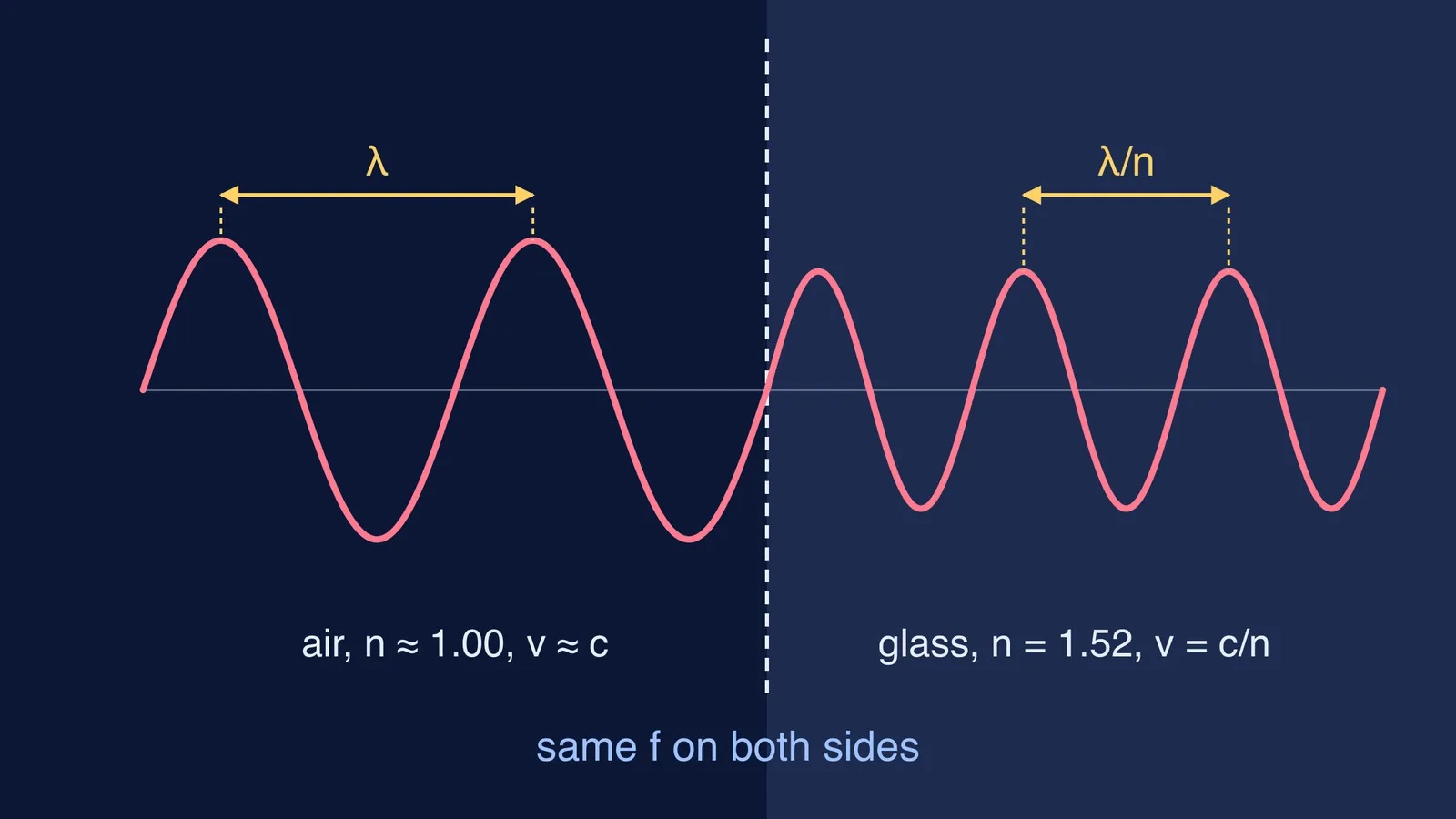
No. When light goes from vacuum into a medium such as water, "its speed and wavelength change, but its frequency f remains the same", as the OpenStax College Physics 2e section on the wave aspect of light puts it.
Sound behaves the same way. The OpenStax section on the speed of sound says the frequency "usually remains the same because it is like a driven oscillation and has the frequency of the original source."
Why does the source decide the frequency?
Each vibration of the source sends out one wave. The crests reaching the boundary each second must all leave the other side in that second; otherwise they would pile up there or appear from nowhere. So the frequency stays whatever the source made it.
This is also why things don't change colour underwater. OpenStax notes that although wavelengths change from one medium to another, colours do not, "since colors are associated with frequency" (OpenStax, wave aspect of light).
What changes instead: speed and wavelength together
The medium sets the speed, and the rest follows from the wave equation v = fλ (OpenStax, speed of sound). If v changes and f is fixed, λ must change by the same factor.
For light, the refractive index is defined as n = c/v, where v is the speed of light in the material (OpenStax, law of refraction). The wavelength in a medium is λn = λ/n, where λ is the wavelength in vacuum (OpenStax, wave aspect of light).
Into a slower medium (light from air into glass): speed falls, wavelength shortens.
Into a faster medium (sound from air into water): speed rises, wavelength lengthens.
Frequency: unchanged in both cases.
If n = c/v is new to you, our explainer on the speed of electromagnetic waves in a medium works through it.
Worked example: one tone and one beam across a boundary
Sound first. A 500 Hz tone travels through air at 20°C, where sound moves at 343 m/s, and then into fresh water, where it moves at 1480 m/s (OpenStax speed of sound table).
Frequency in water: still 500 Hz.
Wavelength in air: 343 ÷ 500 = 0.686 m.
Wavelength in water: 1480 ÷ 500 = 2.96 m.
The speed went up about 4.3 times, so the wavelength did too.
Now light. A beam with a vacuum wavelength of 600 nm enters fresh water (n = 1.333) and crown glass (n = 1.52), values from OpenStax Table 25.1. Take c = 3.00 × 10^8 m/s.
Frequency: f = c/λ = (3.00 × 10^8) ÷ (600 × 10^-9) = 5.00 × 10^14 Hz, in every medium.
In water: v = c/n ≈ 2.25 × 10^8 m/s, and λ = 600 ÷ 1.333 ≈ 450 nm.
In glass: v ≈ 1.97 × 10^8 m/s, and λ = 600 ÷ 1.52 ≈ 395 nm.
Check: (2.25 × 10^8) ÷ (450 × 10^-9) = 5.00 × 10^14 Hz. Same frequency, as it should be.
Notice that 395 nm is close to the violet end of the 380 to 760 nm visible range OpenStax gives for vacuum (OpenStax, wave aspect of light). The beam inside the glass is not violet, though; its colour goes with its frequency, which has not moved.
Why n differs slightly by colour is covered in why the critical angle depends on colour.
How do you check your answer in the exam?
Name the source. If it hasn't changed, f hasn't changed.
Decide whether the new medium is faster or slower, and write the speed ratio.
Scale λ by the same ratio as v. For light, λ in the medium = λ in vacuum ÷ n.
Cross out any option where f changes, or where v and λ move in opposite directions.
If the question asks about colour, work from frequency, never from the wavelength inside the medium.
If you get the idea but keep slipping when the numbers arrive, the Fermi Problem Library has worked problems with a step-by-step solver that explains the reasoning rather than printing an answer, so you can see where v = fλ enters each step. If the crests bunching up at the boundary are hard to picture, the Fermi Simulation Lab has interactive simulations for ideas that are easier to see than to read.
So when does the frequency you hear change?
Most often when something moves. OpenStax defines the Doppler effect as "an alteration in the observed frequency of a sound due to motion of either the source or the observer" (OpenStax, Doppler effect). Our post on the Doppler effect for sound walks through it.
Next time a question asks what changes at a boundary, start with f: it stays, and everything else follows from v = fλ.


