

On this page
When you shine white light from a denser medium (like water or glass) into a rarer one (like air), some light escapes and some is reflected back. As you increase the angle of the beam, you eventually hit the critical angle: the point where the light can no longer escape and is totally internally reflected.
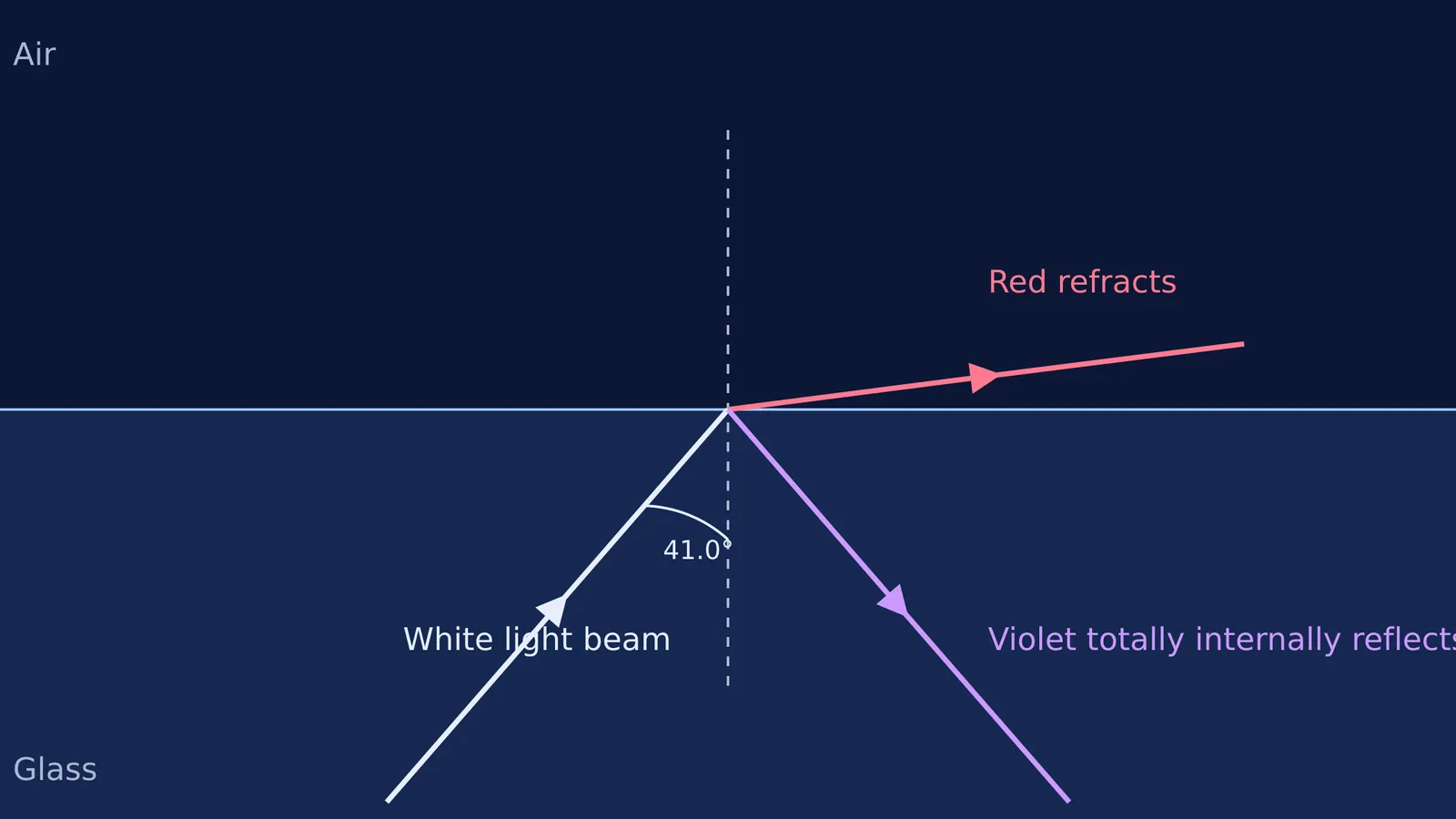
But this angle is not the same for every colour. If you gradually tilt a beam of white light, the violet edge of the spectrum will disappear first, while the red edge continues to emerge into the air.
This happens because the critical angle is driven entirely by the refractive index, and refractive index depends on the wavelength of light.
Why does refractive index depend on colour?
Light travels more slowly in materials like glass than it does in a vacuum. (You can read more about what happens to speed, wavelength and frequency when light enters glass). The refractive index (n) tells you how much the material slows the light down.
However, a material does not slow all colours equally. This property is known as dispersion. According to Cauchy's equation, the refractive index of a transparent medium increases as the wavelength of light decreases.
Because violet light has a much shorter wavelength than red light, it experiences a higher refractive index and gets slowed down more. This is why a prism splits white light (a process explained in detail in our post on dispersion of white light by a glass prism): the violet light bends more sharply than the red.
Which colour has the highest critical angle?
Red light has the highest critical angle in the visible spectrum, while violet has the lowest.
To see why, look at the formula for the critical angle (θ_c): sin(θ_c) = n₂ / n₁
Here, n₁ is the denser medium (glass) and n₂ is the rarer medium (air, where n ≈ 1). If n₁ is larger, the fraction 1 / n₁ becomes smaller, which means the critical angle θ_c is smaller.
Since violet light faces the highest refractive index in the glass, it has the smallest critical angle. It gets trapped inside the material earlier than any other colour.
How do you calculate the critical angle for different colours?
Let us take crown glass as an example. According to standard optical tables from OpenStax University Physics, the refractive index of crown glass is about 1.530 for violet light and 1.512 for red light.
We can plug these into the critical angle formula (assuming the outside medium is air):
For violet light: sin(θ_c) = 1 / 1.530 = 0.6536. This gives a critical angle of 40.8°.
For red light: sin(θ_c) = 1 / 1.512 = 0.6614. This gives a critical angle of 41.4°.
If you shine a white beam at exactly 41.0°, the violet light (which needs only 40.8° to reflect) will be completely trapped inside the glass. The red light (which needs 41.4° to reflect) will still escape into the air, though it will emerge at a very grazing angle of 83°.
Calculations like these often appear in JEE and NEET optics problems. If you need to revise this topic from the ground up, the Fermi Concept Library contains every concept in physics, chemistry, biology, mathematics and computing, each with its own lesson and its place in the map.
Why does this matter for diamonds and optical fibres?
This variation in critical angle is the secret to a diamond's sparkle, known as its "fire".
Diamonds have an exceptionally high overall refractive index, which gives them a very small critical angle of about 24°. But they also have high dispersion. According to OpenStax University Physics, the refractive index of a diamond is 2.458 for violet light and 2.410 for red light.
Because the critical angles for red and violet are slightly different (about 24.5° for red and 24.0° for violet), the different colours of light take slightly different paths as they bounce around inside the cut stone. When the light finally exits, the colours have spread out widely, hitting your eye as distinct flashes of rainbow light.
While diamonds use dispersion for beauty, optical fibres are designed to minimise its effects. If different colours of light had wildly different critical angles in a fibre optic cable, pulses of light would spread out and blur together over long distances—a problem known as chromatic dispersion. To prevent this, communication networks do not use white light. Instead, they use single-wavelength infrared lasers. Because the laser emits only one specific wavelength, the refractive index remains perfectly constant, and the light reflects uniformly down the cable without splitting.
Whenever you face a tricky numerical about a new material or an unknown wavelength, the Fermi Problem Library has worked problems with a step-by-step solver that explains the reasoning rather than printing an answer.
How do you solve exam questions on critical angle?
When you encounter an exam question asking about critical angles and colours, follow this chain of logic:
Identify the wavelengths: Which colour has the longer wavelength? (Red is longer, violet is shorter).
Link to refractive index: Shorter wavelengths face a higher refractive index (n_violet > n_red).
Check the critical angle: A higher refractive index means the critical angle is smaller (θ_c,violet < θ_c,red).
Determine the outcome: If the incident angle falls between the two critical angles, the shorter wavelength (violet) is totally internally reflected, while the longer wavelength (red) refracts out.


