

On this page
Light slows down when it enters glass or water, and Maxwell's equations tell you by exactly how much. The answer depends on just two properties of the material: how easily it polarises (its permittivity) and how easily it magnetises (its permeability).
What is the formula for the speed of an electromagnetic wave in a medium?
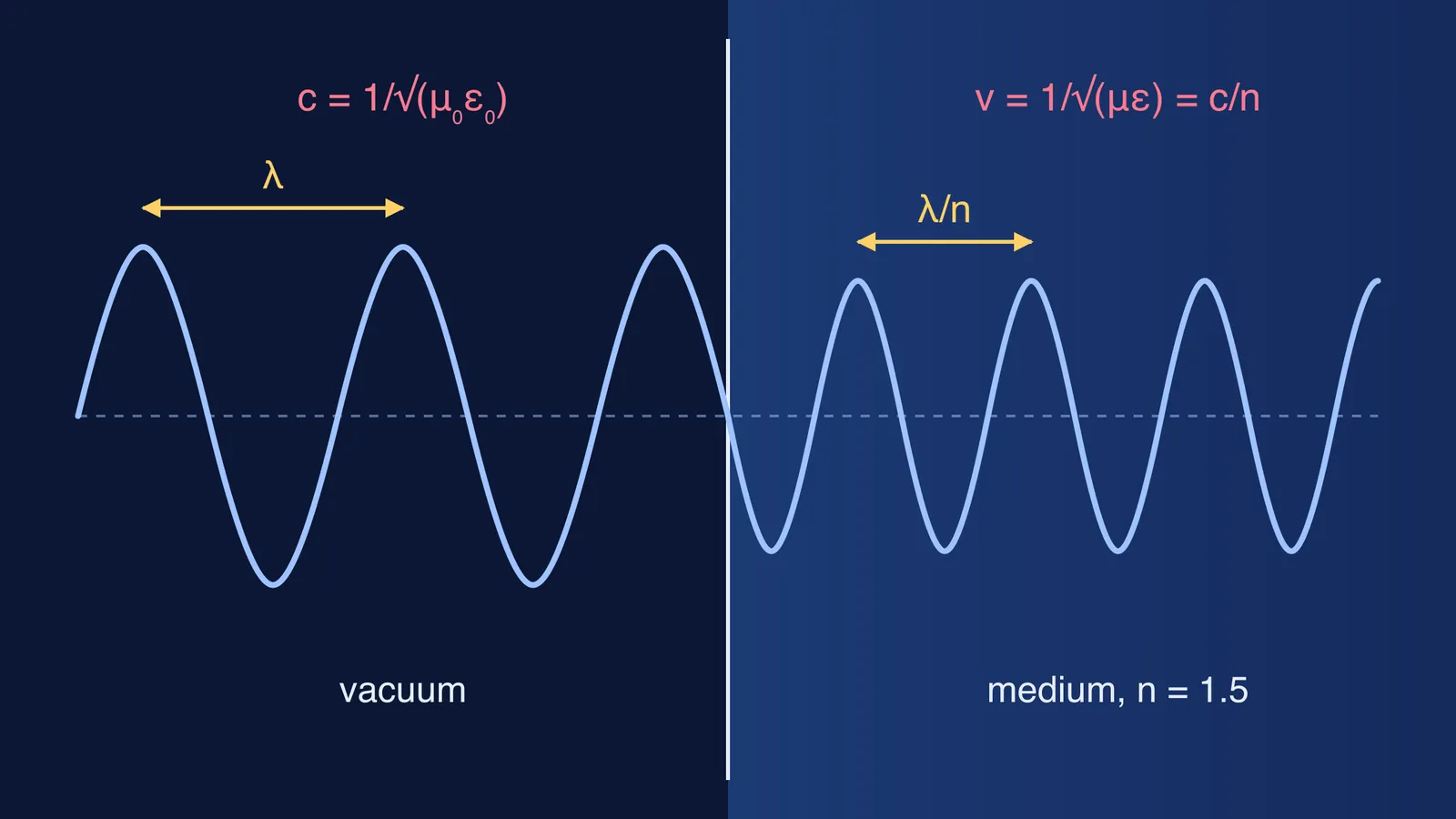
In vacuum, Maxwell's equations predict that electromagnetic waves travel at c = 1/√(μ0 ε0), as the Wikipedia article on the speed of light explains. Since 1983 the metre has been defined using light, so c is fixed at exactly 299 792 458 m/s (NIST).
The two constants are measured values. The vacuum permittivity is ε0 = 8.8541878188 × 10⁻¹² F/m (NIST CODATA 2022), and the vacuum permeability is μ0 = 1.25663706127 × 10⁻⁶ N/A² (NIST CODATA 2022). Multiply them, take the square root and the reciprocal, and you get 2.9979 × 10⁸ m/s.
Inside a material you swap in the material's own values, μ = μr μ0 and ε = εr ε0:
v = 1/√(με)
v = 1/√(μr μ0 εr ε0) = c/√(μr εr)
Here μr is the relative permeability and εr is the relative permittivity, which is the same thing as the dielectric constant K. Both are pure numbers with no units.
How does refractive index relate to dielectric constant?
Refractive index is defined as n = c/v, the speed of light in vacuum divided by its speed in the medium (Wikipedia: Refractive index). Divide c by c/√(μr εr) and you get the link directly:
n = √(μr εr)
Most natural materials are non-magnetic at optical frequencies, so μr is very close to 1 and n ≈ √εr. This ties an optics number to an electrostatics number.
How do you use the formula in a worked example?
A medium has relative permeability 1.3 and dielectric constant 2.14. Find the speed of light in it and its refractive index.
Multiply the relative values: μr εr = 1.3 × 2.14 = 2.782.
Take the square root: n = √2.782 ≈ 1.67.
Divide: v = c/n = (3.00 × 10⁸ m/s)/1.67 ≈ 1.80 × 10⁸ m/s.
Sanity check: n is greater than 1, so v comes out smaller than c.
Second case: a non-magnetic plastic with K = 2.25 gives n = √2.25 = 1.5 and v = 2.0 × 10⁸ m/s. The hero diagram above shows that case. The frequency stays the same at the boundary, so the wavelength shrinks to λ/n.
Why is water's refractive index 1.33 if its dielectric constant is 80?
Standard tables list the dielectric constant of water as 80.4 at 20 °C (HyperPhysics, from Sears, Zemansky and Young) and its refractive index as 1.33 (HyperPhysics). But √80.4 ≈ 8.97, which is nowhere near 1.33.
The formula still holds. The catch is that permittivity depends on frequency (Wikipedia: Relative permittivity). The 80 is a static value, measured in a steady or slowly changing field. Each water molecule is a permanent dipole, and in a slow field it has time to turn and line up, which makes εr large. Visible light of wavelength 600 nm oscillates at f = c/λ = 5 × 10¹⁴ times a second, and the molecules can't turn that fast. Only their electron clouds respond.
The same reference gives water's relative permittivity for visible light as 1.77 (Wikipedia: Relative permittivity), and √1.77 ≈ 1.33, which matches the refractive index. Air shows the relation working at both frequencies, because its molecules barely polarise at all: the static K of 1.00059 (HyperPhysics) has a square root of about 1.00029, which is the refractive index the HyperPhysics table lists for air.
Because εr changes with frequency, n also changes with colour. That's dispersion, and our post on how refractive index depends on wavelength through Cauchy's relation picks up from here.
What should you check before answering an exam question on this?
Is the medium magnetic? If μr is given, keep it inside the square root.
Are you dividing c by n? In school and JEE problems n is greater than 1, so v is less than c.
Did the frequency change? It shouldn't. Wavelength and speed both drop by a factor of n.
Asked for the field amplitudes? In a medium E0/B0 = v rather than c. Our explainer on the relation between E0 and B0 in an EM wave covers the vacuum case.
Unsure of units? Our guide to the permittivity of free space, its value and units shows how F/m and N/A² combine to give m/s.
If you keep reaching for the wrong formula on numericals like these, the Fermi Problem Library has worked problems with a step-by-step solver that explains the reasoning rather than printing an answer. If the gap is further back, in permittivity or polarisation themselves, the Fermi Concept Library gives each physics concept its own lesson and shows where it fits on the map.


