

On this page
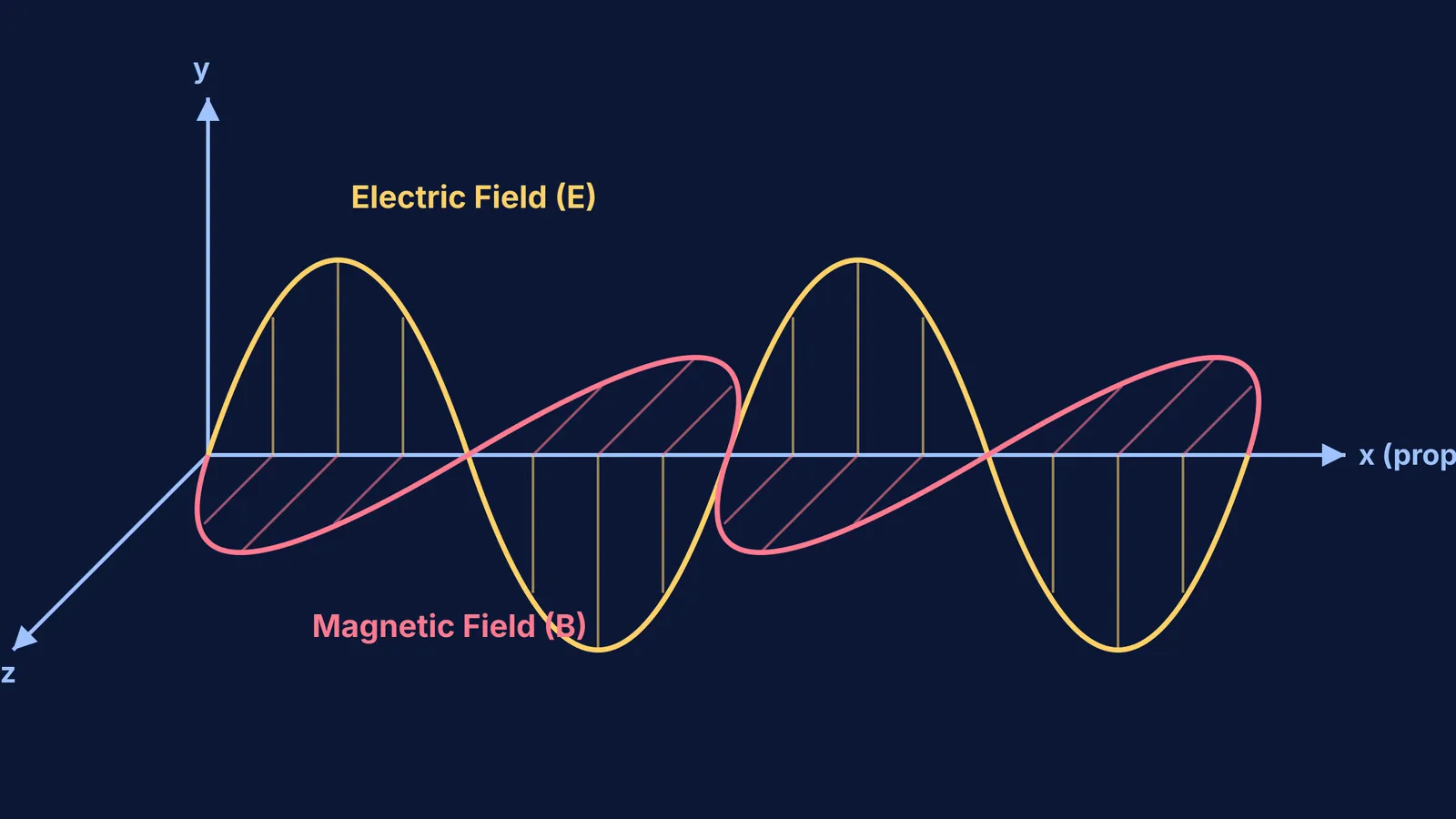
In a vacuum, the electric and magnetic fields that make up an electromagnetic (EM) wave are intimately linked. If you know the amplitude of one, you can find the other using a single constant: the speed of light.
Here is the relationship between the fields, why they are tied together, and how to use the right-hand rule to find their directions.
What is the relation between electric and magnetic field amplitude in an EM wave?
At any instant in time, the magnitude of the electric field (E) and the magnetic field (B) in a plane EM wave are proportional to each other. Their peak amplitudes, E₀ and B₀, are connected by the speed of light (c) in a vacuum (OpenStax University Physics Volume 2):
E₀ = cB₀
Because the speed of light is so large (3.00 × 10⁸ m/s), the numerical value of the electric field in volts per meter (V/m) is much larger than the magnetic field in teslas (T). For example, a typical radio wave might have an electric field amplitude of 300 V/m. Using the formula, its magnetic field amplitude is just 10⁻⁶ T, or 1 microtesla.
Despite this stark difference in numerical values, the two fields are perfectly in phase. They reach their maximums, pass through zero, and hit their minimums at the exact same time and location in space.
Why E₀/B₀ = c?
The ratio E₀/B₀ = c is not a coincidence; it is a direct result of Maxwell's equations.
In an electromagnetic wave, a changing electric field generates a magnetic field, and a changing magnetic field generates an electric field. Specifically, Faraday's law for a changing B dictates how a magnetic field creates a circulating electric field, while Ampere's law shows how a changing electric field sustains the magnetic field. For the wave to propagate through empty space without falling apart, these two effects must balance perfectly. This balance only happens if the wave travels at speed c = 1/√(μ₀ε₀), which mathematically forces the ratio of the field amplitudes to be exactly c.
If you are revising wave optics or Maxwell's equations, you can trace the derivation of E₀ = cB₀ in the Fermi Concept Library.
How to find the direction of the magnetic field from the electric field in an EM wave?
Electromagnetic waves are transverse waves. This means that the electric field vector (E), the magnetic field vector (B), and the wave's velocity vector (v) are all mutually perpendicular.
The direction in which the wave travels is always given by the cross product:
v points along E × B
If you know the direction of the wave's propagation and the direction of the electric field, you can find the magnetic field using the right-hand rule:
Point the fingers of your right hand in the direction of the electric field (E).
Orient your palm so that when you curl your fingers, they point toward the magnetic field (B).
Your outstretched thumb will point in the direction the wave is travelling (v).
If you already know the wave direction and E, you just twist your hand until your thumb points along the wave's path. Your palm now faces the direction of B.
Worked example
Suppose a microwave travels along the positive z-axis, and at a given instant, its electric field points along the negative x-axis. Which way does the magnetic field point?
Your thumb (propagation) points along +z (out of the page).
Your fingers (E) point along -x (to the left).
To make this work, your palm must face downward. Therefore, the magnetic field B points along the negative y-axis.
When you are solving EM wave problems and get tangled in vector cross products or signs, the Fermi Problem Library has worked problems with a step-by-step solver that explains the reasoning rather than printing an answer. This helps you catch the missing minus sign before it becomes a habit.
If the wave travels into a different medium, like water or glass, the relationship changes slightly to E₀ = vB₀, where v is the new, slower speed of Light entering glass.


