

On this page
The permittivity of free space, denoted by ε₀ (epsilon naught), is one of the most important constants in electromagnetism. It describes how well a vacuum permits electric field lines to pass through it. If you are preparing for physics exams, understanding where ε₀ comes from and how to derive its units is essential.
In this guide, we break down the exact value of ε₀, the different ways to write its units and how the 2019 SI redefinition changed the way we measure the Coulomb constant.
What is the value of the permittivity of free space?
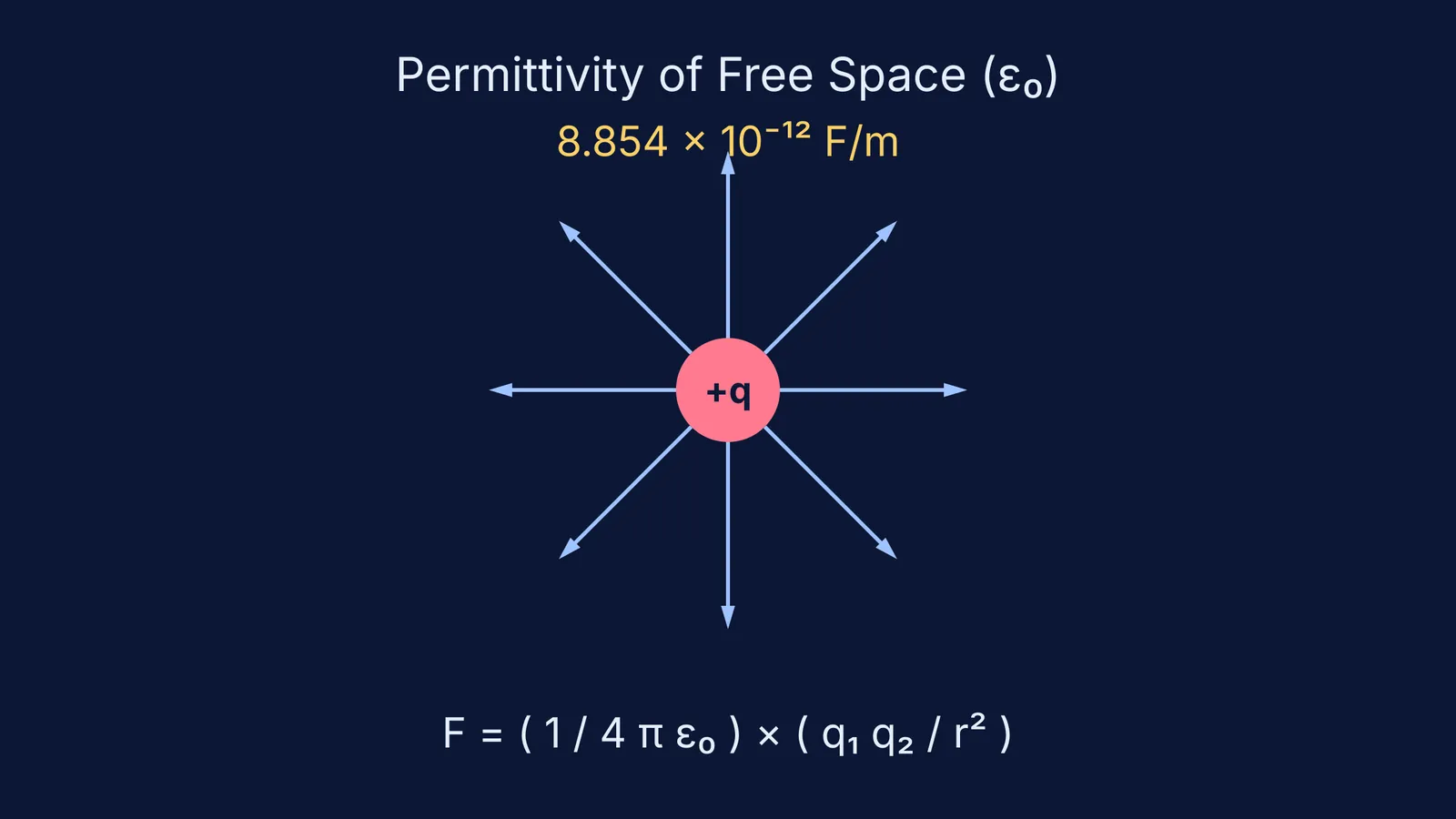
According to the 2022 CODATA recommended values, the precise value of the permittivity of free space is 8.854 187 8188(14) × 10⁻¹² F/m.
For most calculations in school and undergraduate physics, this is rounded to: ε₀ ≈ 8.85 × 10⁻¹² F/m
Because ε₀ relates the charge of an object to the electric field it creates, it appears in fundamental equations such as Gauss's law and Coulomb's law. If you are working through problems involving the work to assemble point charges or calculating the energy density in an electric field, ε₀ is the constant scaling factor.
What are the units of epsilon naught?
The units of ε₀ can be written in several equivalent ways, depending on the equation you use to derive it.
Farads per metre (F/m): This is the standard SI unit. It comes from the formula for the capacitance of a parallel-plate capacitor, C = (ε₀ A) / d, where C is capacitance in farads, A is area in square metres, and d is distance in metres.
Coulombs squared per newton per square metre (C²/N m²): This form is derived directly from Coulomb's law, F = (1 / 4πε₀) × (q₁ q₂ / r²). Rearranging for ε₀ gives units of charge squared over force times distance squared.
Base SI units: When broken down entirely into amperes, seconds, kilograms and metres, the units are A² s⁴ kg⁻¹ m⁻³.
If you ever forget the units during an exam, the easiest way to find them is to write down Coulomb's law and solve for ε₀. If you encounter concept gaps like this while studying, the Fermi Concept Library maps out every topic in physics so you can trace ideas back to their origins.
The Coulomb constant (k) and the 2019 SI redefinition
The Coulomb constant (k) is defined as k = 1 / 4πε₀.
Using the value of ε₀, the Coulomb constant is approximately 8.987 × 10⁹ N m²/C² (often rounded to 9 × 10⁹ for simpler calculations).
Before May 2019, the Coulomb constant had an exact, defined value because the vacuum magnetic permeability (μ₀) and the speed of light (c) were defined exactly, and ε₀ is linked to them by the equation c = 1 / √(μ₀ ε₀).
However, the 2019 redefinition of SI base units fixed the elementary charge (e) and the Planck constant (h) instead. As a result, ε₀ and the Coulomb constant are no longer exact mathematical definitions; they are measured quantities with a tiny experimental uncertainty. Understanding the relationship between these charges and potentials is especially useful when studying systems like concentric spherical shells.
How to check your dimensions step by step
Exam questions often test your ability to work with the dimensional formula of ε₀. Here is a checklist to derive it yourself:
Start with the formula: F = (1 / 4πε₀) × (q₁ q₂ / r²)
Isolate ε₀: ε₀ = (q₁ q₂) / (4π F r²)
Write the dimensions of charge q = [A T]
Write the dimensions of force F = [M L T⁻²]
Write the dimensions of distance squared r² = [L²]
Combine them: ε₀ = [A² T²] / ([M L T⁻²][L²]) = [M⁻¹ L⁻³ T⁴ A²]
Getting this derivation right is a classic test of understanding physics from first principles. If you get stuck on questions involving these derivations, the Fermi Problem Library provides a step-by-step solver that explains the reasoning rather than just printing an answer.


