

On this page
Have you ever noticed how ocean waves bend to become parallel to the beach as they approach the shore? Or why the lines in a ripple tank suddenly bunch together when they cross a transparent block? It all comes down to the depth of the water.
When waves move from deep to shallow water, they undergo refraction. This simple physical change dictates their speed, their wavelength, and their direction.
Do water waves slow down in shallow water?
Yes. In shallow water, a wave's speed is dictated by the depth of the water rather than its wavelength. As the water gets shallower, friction with the bottom increases, which drags on the wave and slows it down.
In the "shallow water" limit, the speed v is given by the formula v = √(gd), where g is the acceleration due to gravity and d is the depth 1. Because the depth shrinks when entering the shallow region, the wave's speed must drop.
This sudden drop in speed is not just a laboratory curiosity; it is the reason why ocean waves always seem to break parallel to the shoreline, no matter which way the wind is blowing far out at sea. As the seabed slopes upward, the water gets shallower and friction with the ocean floor takes over.
What happens to the wavelength and frequency?
Every wave follows the fundamental wave equation: v = fλ, where f is the frequency and λ is the wavelength.
Frequency remains constant. The frequency of a wave is set by whatever created it (like the vibrating motor in a ripple tank or the wind out at sea). It does not change when the wave enters a new medium.
Wavelength decreases. Because the frequency f is locked, a drop in speed v means the wavelength λ must also drop.
You can see this effect clearly from above. In the open ocean, the distance between two wave crests might be hundreds of metres. But as those same waves enter a shallow bay, the crests bunch together, reducing the wavelength to just a few dozen metres. The energy is compressed into a smaller space, which eventually causes the wave to grow taller and break.
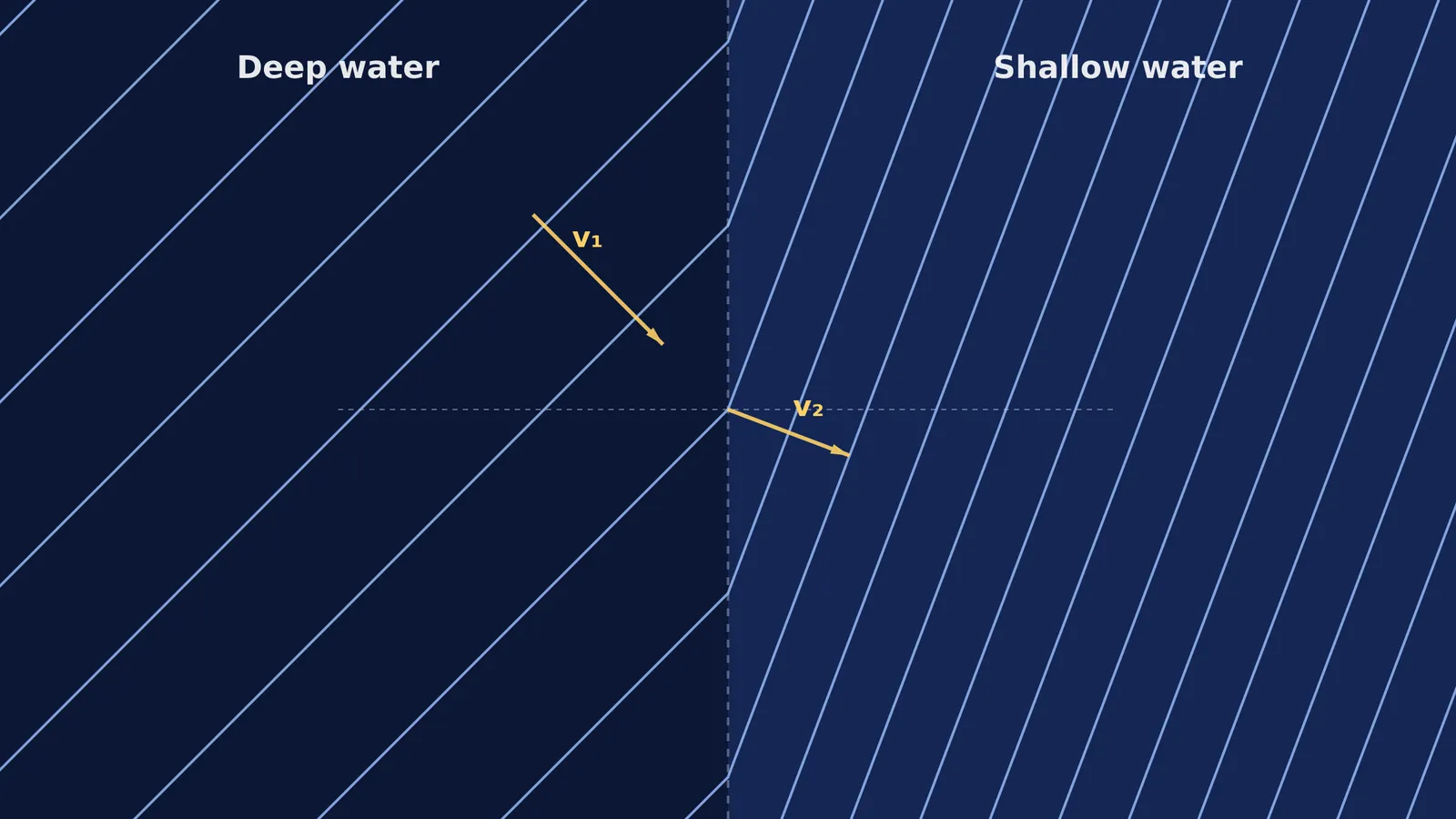
If you look closely at a ripple tank demonstration—where a transparent block is submerged to create a shallow region—you will see the bright wavefronts instantly become closer together as they cross the boundary 2.
Why do the waves bend?
If the waves hit the shallow region head-on, they just slow down and compress. But if they strike the boundary at an angle, they change direction.
Imagine a wavefront approaching the shallow water at an angle. The part of the wave that hits the shallow region first slows down immediately, held back by the drag of the shallower bottom. The rest of the wavefront is still in deep water, traveling at its original, faster speed. This speed difference causes the wave to pivot, much like a car pulling to one side when its right wheels hit a muddy shoulder while the left wheels remain on smooth asphalt. By the time the entire wavefront has entered the shallow water, its path has bent towards the normal (the imaginary line perpendicular to the boundary).
This is the exact same mechanism that explains what happens when light enters glass. While water waves slow down due to the physical depth of the liquid, light waves slow down because they are interacting with the denser electromagnetic environment of the glass. In both cases, the drop in speed forces the waves to bunch up and change direction.
How to master wave optics
Seeing waves refract is much easier than reading about them. If you want to build a better intuition for Huygens' principle and wave bending, the Fermi Simulation Lab provides interactive simulations for the ideas that are easier to see than to read. You can change the depth, adjust the angle of incidence, and watch how the wavefronts respond in real time.
If you hit a roadblock while working through the mathematics of Snell's Law or the wave equation, Fermi's AI tutor can help. Rather than just giving you the final answer, it works out what you already know and builds a plan for the session, teaching you the reasoning step by step until the concept clicks.


