

On this page
When you look at a photograph of a string carrying a wave, you are seeing a snapshot: a graph of displacement (y) against position (x) frozen at a single instant in time. If you take two snapshots a fraction of a second apart, you can measure exactly how it is moving.
By tracking how far a specific feature—like a crest—has moved between the two frames, you can calculate the wave's speed and figure out its direction. Here is how to do it step by step.
What is a wave snapshot?
A travelling wave is a disturbance that moves through a medium over time. Its equation is usually written as a function of both position and time, such as y(x, t) = A sin(kx − ωt).
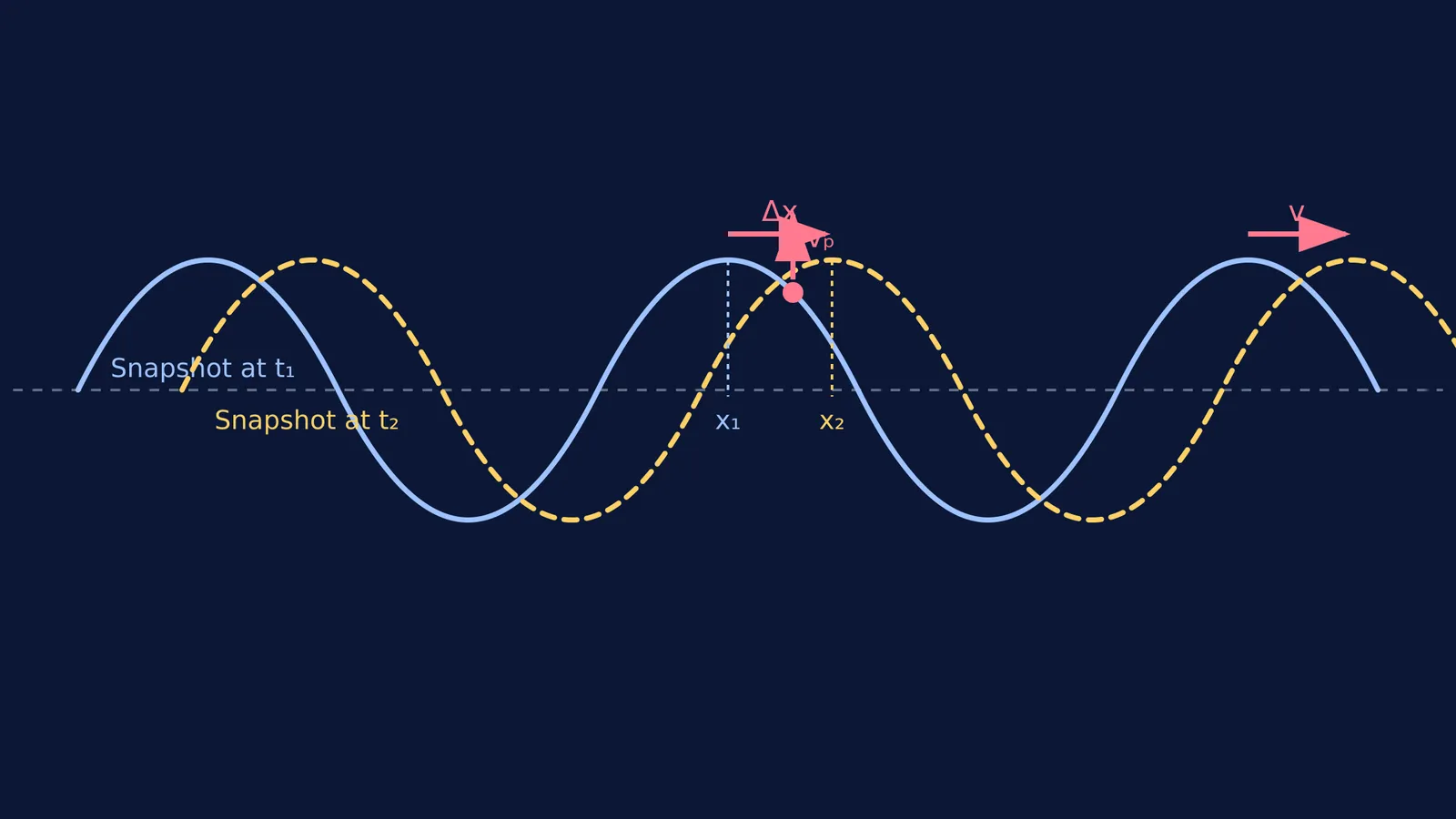
A snapshot fixes the time t. If you draw y against x at t = 0, you get a curve showing the shape of the entire string at that exact moment. A second snapshot at t = Δt shows the same shape, but shifted along the x-axis.
How does a snapshot differ from a history graph?
A common mistake in exams is confusing a snapshot graph with a history graph.
A snapshot graph plots displacement y against position x. It shows the entire wave at a single instant in time, much like a photograph. The distance between two adjacent crests on this graph is the wavelength (λ).
A history graph plots displacement y against time t for one specific point on the string. It shows how that single particle bobs up and down over time. The distance between two adjacent peaks on this graph is the period (T).
If you are asked to find the wave speed from two graphs, make sure you check the axes. You need snapshots (y vs x) to measure Δx. If you are given a snapshot graph and a history graph, you can find the wavelength from the first and the period from the second, and then calculate speed using the formula v = λ / T.
How do you calculate wave speed?
To find the wave speed v, you need to see how fast the pattern is moving. The easiest way is to pick a distinct point on the wave, such as a crest (a peak) or a trough (a valley), and track it.
Read the position x₁ of the crest in the first snapshot at time t₁.
Find the new position x₂ of the exact same crest in the second snapshot at time t₂.
Calculate the distance it travelled: Δx = |x₂ − x₁|.
Calculate the time elapsed: Δt = t₂ − t₁.
The wave speed is v = Δx / Δt.
Researchers have shown that this exact visual tracking method helps students build intuition for mechanical waves; a study by Bonato et al. (2017) demonstrated that using smartphone cameras for slow-motion video analysis allows students to measure the speed of pulses along a spring in a simple yet rigorous way.
If you need to explore how this fits into the broader picture, the Fermi Concept Library maps out every concept in physics, chemistry, biology, mathematics and computing, each with its own lesson.
How do you find the wave's direction?
The direction of the wave is given by the sign of the shift Δx.
If the crest moved to the right (x₂ > x₁), the wave is travelling in the positive x-direction.
If the crest moved to the left (x₂ < x₁), the wave is travelling in the negative x-direction.
When working through equations for these shifts, you might come across expressions like the travelling wave equation. A negative sign between the kx and ωt terms confirms motion in the +x direction, while a positive sign means the −x direction. Reflection at a boundary can also reverse this direction.
How does particle velocity confirm the direction?
Sometimes, an exam question gives you a single snapshot but tells you which way a specific particle on the string is moving. The string itself does not move left or right; its particles only oscillate up and down.
There is a direct relationship between a particle's vertical velocity (vₚ), the wave's horizontal speed (v_wave), and the slope of the wave at that exact point:
vₚ = −v_wave × slope
You can use this formula as a quick check for the wave's direction:
If a particle is on a downward-sloping part of the wave (negative slope) and is moving upwards (positive vₚ), then v_wave must be positive. The wave is moving to the right.
If the particle is moving downwards (negative vₚ) on that same negative slope, v_wave must be negative. The wave is moving to the left.
You can picture this by sliding the snapshot slightly in your imagined direction. If the curve shifts right, a particle on the forward slope must move up to meet the incoming crest. Playing with a wave simulation can make this much easier to see than reading it from a textbook. For hard-to-picture ideas like this, the Fermi Simulation Lab provides interactive simulations for the ideas that are easier to see than to read.
How do you solve a wave snapshot problem?
Problem: A wave snapshot at t = 0 s shows a crest at x = 2 cm. A second snapshot at t = 0.5 s shows the same crest has moved to x = 5 cm. What is the wave speed and direction?
Solution:
Δx = 5 cm − 2 cm = 3 cm.
Δt = 0.5 s − 0 s = 0.5 s.
Speed v = 3 / 0.5 = 6 cm/s.
Direction: Since 5 > 2, the crest moved to the right. The wave travels in the +x direction.
If you find yourself stuck on wrong-method mistakes in wave kinematics, the Fermi Problem Library has worked problems with a step-by-step solver that explains the reasoning rather than printing an answer.


