

On this page
Step out of a bath under a fan and you shiver, though nothing cold touched you. The water on your skin left and took heat with it. A particle simulation shows why, and once you see it you can predict what speeds the cooling up.
Why does evaporation cause cooling?
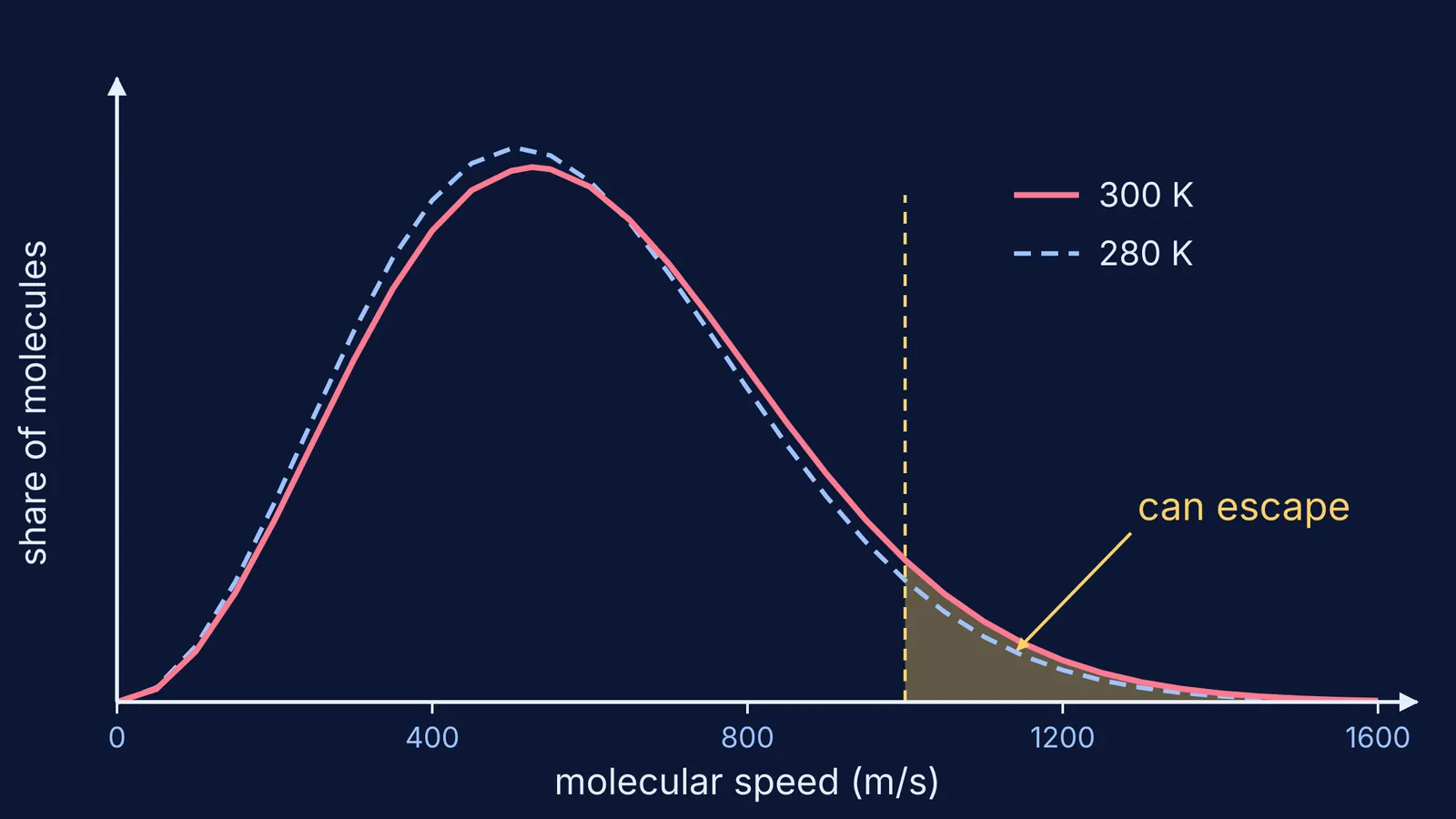
Molecules in a liquid do not all move at the same speed. Their speeds spread out along the Maxwell–Boltzmann distribution: a big hump of ordinary movers and a thin tail of very fast ones (OpenStax University Physics, Volume 2).
To leave, a molecule at the surface needs enough energy to break away from the pull of its neighbours, and only the fast tail has it. The same OpenStax chapter puts it plainly: “The highest-energy molecules are those that can escape from the intermolecular attractions of the liquid. Thus, when some liquid evaporates, the molecules left behind have a lower average energy, and the liquid has a lower temperature.”
Temperature tracks average kinetic energy, so removing the fastest molecules lowers it.
What does a particle simulation of evaporation show?
The Evaporative Cooling illustration on ComPADRE Physlets uses two chambers of particles separated by a membrane that lets through only particles hitting it at a speed of 25 or more, in the simulation's units. When the membrane opens, the fast ones cross and the speed distribution in the left chamber shifts. In the page's words, “The fastest particles leave and so the temperature of what remains behind is cooler.”
Watch the speed histogram left behind lose its right-hand tail. Then ask what should happen next: with no heat flowing in, fewer particles reach the escape speed, so you would expect escapes to slow down.
How do temperature, wind, surface area and humidity change the cooling rate?
The UN Food and Agriculture Organization names solar radiation, air temperature, air humidity and wind speed as the weather factors to consider when assessing evaporation (FAO Irrigation and Drainage Paper 56). Here is each one at the particle level.
Temperature. A warmer liquid has a fatter fast tail. “At a higher temperature, a greater fraction of molecules have enough energy to escape from the liquid” (OpenStax Chemistry 2e). Prediction: hotter liquid evaporates faster.
Humidity. Vapour molecules in the air also rejoin the liquid. The FAO guide calls the vapour pressure difference between surface and air the driving force, so humid air slows net evaporation. OpenStax College Physics 2e notes that “high humidity inhibits evaporation”, which is why sweat sits on your forehead on a sticky monsoon day.
Wind. The FAO guide says the air above the surface “becomes gradually saturated and the process will slow down” unless it is replaced, and that replacement “depends greatly on wind speed”. A fan sweeps away the molecules that would have come back.
Surface area. Only surface molecules can escape. Spread the same water wider and more molecules sit at the boundary, so more escape each second. Wet clothes dry faster spread out than in a heap.
How much heat does evaporation remove? A worked example
Turning water into vapour takes a lot of energy. The latent heat of vaporisation of water is about 2,430 kJ/kg at 30 °C and 2,256 kJ/kg at 100 °C (Engineering ToolBox water data). Your body uses this: OpenStax College Physics 2e says evaporating sweat at body temperature takes 2,428 kJ/kg, about 10 percent more than at 100 °C.
Take a steel tumbler holding 200 g of water at 30 °C, and suppose 5 g evaporates.
Heat carried away: Q = mL = 0.005 kg × 2,430 kJ/kg ≈ 12.2 kJ.
Water left: 195 g. The specific heat of water is 4,186 J/(kg·°C) (OpenStax College Physics 2e, Table 14.1).
Drop if no heat flowed in: ΔT = Q/(mc) = 12,150 J ÷ (0.195 kg × 4,186 J/(kg·°C)) ≈ 15 °C.
Losing 2.5% of its mass would chill the water by about 15 °C. In a real room, warmer air keeps pushing heat back in, so the water settles where the two balance.
How should you study evaporation with a simulation?
Use a predict, run, explain loop, which turns a simulation into an experiment.
Write your prediction first: “If I double the wind, the cooling rate will go up, down or stay the same, because…” Give the reason in terms of molecules.
Change one setting only: temperature, wind, surface area or humidity.
Watch the speed histogram, not just the thermometer.
Explain every surprise. A wrong prediction teaches you the most.
Finish with a closed box: no wind, humid air. Escapes and returns balance, which OpenStax Chemistry 2e describes as the vapour being in equilibrium with the liquid.
For when simulations help, read what PhET research says interactive physics simulations are good for. For the textbook side, see matter in our surroundings: states, evaporation and latent heat and kinetic theory of gases: rms speed and specific heats.
Evaporation lives in thousands of moving particles, so it is easier to see than to read. The Fermi Simulation Lab has interactive simulations for ideas like this, and Fermi's AI tutor can run the simulation with you and check your understanding as it goes. Make your four predictions before you press play.


