On this page
You flick a tap shut and the wall answers with a thud. Or the pipes knock when the washing machine finishes filling. What you hear is water that was moving a moment ago being made to stop, and the physics behind it is the same momentum and pressure you meet in Class 11.
What is water hammer?
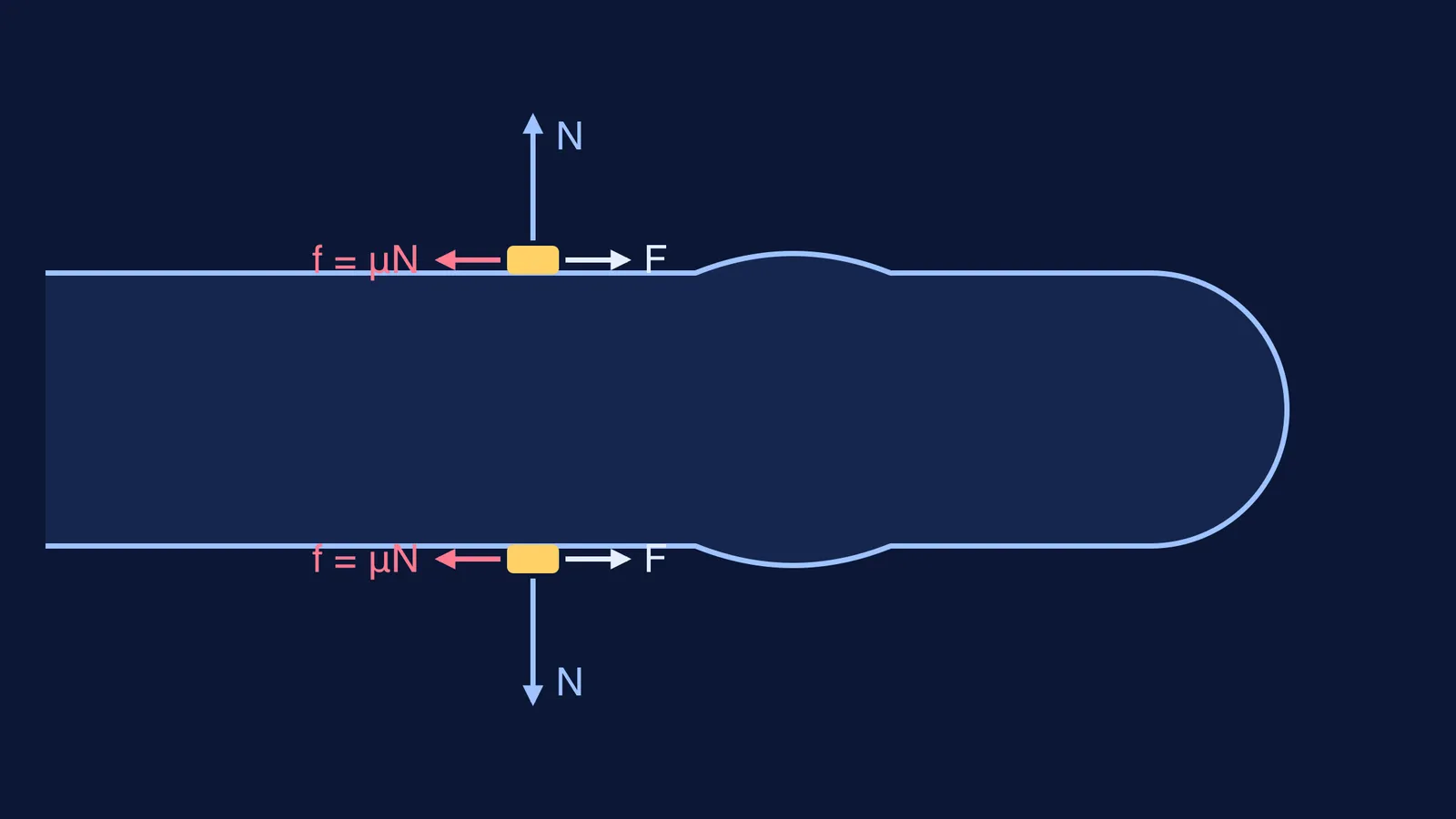
Water hammer is the surge of pressure created when water flowing through a pipe is suddenly stopped, as a plumbing manufacturer's technical brochure on water hammer arrestors defines it. The same brochure explains that a pressure wave then travels back through the piping until it finds a point of relief, and that the noise of banging pipes comes from these shocks. A pipe that is free to move gets knocked against walls and brackets as the wave passes.
It lists dishwashers, clothes washers and fast-closing shut-off valves as things that contribute, because all of them can stop the flow quickly.
Why does stopping water create so much pressure?
Start with momentum. A pipe of length L and cross-section A holds water of mass ρAL. Moving at speed v, that water carries momentum ρALv. To stop it in a time t, the closed tap has to push back with an average force F = ρALv/t, Newton's second law as change in momentum from force and time. Divide by the area A and the extra pressure at the tap is Δp = ρLv/t.
That is exactly the formula for gradual valve closure in Prof. Arturo Leon's water hammer lecture at Florida International University. In this formula, halving the closing time doubles the pressure rise.
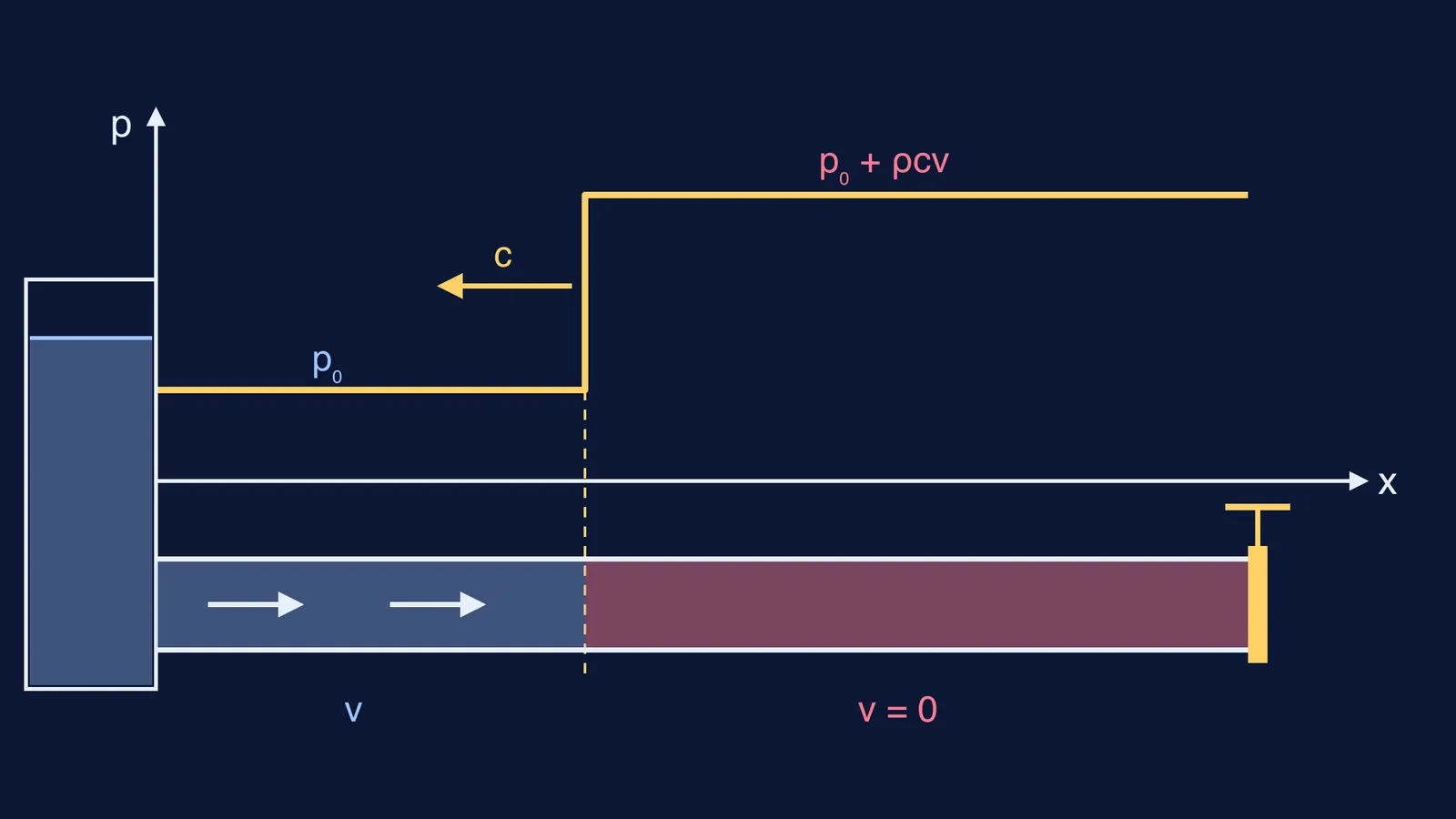
The time cannot shrink to zero, though. Water is very slightly compressible and pipe walls stretch, so the stop spreads back up the pipe as a pressure wave. For a closure faster than that wave can make the trip, the same lecture gives the Joukowsky equation:
Δp = ρcv, where c is the speed of the pressure wave in the water-filled pipe.
c is roughly 1,000 m/s for water in a pipe, according to the lecture.
A closure counts as sudden when it takes less than 2L/c, the time for the wave to reach the far end of the pipe and come back.
The lecture gives water's bulk modulus as 2.1 × 10⁹ N/m² and its density as 1,000 kg/m³; in a perfectly rigid pipe c = √(E/ρ), which works out to about 1,450 m/s. Real pipes give a little, so the wave is slower. It is a sound wave; compare our post on the speed of sound in steel, water and air.
Worked example: a flick of the wrist versus a slow turn
Take an Indian home fed by an overhead tank, using the formulas from Prof. Leon's lecture slides. Assume, for this example only, a 10 m pipe from tank to tap, water moving at 1.5 m/s, and c = 1,000 m/s.
Normal pressure at the tap from a 10 m column: ρgh = 1,000 × 9.8 × 10 ≈ 98,000 Pa, about 1 bar.
Round-trip time of the wave: 2L/c = 20/1,000 = 0.02 s.
A fast valve that shuts in under 0.02 s: Δp = ρcv = 1,000 × 1,000 × 1.5 = 1.5 × 10⁶ Pa, about 15 bar, roughly fifteen times the normal pressure.
A hand turning the tap over half a second, a gradual closure: Δp = ρLv/t = 1,000 × 10 × 1.5 / 0.5 = 30,000 Pa, about 0.3 bar.
These are idealised numbers; friction, the stretch of the pipe and trapped air all lower real surges. The point survives: the same water, losing the same momentum, presses far harder when it is stopped fast.
The egg version is in our post on why a cushion stops an egg breaking.
How do you stop pipes banging at home?
Close taps gently, especially quarter-turn and single-lever taps that can snap shut.
Note when the bang happens. If it follows the washing machine or dishwasher filling, their fast valves are the likely cause.
Ask a plumber about a water hammer arrestor. The Watts arrestor brochure describes it as a sealed, pre-charged air chamber that absorbs the shock, best placed as close as possible to the quick-closing valve.
If you have a pressure pump, ask about pressure. The same brochure says flow pressure in branch lines should ideally not exceed 55 psi (about 3.8 bar) and recommends pressure-reducing valves above that.
Have loose pipes clamped. A pipe that can move will knock even with a small surge.
Leave anything beyond tightening a clamp to a licensed plumber.
How can you picture the pressure wave?
You never see the wave inside a closed pipe. The Fermi Simulation Lab has interactive simulations for the ideas that are easier to see than to read. If impulse and momentum numericals are where you lose marks, the Fermi Problem Library has worked problems with a step-by-step solver that explains the reasoning rather than printing an answer.
Next time a tap bangs, try the sum with your own pipe length.