

On this page
The classic egg drop experiment is more than just a fun engineering challenge. It is a perfect demonstration of one of the most fundamental rules of physics: the relationship between impulse, momentum and stopping time.
If you drop two identical eggs from the same height—one onto a concrete floor and one onto a thick foam cushion—they both hit the ground travelling at the exact same speed. Yet one shatters instantly, while the other survives intact. The secret lies entirely in how long it takes them to come to a stop.
What is the impulse-momentum theorem?
To understand the physics of a falling egg, we first need to look at its momentum. Momentum (p) is the product of an object's mass and its velocity. As the egg falls, it accelerates, gaining speed and therefore gaining momentum.
When the egg hits the surface and comes to a halt, its final velocity drops to zero. The change in momentum (Δp) is identical whether it hits a concrete floor or a cushion.
In physics, a change in momentum is called an impulse (J). The impulse-momentum theorem states that impulse is equal to the average force applied multiplied by the time over which it acts:
J = F × Δt = Δp
This equation tells us that a specific change in momentum (Δp) requires a specific impulse (J). Because the egg's mass and its speed just before impact are fixed, the total impulse needed to stop it is also a fixed, constant value.
Why does a cushion stop an egg breaking?
Because the total impulse (F × Δt) must remain constant for a given drop height, force and time are inversely proportional. This means that if you change one variable, the other must change in the opposite direction to balance the equation.
A hard concrete floor has almost no give. When an egg hits it, the collision is over in a tiny fraction of a second. Because the stopping time (Δt) is extremely small, the impact force (F) must be massive to deliver the required impulse. This immense spike in force easily overwhelms the structural strength of the calcium carbonate shell, causing it to crack.
A cushion, on the other hand, is designed to compress. As the egg sinks into the foam, the deceleration is spread out. By extending the stopping time, the mathematical necessity of the equation forces the average impact force to drop. In fact, increasing the time duration of an impact by a factor of 100 results in a decrease in force by a factor of 100. The cushion extends the impact long enough that the peak force never reaches the breaking threshold of the shell.
Comparing force-time graphs for a hard floor and a cushion
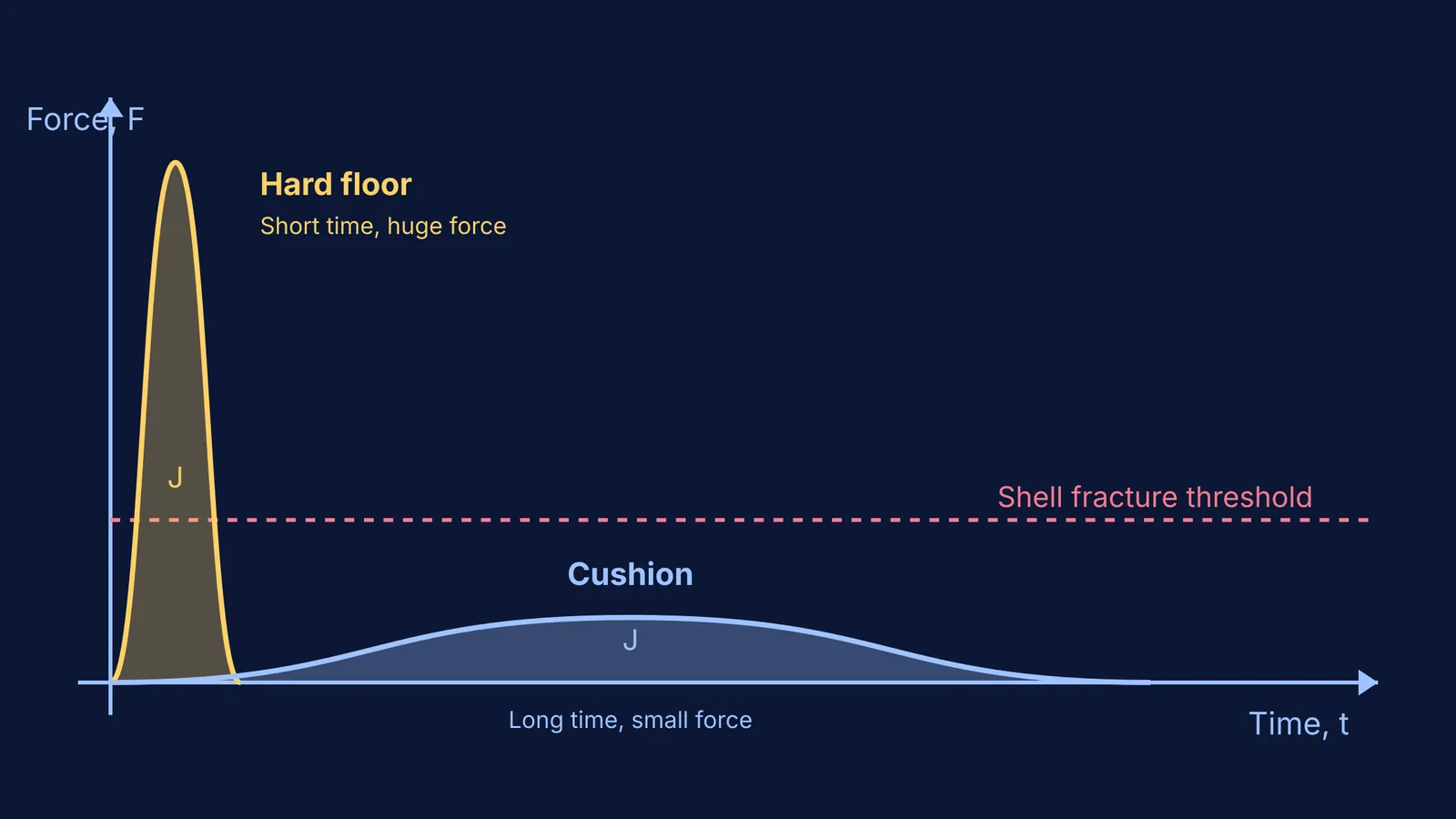
When we plot the impact force against time on a graph, the total area under the curve represents the impulse (J). Because the impulse is the same for both drops, the area under both curves must be exactly equal.
The Hard Floor: The graph shows a tall, razor-thin spike. The time interval is nearly zero, driving the peak force incredibly high—well above the shell's fracture threshold.
The Cushion: The graph shows a wide, flat hill. The stopping time is stretched out along the horizontal axis, keeping the peak force safely below the breaking point.
This is the exact same physics that governs car crumple zones, airbags, and the foam mats used in gymnastics. They all exist to buy milliseconds of extra time.
If these force-time graphs feel abstract, you can build your own models in the Fermi Simulation Lab, which features interactive simulations for the ideas that are easier to see than to read. You can also explore how these laws scale up by investigating the momentum of larger systems, such as a shell exploding midair, or how force balances out when finding the minimum force to drag a block.
A worked example: calculating the impact force
Let's put real numbers to the physics. Imagine a 50 g (0.05 kg) egg dropped from a height of 2 metres.
Speed at impact: Using the equations of motion (v² = u² + 2gs), the egg hits the ground at approximately 6.26 m/s.
Change in momentum (Δp): Mass × velocity = 0.05 kg × 6.26 m/s = 0.313 Ns. This is our required impulse.
Scenario A: The Hard Floor If the concrete floor stops the egg in just 0.002 seconds (2 milliseconds): Average Force = Impulse / Time F = 0.313 / 0.002 = 156.5 Newtons. This force will instantly shatter the egg.
Scenario B: The Cushion If a thick foam cushion compresses and extends the stopping time to 0.2 seconds (200 milliseconds)—a factor of 100 longer: Average Force = Impulse / Time F = 0.313 / 0.2 = 1.565 Newtons. The force drops by a factor of 100, and the egg survives completely intact.


