

On this page
If you have ever winced while catching a hard ball, you already know the idea behind this numerical. NCERT's Class 9 chapter How Forces Affect Motion explains that a fielder pulls their hands back so the ball takes longer to stop, which means a smaller force is needed. Here is the formula behind that, two worked examples, and the mistakes that cost marks.
What is the formula for change in momentum from force and time?
Momentum is mass multiplied by velocity, p = mv, and it is a vector, so its direction matters (NCERT Class 11 Physics, Chapter 4, Laws of Motion).
Impulse is force multiplied by the time it acts, and it equals the change in momentum: F × t = Δp = m(v − u), where u is the starting velocity and v the final one (NCERT Class 11 Physics, Chapter 4).
Impulse is measured in newton-seconds (N s). The same NCERT chapter gives the unit of momentum as kg m/s or N s, so the two are the same unit. When the force changes during contact, F in this formula is the average force, F = Δp ÷ t (OpenStax University Physics, section 9.2).
Use the same five steps for every question:
Choose a positive direction, usually the way the object starts moving.
Convert units: km/h to m/s (divide by 3.6), grams to kilograms.
Write Δp = m(v − u), keeping the signs.
Divide Δp by time to get force, or by force to get time.
Read the sign: a negative force acts against the starting motion.
How do you solve a cricket ball catch numerical?
The ICC playing conditions say a new men's ball must weigh between 155.9 g and 163 g, so take m = 0.16 kg. Suppose it reaches the fielder at 30 m/s (108 km/h); that speed is our choice for the example.
Change in momentum: Δp = 0.16 × (0 − 30) = −4.8 kg m/s.
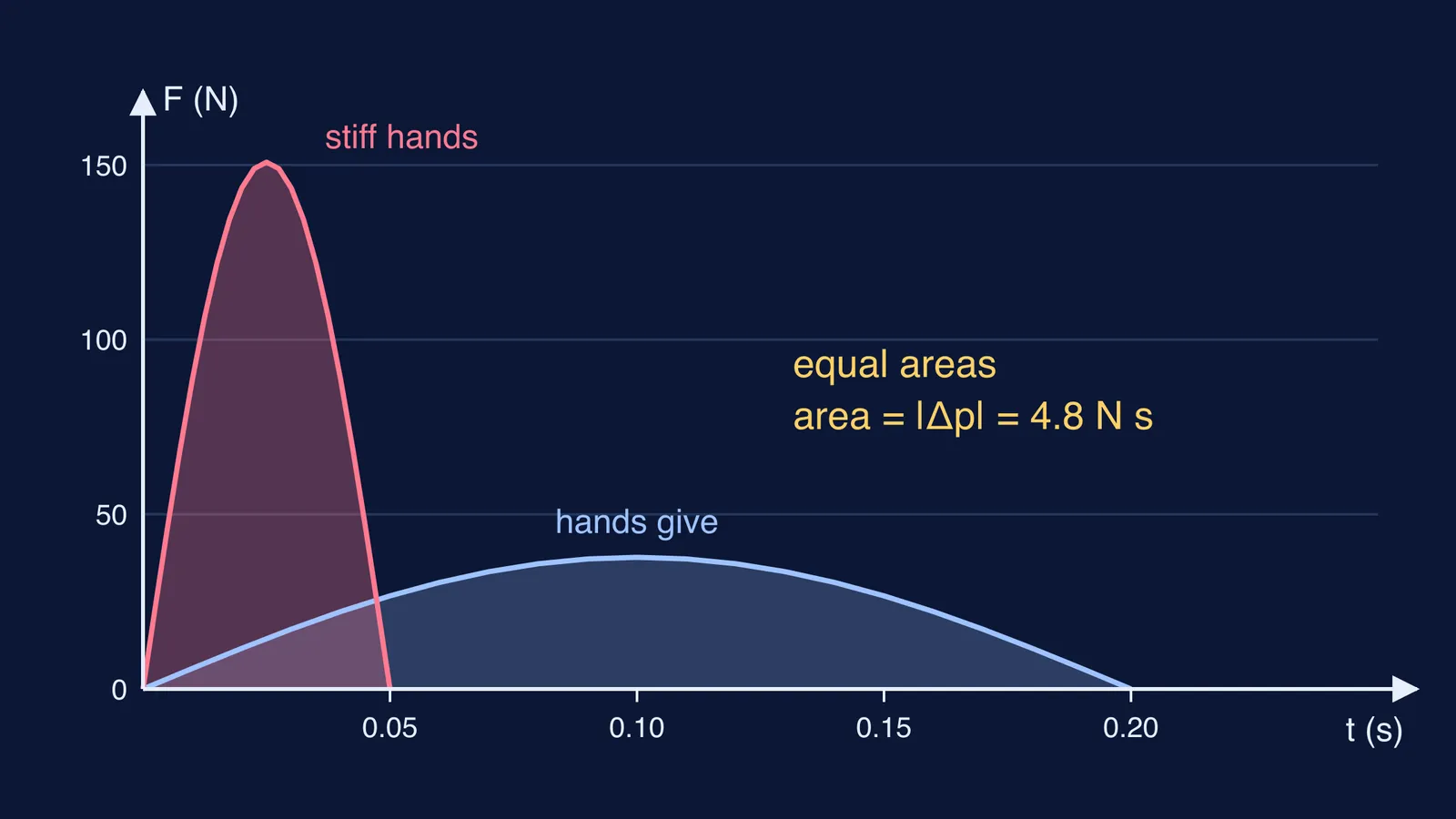
Stiff hands stop the ball in 0.05 s: F = −4.8 ÷ 0.05 = −96 N.
Hands that give stop it in 0.20 s: F = −4.8 ÷ 0.20 = −24 N.
The change in momentum is the same. Four times the stopping time gives a quarter of the average force. For a sense of scale, 96 N is about the weight of a 10 kg bag of rice (10 × 9.8 = 98 N).
A bounce is where marks slip. In NCERT Class 11 Example 4.4, a 0.15 kg ball comes in at 12 m/s and the batsman hits it straight back at 12 m/s. The impulse is 0.15 × 12 − (−0.15 × 12) = 3.6 N s, not zero.
How do you find the braking force on a car?
Take a 1,200 kg car at 72 km/h, which is 20 m/s (our numbers for the example). Δp = 1,200 × (0 − 20) = −24,000 kg m/s.
A gentle stop over 8 s: F = −24,000 ÷ 8 = −3,000 N.
A hard stop over 3 s: F = −24,000 ÷ 3 = −8,000 N.
You can check the method against NCERT Class 9 Example 6.6, part (iii), where a 1,500 kg sports car slows from 10 m/s to rest in 5 s. The book uses v = u + at to find a = −2 m/s², then F = ma = −3,000 N. The impulse route gives the same answer in one line: 1,500 × (0 − 10) ÷ 5 = −3,000 N.
The same NCERT chapter explains airbags with the same idea: the cushion makes a passenger's head and chest take longer to stop, which reduces the force on them and lowers the risk of serious injury, particularly when combined with a seat belt.
If momentum as a vector still feels shaky, the Fermi Concept Library gives every concept in physics its own lesson and its place in the map, so you can see what impulse is built on.
Which mistakes cost marks in impulse numericals?
Leaving speed in km/h or mass in grams.
Dropping the minus sign, then reporting a stopping force that points forward.
Writing p instead of Δp when the object does not start or end at rest.
Using the whole flight time instead of the contact time.
Try two NCERT problems on your own, then check:
A 400 kg three-wheeler carrying a 65 kg driver stops from 36 km/h in 4.0 s (NCERT Class 11 Exercise 4.8). Answer: 465 × 10 ÷ 4.0 ≈ 1,160 N.
A 0.4 kg football is kicked from rest to 108 km/h with an estimated force of 800 N; find the contact time (NCERT Class 9 Chapter 6, question 13). Answer: t = 0.4 × 30 ÷ 800 = 0.015 s.
If you get the formula right but the answer wrong, the Fermi Problem Library has worked problems with a step-by-step solver that explains the reasoning rather than printing an answer, so you can see where your working went off track.


