On this page
Before you read on, rank steel, water and air from fastest to slowest for sound, and write one reason. Many students reason from density: steel is heavy, so sound should crawl through it. The numbers below test that.
Which is faster: sound in steel, water or air?
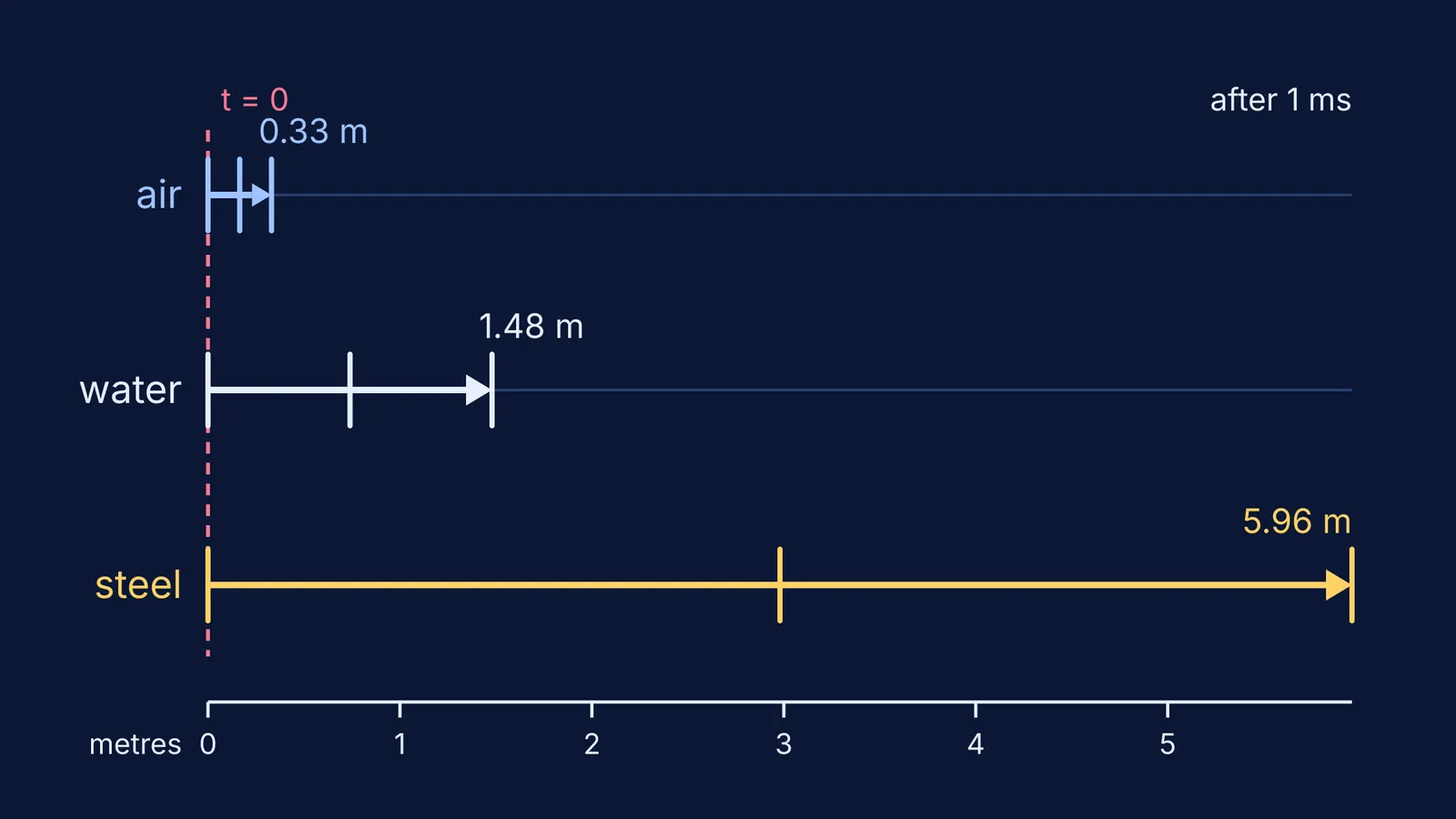
Steel is fastest, water is next and air is slowest. In the speed-of-sound table in OpenStax University Physics, section 17.2, steel is listed at 5,960 m/s, fresh water at 20 °C at 1,480 m/s and air at 0 °C at 331 m/s. At 20 °C, air carries sound at about 343 m/s, according to the HyperPhysics speed of sound table.
That makes steel roughly 18 times faster than cold air. If your ranking matched, check your reason: density alone predicts the opposite order.
What decides the speed of sound in a material?
Sound is a travelling squeeze. One layer of particles pushes the next, and how quickly that push passes along depends on two properties. OpenStax states the rule as: the speed of a mechanical wave is the square root of an elastic property divided by an inertial property.
Elastic property: how hard the material pushes back when squeezed. For a liquid or gas this is the bulk modulus B; for a thin solid rod it is Young's modulus Y.
Inertial property: the density ρ, the mass each layer has to get moving.
So v = √(B/ρ) for fluids and v = √(Y/ρ) for a thin rod. For a gas, the bulk modulus that matters is γp, the heat capacity ratio times the pressure. That is Laplace's correction, explained in our post on Newton's formula and Laplace's correction for sound in gases.
How do the numbers work out for steel, water and air?
Here is the test: take textbook values and see whether the formula reproduces the measured speeds.
Air at 0 °C: density 1.29 kg/m³ at 101.3 kPa (OpenStax Table 14.1), and γ = 1.4 for dry air (heat capacity ratio). So γp ≈ 1.42 × 10⁵ Pa and v = √(1.42 × 10⁵ / 1.29) ≈ 332 m/s.
Water: bulk modulus 0.22 × 10¹⁰ Pa, which is 2.2 × 10⁹ Pa (OpenStax Table 12.1), and density 1,000 kg/m³ at 4 °C (Table 14.1). So v = √(2.2 × 10⁹ / 1,000) ≈ 1,483 m/s.
Steel rod: Young's modulus 20.0 × 10¹⁰ Pa (Table 12.1) and density about 7,850 kg/m³, inside the 7,750 to 8,050 kg/m³ range given in Wikipedia's steel article. So v = √(2.0 × 10¹¹ / 7,850) ≈ 5,050 m/s.
Air and water land within a few metres per second of the table. Steel comes out below 5,960 m/s, and that is not a mistake. The √(Y/ρ) formula is for a thin rod, which can bulge sideways as it is squeezed. A large block cannot bulge, so it behaves as if it were stiffer; the Wikipedia speed of sound article gives about 6,000 m/s for this bulk wave in steel and notes that the thin-rod formula gives lower values. Either way, the order holds.
Why doesn't the denser material slow sound down?
Compare ratios using the OpenStax Table 12.1 and Table 14.1 values from the section above. Going from water to steel, density rises about 7.85 times, but stiffness (B for water, Y for steel) rises about 91 times. Speed goes as the square root of their ratio: √(91 / 7.85) ≈ 3.4, which matches 5,050 ÷ 1,483.
Going from air to water, density rises about 775 times, while stiffness rises about 15,500 times. √(15,500 / 775) ≈ 4.5, which matches 1,483 ÷ 332.
Tightly bound particles resist squeezing far more than they add mass. For more practice with B, see bulk modulus and compressibility, with worked depth problems; for the wider solid, liquid and gas picture, read why sound travels fastest in solids.
How can you test a prediction like this yourself?
A predict, explain, check routine turns this into a habit you can reuse for any "rank these" question in board exams or JEE Main:
Predict: write the order and one sentence of reasoning before you look anything up.
List two quantities per medium: the stiffness (B, Y or γp) and the density, with units.
Compare ratios, not raw numbers: work out how many times stiffness and density each change, then take the square root of the stiffness ratio over the density ratio.
Check against a table: if you are within a few per cent, your model works; if not, ask which assumption fails, as with the thin rod.
Feel it: put your ear on one end of a long table while a friend taps the far end gently, then repeat with your head raised, and compare what you hear.
If it is hard to picture compressions racing through a stiff medium, the Fermi Simulation Lab has interactive simulations for ideas that are easier to see than to read. If your numbers keep coming out wrong, the Fermi Problem Library has worked problems with a step-by-step solver that explains the reasoning, so you can see whether the slip is in the units or the formula.