On this page
Hold a tennis ball on top of a basketball, drop both from waist height, and the tennis ball shoots up past your head. It is a classic demonstration and a JEE-style problem in disguise: two collisions, momentum conservation and one coefficient of restitution.
How high does a tennis ball bounce off a basketball?
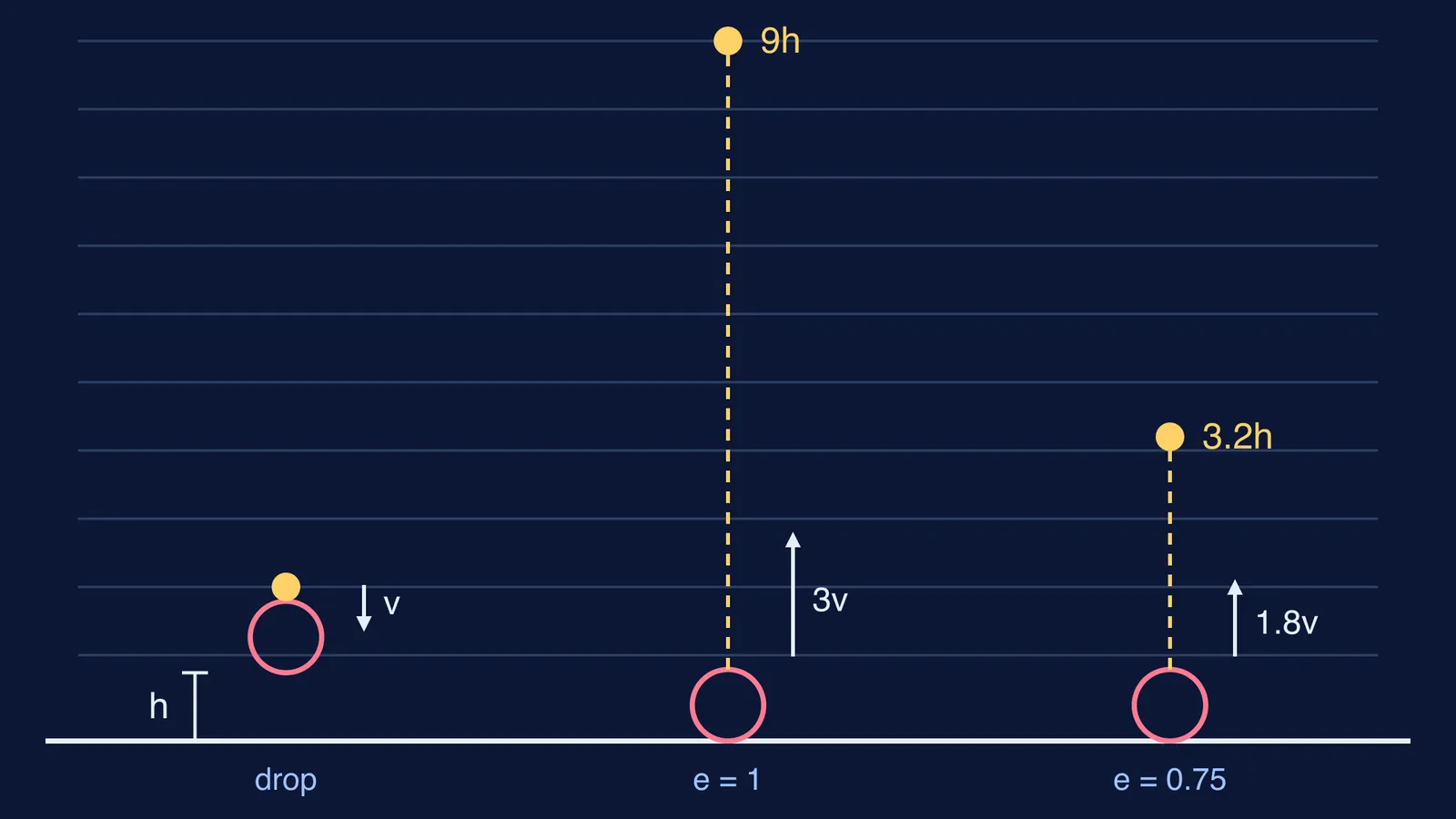
The Galilean cannon entry on Wikipedia gives the ideal limit: with perfectly elastic balls and a much heavier bottom ball, the top ball's upward speed is at most three times its falling speed, and its rebound height at most nine times the drop height. The textbook model gets there by treating the drop as two separate collisions. Both balls fall a height h and arrive at the floor with the same speed v = √(2gh).
The basketball hits the floor first and, if the bounce is perfectly elastic, comes back up at speed v.
A moment later it meets the tennis ball, which is still coming down at speed v.
Seen from the basketball, the tennis ball approaches at 2v. If the basketball is much heavier and the collision is elastic, the tennis ball leaves at 2v relative to the basketball, which is 2v + v = 3v relative to the ground.
Rise height is proportional to speed squared, so the tennis ball climbs (3v)²/2g = 9h.
The nine is measured from the collision point near the floor. Step 3 is the limit explained in our post on elastic collision velocities when a heavy ball hits a light one.
Why does the real tennis ball not go nine times higher?
In 2015 Yani Berdeni, Alan Champneys and Robert Szalai filmed the drop with a high-speed camera and published The two-ball bounce problem in Proceedings of the Royal Society A. The University of Bristol's summary reports that the tennis ball rebounds around three to four times higher than where it was dropped from. Three things eat into the ideal nine.
Every bounce loses energy. The coefficient of restitution e is rebound speed divided by impact speed, so a single ball rebounds to e² of its drop height. The ITF Rules of Tennis require a medium-pace (Type 2) ball to rebound 135 to 147 cm, and the test drop is 254 cm, which puts e for such a ball on concrete at about 0.73 to 0.76. For why rubber turns some of that energy into heat, see elastic hysteresis in rubber.
The basketball is not infinitely heavy. The tennis ball pushes it back down a little, so it cannot hand over the full 2v.
The collisions are not really separate. The Bristol paper found the two-collision model agrees with the camera data only if the balls start with enough separation. For touching balls, the authors model an elastic wave in the squashed lower ball launching the upper one like a particle on a trampoline. Rod Cross, writing in the American Journal of Physics in 2007, used force measurements on each ball to explain why a simple mass-spring model predicts too slow a launch.
Worked example: from 9h to a real number
Let the tennis ball have mass m, the basketball mass M, and write μ = m/M. Take the same e for the floor bounce and the ball-to-ball bounce. Just before the second collision the basketball moves up at ev and the tennis ball moves down at v.
Momentum: M(ev) + m(−v) = Mv₁ + mv₂. Restitution: v₂ − v₁ = e(ev + v). Solving for the tennis ball:
v₂ = [e + e(1 + e) − μ] v / (1 + μ), and the rise height is (v₂/v)² × h.
Ideal, e = 1 and μ = 0: v₂ = 3v, height 9h.
Elastic, but the basketball only ten times heavier (μ = 0.1, our assumption): v₂ = 2.9v/1.1 ≈ 2.64v, height ≈ 7.0h.
Add a realistic bounce, e = 0.75 (inside the ITF range, assumed for both bounces): v₂ = (0.75 + 1.3125 − 0.1)v/1.1 ≈ 1.78v, height ≈ 3.2h.
From a 1 m drop, the model predicts a rise of about 3.2 m, within the Bristol range. In this model the biggest loss comes from the bounces, not the mass ratio. If a step here felt shaky, the Fermi Problem Library has worked problems with a step-by-step solver that explains the reasoning rather than printing an answer.
How can you test this at home?
Work outdoors from waist height, with nobody leaning over the balls.
Tape marks every 10 cm up a wall and film each drop in slow motion.
Drop each ball alone and find its e = √(rebound height ÷ drop height).
Put your e values and a guess for μ into the formula and predict the stacked rebound.
Try with the balls touching and with a small gap, and compare both with your prediction.
If restitution itself is the shaky part, the Fermi Concept Library gives each concept its own lesson. For the next step, try bouncing ball problems on total distance, time and the nth height.