

On this page
Bouncing ball questions test two ideas at once: what the coefficient of restitution does to a single bounce, and how to add up infinitely many bounces.
What does the coefficient of restitution tell you about each bounce?
The coefficient of restitution e is the ratio of the speed of separation after a collision to the speed of approach before it. For ordinary collisions it lies between 0 (no rebound) and 1 (a perfectly elastic bounce). Off a fixed floor, the ball leaves with e times its arrival speed.
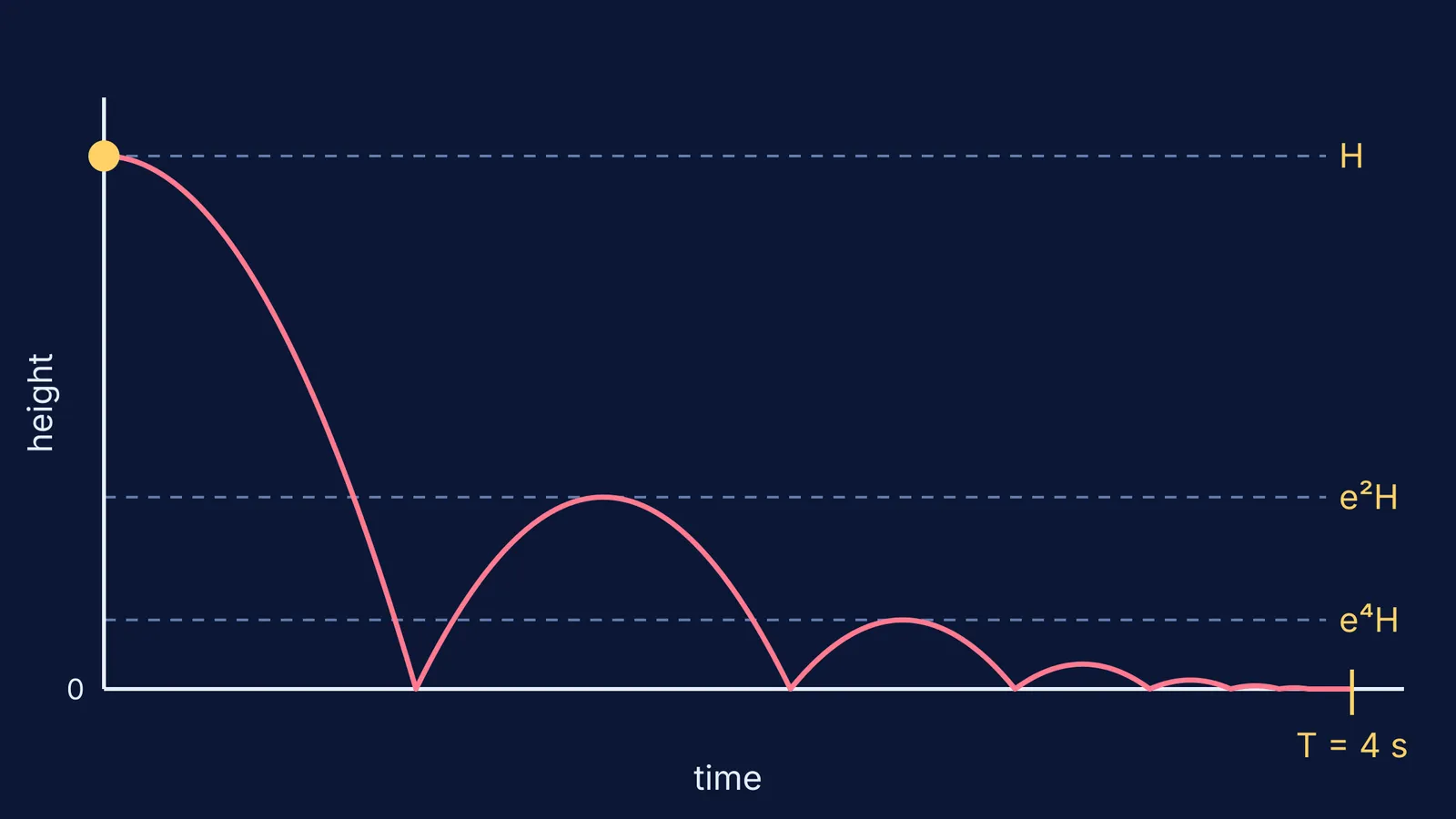
Now link speed to height. From the free-fall equation v² = v₀² − 2g(y − y₀) in OpenStax University Physics, a ball dropped from height H hits the floor at √(2gH). It leaves at e√(2gH), so it rises to e²H. Height depends on the square of speed, which is why e becomes e².
Repeat that n times:
Speed just after the n-th bounce: eⁿ√(2gH)
Height after the n-th bounce: hₙ = e^(2n)H
Measuring e from a drop test: e = √(h/H), where h is the rebound height
A real example: the ITTF Handbook (Law 2.1.3) says a table must give a bounce of about 23 cm when a standard ball is dropped onto it from 30 cm. That makes e = √(23/30), about 0.88, for a ball on a table.
How do you find the total distance travelled by a bouncing ball?
The ball falls H once. After that, every bounce is a rise and an equal fall: 2e²H, then 2e⁴H, then 2e⁶H, and so on. Each term is e² times the one before.
That is an infinite geometric series with first term a = 2e²H and ratio r = e². According to OpenStax Calculus Volume 2, such a series converges to a/(1 − r) whenever r lies between −1 and 1, and e² < 1 for any real bounce. So:
Total distance D = H + 2e²H/(1 − e²) = H(1 + e²)/(1 − e²)
Sometimes a question asks for the distance only up to the n-th time the ball strikes the floor. Then use the finite sum: D up to the n-th impact = H + 2e²H(1 − e^(2(n−1)))/(1 − e²). Check it with n = 1: you get H, the first fall alone.
How long does a bouncing ball take to stop?
The first fall takes t₀ = √(2H/g). A ball that leaves the floor at eⁿ√(2gH) spends 2eⁿt₀ in the air before it lands again. The ratio here is e, not e², because time depends on speed, not height.
So the total time is another geometric series: T = t₀ + 2et₀ + 2e²t₀ + ... = t₀(1 + e)/(1 − e).
The series has a finite sum, so the model predicts infinitely many bounces in a finite time. That comes from assuming e stays the same and ignoring air resistance, so treat T as the ideal-model answer.
Worked example: a ball dropped from 5 m with e = 0.6
Round g to 10 m/s² to keep the arithmetic clean. OpenStax uses 9.8 m/s², so use whichever value your question gives.
Heights: h₁ = 0.36 × 5 = 1.8 m, h₂ = 0.648 m, h₃ = 5 × 0.6⁶ ≈ 0.233 m.
Total distance: D = 5 × (1 + 0.36)/(1 − 0.36) = 5 × 1.36/0.64 = 10.625 m.
Distance up to the third impact: 5 + 2(1.8 + 0.648) = 9.896 m.
First fall: t₀ = √(2 × 5/10) = 1 s.
Total time: T = 1 × 1.6/0.4 = 4 s.
When does a bounce first fall below 1 cm? You need 5 × 0.36ⁿ < 0.01. The 6th bounce reaches about 1.09 cm and the 7th about 0.39 cm, so the answer is the 7th.
Try it on the ITTF table-tennis numbers too. Dropped from 30 cm with e² = 23/30, the ideal model gives D = 0.30 × (53/30)/(7/30) ≈ 2.27 m, more than seven times the drop height, all within a few seconds.
Which mistakes cost marks in bouncing ball questions?
Before you write the final answer, check:
Heights shrink by e²; speeds and flight times shrink by e.
Count the first drop once, and every later bounce twice.
Read whether the question means after the n-th bounce (height e^(2n)H) or up to the n-th impact (a finite sum).
Check the limits. As e approaches 1, D should blow up. When e = 0, D should equal H.
If the series step trips you up, practise it alone first: recurring decimals as fractions using an infinite GP or how to sum arithmetico-geometric series. If the physics side is shaky, our guide to elastic and inelastic collisions and restitution covers e when both bodies move.
When a variant goes wrong and you can't see why, the Fermi Problem Library has worked problems with a step-by-step solver that explains the reasoning rather than printing an answer. If geometric series themselves feel shaky, the Fermi Concept Library gives each concept its own lesson and shows where it sits in the map.


