On this page
Mix an alkyl halide with ammonia and you do not get one amine. You get several. In July 1887 a Berlin chemist, Siegmund Gabriel, published a way round this in the journal Berichte: "Ueber eine Darstellungsweise primärer Amine aus den entsprechenden Halogenverbindungen", on making primary amines from the matching halogen compounds. Nearly 140 years later, the NCERT Class 12 chapter still teaches his method.
Who was Siegmund Gabriel?
Gabriel was born in Berlin in 1851 and died there in 1924, according to his Wikipedia biography. He began studying chemistry at the University of Berlin in 1871. In 1872 he went to Heidelberg to study under Robert Bunsen, then came back to Berlin, where he became an associate professor in 1886. The same biography credits him with the first preparations of phthalazine (1893) and quinazoline (1903), and with extending his amine method to amino acids in 1889.
Why does ammonia give a mixture of amines?
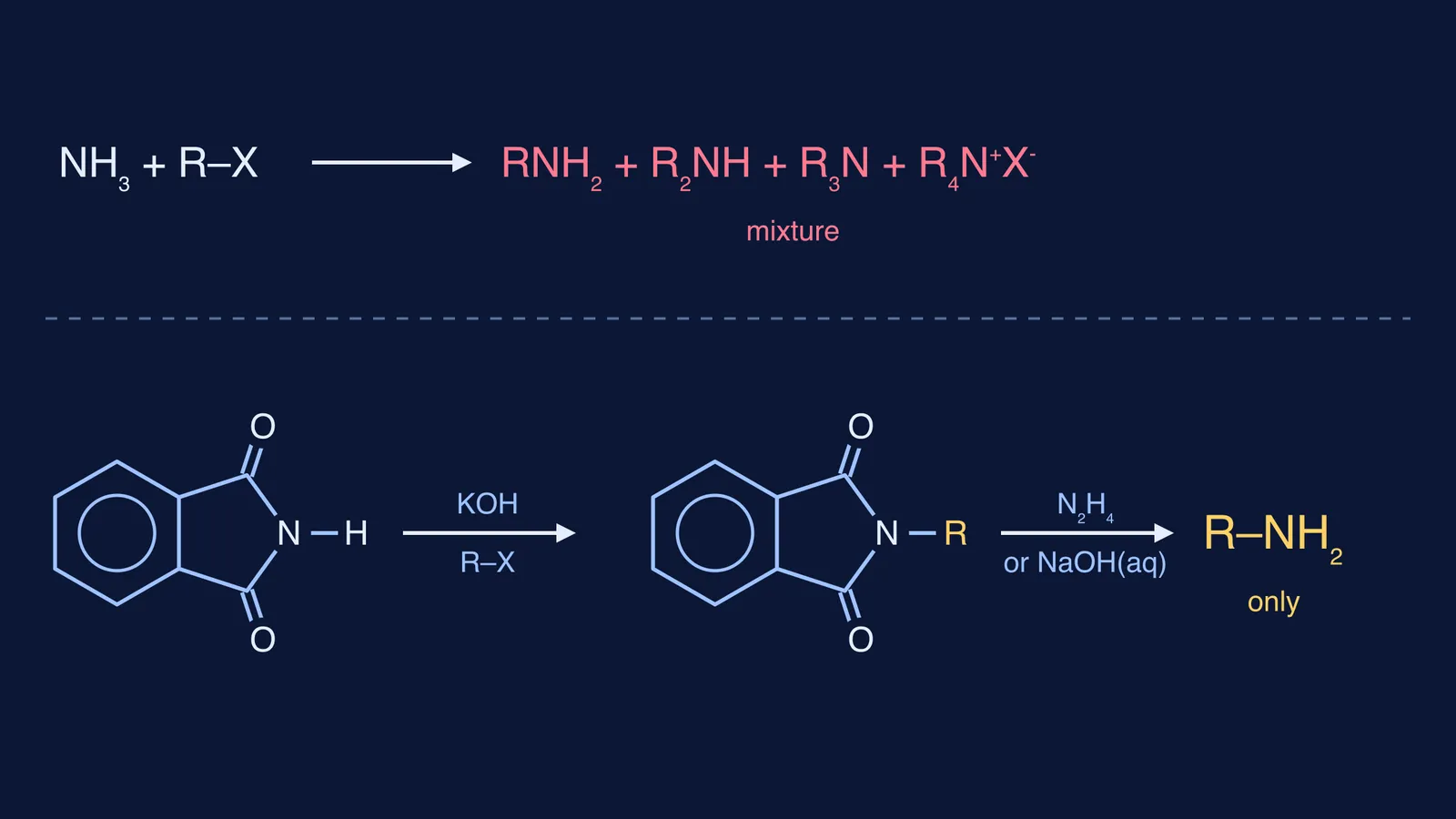
The NCERT Class 12 Amines chapter (Unit 9) describes ammonolysis: an alkyl halide reacts with ethanolic ammonia in a sealed tube at 373 K, and the halogen is replaced by an –NH2 group. The trouble is what happens next. The primary amine formed is itself a nucleophile, so it attacks more alkyl halide to give a secondary amine. That gives a tertiary amine, and finally a quaternary ammonium salt.
NCERT says it plainly: ammonolysis has the disadvantage of yielding a mixture of primary, secondary and tertiary amines and a quaternary ammonium salt. A large excess of ammonia makes the primary amine the major product, but it is not the only one. Our explainer on why ammonolysis of alkyl halides gives a mixture of amines goes through each step.
How does the Gabriel phthalimide synthesis work?
Gabriel's idea was to give the alkyl group a nitrogen that can bond to only one carbon. Phthalimide has a single N–H, held between two C=O groups. The steps, as the NCERT chapter gives them:
Treat phthalimide with ethanolic potassium hydroxide. This removes the N–H proton and gives potassium phthalimide.
Heat the salt with an alkyl halide, R–X. The phthalimide anion replaces the halogen, giving N-alkylphthalimide.
Hydrolyse with aqueous alkali. This releases the primary amine, R–NH2, and leaves sodium phthalate behind.
Step 1 works with KOH because the two carbonyl groups spread the anion's negative charge, making this N–H unusually acidic. Master Organic Chemistry puts its pKa at 8.3.
Why does it stop after one alkyl group? Once the alkyl group is on, the nitrogen has no hydrogen left and is still flanked by two electron-withdrawing carbonyls. It is a poor nucleophile, so it does not react again. The Gabriel synthesis article on Wikipedia describes the phthalimide anion as a stand-in for H2N– here. The same pull on the lone pair explains why amides are less basic than amines.
The callout draws on Ing and Manske's paper, "A modification of the Gabriel synthesis of amines", and the Wikipedia article, which notes that separating the phthalhydrazide can itself be awkward. By 1968 the method had enough variations for a full review in Angewandte Chemie, Gibson and Bradshaw's "The Gabriel synthesis of primary amines".
What can't the Gabriel synthesis make?
Step 2 is a nucleophilic substitution, so the reaction is only as good as that step.
No aromatic amines. Aniline cannot be made this way, because aryl halides do not undergo nucleophilic substitution with the phthalimide anion (NCERT).
Secondary halides usually fail. The substitution is SN2, and it generally does not work with secondary alkyl halides unless they are especially reactive (Wikipedia).
Primary amines only. By design, it cannot give a secondary or tertiary amine.
Which amine method should you pick in an exam?
Count the carbons before you choose a reagent. All four routes below are in the NCERT Amines chapter:
Same number of carbons as the alkyl halide, pure primary amine: Gabriel phthalimide synthesis.
One carbon more: NaCN to a nitrile, then reduce it (H2/Ni or LiAlH4).
One carbon fewer, starting from an amide: Hofmann bromamide degradation. Our guide to Hofmann bromamide degradation explains where the carbon goes.
An aromatic amine such as aniline: reduce the nitro compound (Sn/HCl or Fe/HCl).
Worked example: convert 1-bromobutane into butan-1-amine. Both have four carbons and the product is primary, so use Gabriel. Heat potassium phthalimide with CH3CH2CH2CH2Br to get N-butylphthalimide, then hydrolyse it with NaOH(aq) to get CH3CH2CH2CH2NH2. If you had used ammonia, your answer would also have to account for dibutylamine, tributylamine and the quaternary salt.
If you keep picking the wrong route, work a few conversions in the Fermi Problem Library. Its step-by-step solver explains the reasoning rather than printing an answer. For the background on nucleophiles and leaving groups, see the Fermi Concept Library.