

On this page
What is the ammonolysis of alkyl halides?
When an alkyl halide reacts with an ethanolic solution of ammonia inside a sealed glass tube heated to 373 K (100 °C), the carbon-halogen bond breaks under nucleophilic attack. This cleavage of the carbon-halogen bond by ammonia is called ammonolysis, a foundational reaction documented in the NCERT Class 12 Chemistry textbook (Part II, Amines). Because the nitrogen atom in ammonia carries an unshared electron pair, it acts as a nucleophile, displacing the halide leaving group through bimolecular nucleophilic substitution (S_N2) on primary haloalkanes.
The initial displacement yields a primary alkylammonium salt. When ammonia or a base deprotonates this salt, it liberates the primary amine:
R-X + NH₃ → [R-NH₃]⁺X⁻
[R-NH₃]⁺X⁻ + NH₃ ⇌ R-NH₂ + [NH₄]⁺X⁻
The halide leaving group determines how easily the initial substitution proceeds. Across haloalkanes, experimental reactivity follows the bond-energy hierarchy R-I > R-Br > R-Cl, because the carbon-iodine bond has the lowest bond dissociation enthalpy and iodide forms the most stable leaving group.
Why does ammonolysis produce a mixture of amines?
German chemist August Wilhelm von Hofmann demonstrated in his 1850 study in the Philosophical Transactions of the Royal Society that reacting alkyl iodides with ammonia does not halt at the primary amine. Instead, the reaction forms a mixture of primary (1°), secondary (2°), and tertiary (3°) amines, alongside a quaternary (4°) ammonium salt.
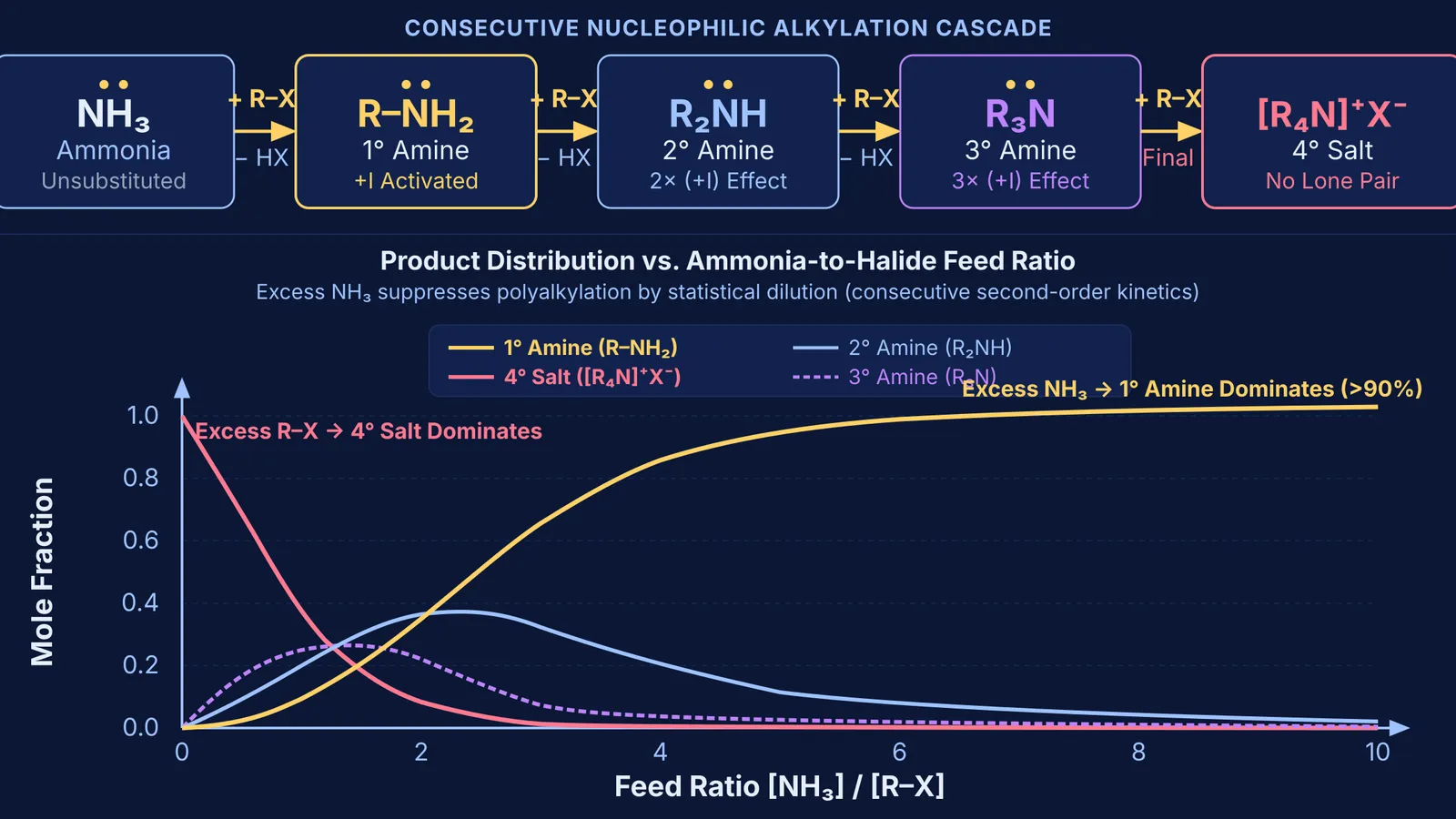
The core reason is nucleophilic competition. The primary amine (R-NH₂) produced in the opening step retains an unshared lone pair on its nitrogen atom. Even more decisively, the attached alkyl group pushes electron density toward nitrogen through the positive inductive (+I) effect. This increased electron density makes the nitrogen atom in the newly formed primary amine even more nucleophilic than ammonia itself. Consequently, the primary amine attacks remaining alkyl halide molecules faster than ammonia can:
R-NH₂ + R-X → [R₂NH₂]⁺X⁻ (yielding secondary amine R₂NH upon deprotonation)
R₂NH + R-X → [R₃NH]⁺X⁻ (yielding tertiary amine R₃N upon deprotonation)
R₃N + R-X → [R₄N]⁺X⁻ (forming the stable quaternary ammonium salt)
Because the secondary amine carries two electron-donating alkyl groups and the tertiary amine carries three, both remain strong nucleophiles. Alkylation only terminates when all four valence positions around nitrogen are bonded to carbon atoms, forming a tetraalkylammonium cation that carries a formal positive charge, lacks an unshared electron pair, and cannot attack further.
How does excess ammonia favour the primary amine?
Because each amine product is a competing nucleophile, controlling the reaction comes down to collision statistics. In a kinetic investigation of nucleophilic substitution in liquid ammonia published in Faraday Discussions, Pengju Ji, John H. Atherton, and Michael I. Page showed that substitution by ammonia follows a bimolecular pathway with activation energies near 40.3 to 43.8 kJ·mol⁻¹. When ammonia is present in massive stoichiometric excess, entering alkyl halide molecules are surrounded almost entirely by ammonia molecules rather than newly formed amine molecules.
Collision frequency with ammonia overwhelms the rate of subsequent alkylation steps, suppressing secondary and tertiary products and making the primary amine the dominant major product. Conversely, adjusting the reactant ratios changes the outcome entirely:
Large excess of ammonia: Suppresses polyalkylation by statistical dilution, making the primary amine (R-NH₂) the dominant product.
Equimolar mixture: Yields an intractable four-component cocktail of 1°, 2°, and 3° amines alongside quaternary ammonium halides.
Large excess of alkyl halide: Forces exhaustive alkylation, converting virtually all nitrogen into the quaternary ammonium salt ([R₄N]⁺X⁻).
When mapping reaction pathways or closing concept gaps around nucleophilic substitution, the Fermi Concept Library covers every concept in physics, chemistry, biology, mathematics and computing, each with its own lesson and its place in the map.
How do chemists separate or avoid the amine mixture?
Because primary, secondary, and tertiary amines formed from the same alkyl halide share similar boiling ranges and polarities, separating an ammonolysis mixture by fractional distillation is notoriously inefficient. Chemists instead use chemical separation or bypass ammonolysis altogether:
Chemical separation via benzenesulfonyl chloride: You can resolve the mixture using Hinsberg's reagent to separate amines, because primary amine sulfonamides dissolve in aqueous alkali, secondary amine sulfonamides remain insoluble precipitates, and tertiary amines do not react.
Gabriel phthalimide synthesis: Using potassium phthalimide guarantees monoalkylation, making Gabriel phthalimide synthesis ideal for pure primary amines without generating secondary or tertiary by-products.
Hofmann bromamide degradation: Heating an unsubstituted amide with bromine and alkali triggers molecular rearrangement, using Hofmann bromamide degradation to yield a primary amine containing one fewer carbon atom.
Nitrile and amide reduction: Catalytic or hydride reduction (using lithium aluminium hydride or hydrogen with nickel) converts alkyl cyanides and amides cleanly into primary amines.
If you find yourself stuck on multi-step synthesis numericals or product-distribution questions, the Fermi Problem Library offers worked problems with a step-by-step solver that explains the reasoning rather than printing an answer.
Mastering ammonolysis comes down to seeing how collision probability and electronic effects compete in the reaction flask.


