

On this page
Methylamine and acetamide (ethanamide) both have a nitrogen with a lone pair, yet only one behaves like a real base. The difference is one idea from resonance, and it answers a whole family of basicity questions in CBSE boards and JEE Main.
What makes a nitrogen compound basic?
A Brønsted base accepts a proton, and in amines and amides the proton lands on the nitrogen lone pair. So "how basic is it?" really means "how available is that lone pair?"
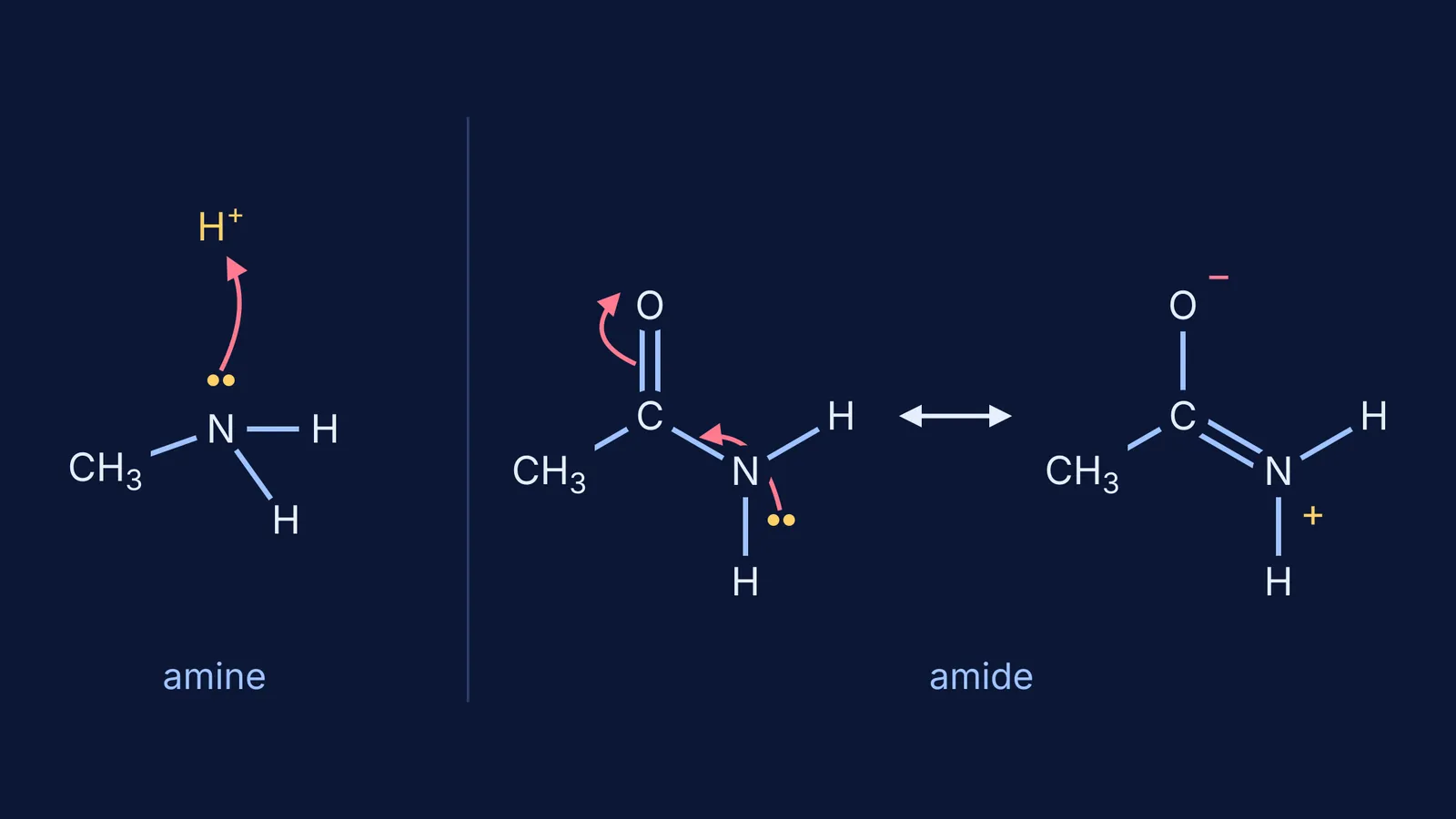
In an amine such as methylamine, CH3NH2, the lone pair stays on nitrogen. The LibreTexts chapter on the basicity of amines/24%3A_Amines_and_Heterocycles/24.03%3A_Basicity_of_Amines) says it plainly: the lone pair of an amine nitrogen "is localized in one place". That pair is ready to bond to H+.
Why are amides less basic than amines?
In an amide, the nitrogen is bonded to a carbonyl carbon (C=O). The nitrogen lone pair sits right next to the C=O π bond, so it can spread into it. Draw it with curly arrows: the lone pair moves in to make a C=N double bond, and the C=O π electrons move out onto oxygen. That gives a second resonance structure with O− and N+ (the diagram at the top shows both).
The real amide is a hybrid of the two structures, so the lone pair is shared across nitrogen, carbon and oxygen. The same LibreTexts chapter/24%3A_Amines_and_Heterocycles/24.03%3A_Basicity_of_Amines) explains that these two electrons are "too stable being part of the delocalized pi-bonding system" to bond easily with a proton.
There is a second cost: protonating the nitrogen would lock the lone pair into an N–H bond and wipe out the amide's resonance stabilisation, as Roberts and Caserio's chapter on amides/24%3A_Organonitrogen_Compounds_II_-_Amides_Nitriles_and_Nitro_Compounds/24.02%3A_Amides_as_Acids_and_Bases) explains.
You can see the delocalisation in the molecule's shape. The amine nitrogen is pyramidal, but the three bonds on an amide nitrogen are planar, as the Wikipedia article on amides notes. The C–N bond gains partial double-bond character, so turning about it is slow: the energy barrier is roughly 80 kJ/mol, according to the Wikipedia article on the peptide bond. This is the same reason the peptide bond in proteins is planar.
How much less basic is an amide?
Chemists compare bases using the pKa of the conjugate acid: the higher the pKa, the stronger the base.
Methylammonium ion, CH3NH3+: pKa 10.66 (LibreTexts/24%3A_Amines_and_Heterocycles/24.03%3A_Basicity_of_Amines)).
Ammonium ion, NH4+: pKa 9.3 (same source).
Protonated ethanamide: Ka about 10, so pKa about −1, with Kb of ethanamide about 10^−15 (Roberts and Caserio/24%3A_Organonitrogen_Compounds_II_-_Amides_Nitriles_and_Nitro_Compounds/24.02%3A_Amides_as_Acids_and_Bases)).
Going from 10.66 down to about −1 is a drop of more than 11 pKa units. Each unit is a factor of ten, so methylamine is a stronger base than acetamide by a factor of more than 10^11. Roberts and Caserio add that amides are too weakly basic to be protonated to any extent in water.
Where does an amide get protonated?
In strong acid, an amide does pick up a proton, but on the carbonyl oxygen, because the cation formed is resonance stabilised, as a LibreTexts page on relative basicity explains. Putting the proton on nitrogen would destroy the resonance, so oxygen wins.
How do you answer this in a board or JEE exam?
Worked example: arrange CH3CONH2, CH3NH2 and NH3 in decreasing order of basicity.
Find the lone pair on each nitrogen.
Ask whether it is localised or delocalised. In CH3NH2 and NH3 it is localised; in CH3CONH2 it is delocalised into C=O.
Compare the localised ones by electron push. The methyl group donates electron density (+I effect), so CH3NH2 beats NH3, which matches the conjugate-acid pKa values of 10.66 against 9.3 in the LibreTexts basicity table/24%3A_Amines_and_Heterocycles/24.03%3A_Basicity_of_Amines).
Put the delocalised one last.
Answer: CH3NH2 > NH3 > CH3CONH2.
For a two-mark "give reason" question, this script works: "In amides, the lone pair on nitrogen is delocalised onto the carbonyl oxygen by resonance (draw both structures). It is less available to accept a proton, so amides are much weaker bases than amines, where the lone pair is localised on nitrogen."
Before you write "more basic" in any comparison, run this checklist:
Is the lone pair conjugated with a C=O, a benzene ring or another π bond?
Is the nitrogen sp3 or sp2? See how hybridisation changes nitrogen basicity.
Are there electron-donating or electron-withdrawing groups nearby?
Is the lone pair one bond away from the ring or two? That is why benzylamine is more basic than aniline.
If resonance arrows still feel like guesswork, the Fermi Concept Library has a lesson for every concept in chemistry, each with its place in the map, so you can go back to resonance before returning to basicity. To practise ranking questions, the Fermi Problem Library has worked problems with a step-by-step solver that explains the reasoning rather than printing an answer.


