

On this page
In Lewis acid-base chemistry, a base acts as an electron-pair donor. Its strength reflects how readily the unshared pair of electrons on nitrogen can be shared with an electron-deficient proton. When comparing neutral nitrogen compounds such as alkylamines, imines, and nitriles, the decisive factor is the hybridisation of the orbital that houses the lone pair.
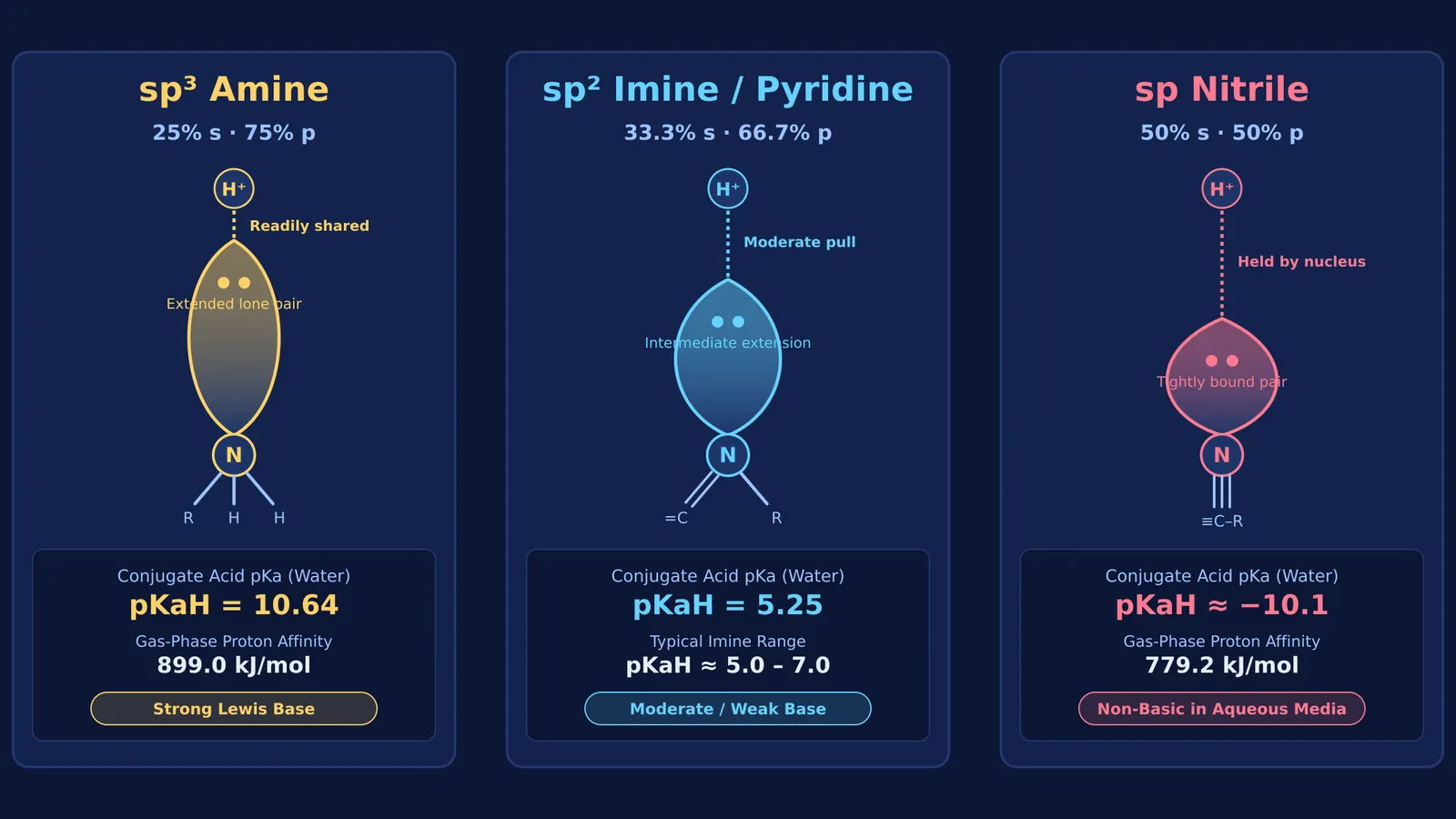
Atomic s-orbitals are spherical, penetrating, and hold electron density closer to the positively charged nucleus than p-orbitals. In 1961, chemist Henry A. Bent published his foundational analysis of hybridisation in Chemical Reviews, showing how orbital character dictates electron distribution. When atomic s and p orbitals hybridise, the fraction of s-character sets the effective electronegativity of that hybrid orbital. A nitrogen atom with an sp³ hybrid orbital contains 25% s-character and 75% p-character. An sp² hybrid orbital contains 33.3% s-character, and an sp hybrid orbital contains 50% s-character.
Jurgen Hinze and H. H. Jaffé demonstrated in the Journal of the American Chemical Society that orbital electronegativity rises directly with increasing s-character. As the s-character increases from 25% to 50%, the nitrogen nucleus pulls the lone-pair electron cloud closer to itself. The more tightly held these electrons are, the less available they are to coordinate with an incoming proton, resulting in lower basicity.
The Fermi Concept Library provides lessons on every concept in chemistry, mapping orbital geometry directly to reaction mechanisms and base strengths.
Why is an sp³ amine more basic than an sp² imine or pyridine?
In an aliphatic amine such as methylamine or ethylamine, nitrogen is sp³ hybridised. With only 25% s-character, the sp³ hybrid orbital is relatively elongated and diffuse, as described in OpenStax Organic Chemistry. The nitrogen lone pair sits farther from the nucleus, making it readily available for donation to an electrophilic species.
When nitrogen forms a double bond, as in an imine (R₂C=NR) or in aromatic pyridine (C₅H₅N), the nitrogen atom adopts sp² hybridisation. Here, the lone pair occupies an sp² hybrid orbital with 33.3% s-character. Because the electron density is concentrated closer to the nitrogen core, the lone pair experiences a stronger electrostatic attraction from the nucleus.
Chemists compare base strengths using the pKa of the conjugate acid, termed pKaH. In standard aqueous compilations from OpenStax Organic Chemistry, the conjugate acid of methylamine (CH₃NH₃⁺) has a pKaH of 10.64 in water. By contrast, the pyridinium ion (C₅H₅NH⁺) has a pKaH of 5.25, while typical aliphatic iminium ions have pKaH values between 5.0 and 7.0. Because each drop of one pKa unit corresponds to a 10-fold decrease in base strength, methylamine is more than 100000 times more basic than pyridine in aqueous solution. Complementary equilibrium measurements by Frederick G. Bordwell in Accounts of Chemical Research demonstrate that this hybridisation-driven gap persists across non-aqueous solvents like dimethyl sulfoxide. Understanding these logarithmic shifts is essential when examining conjugate acid-base pairs across equilibrium reactions.
Why are sp nitriles barely basic in water?
Nitriles such as acetonitrile (CH₃C≡N) feature an sp-hybridised nitrogen atom triple-bonded to carbon. In this arrangement, the unshared lone pair resides in an sp hybrid orbital possessing 50% s-character. The high s-character holds the electron pair tightly bound to the nitrogen nucleus.
In aqueous solution, the conjugate acid of acetonitrile—the acetonitrilium ion (CH₃CNH⁺)—has an estimated pKaH of approximately −10.1, as documented in compilation studies of weak organic bases by Edward M. Arnett in Progress in Physical Organic Chemistry. A negative pKaH indicates that the protonated form is an exceptionally strong acid, meaning neutral acetonitrile is an extremely weak base that will not accept protons in neutral or mildly acidic water.
Gas-phase measurements confirm that this effect is an intrinsic property of the orbital rather than an artifact of solvation. In a comprehensive thermodynamic evaluation published in the Journal of Physical and Chemical Reference Data, Edward P. L. Hunter and Sharon G. Lias recorded the intrinsic proton affinities of neutral nitrogen molecules. Unsubstituted ammonia (sp³) has a proton affinity of 853.6 kJ/mol, and methylamine (sp³) reaches 899.0 kJ/mol. In contrast, acetonitrile (sp) has a proton affinity of only 779.2 kJ/mol. The 119.8 kJ/mol difference between methylamine and acetonitrile illustrates how tightly the sp orbital confines its electrons.
How do you rank nitrogen basicity in JEE and NEET questions?
Competitive examination questions in JEE Main, JEE Advanced, and NEET-UG frequently ask students to order nitrogen-containing organic compounds by basic strength. To avoid common traps and benchmark values against compilations in OpenStax Organic Chemistry, apply this four-step diagnostic protocol:
Determine the hybridisation of each nitrogen atom: Check whether the unshared lone pair resides in an sp³ orbital (amines), an sp² orbital (imines, pyridine), or an sp orbital (nitriles).
Check for resonance delocalisation: Distinguish localised lone pairs from those involved in aromaticity or conjugation. In pyrrole, the nitrogen lone pair contributes 2 pi electrons to complete the 6-pi aromatic sextet (leaving conjugate acid pKaH at 0.4), making it even less basic than pyridine despite formally having sp²-like character. In aniline, resonance delocalises the lone pair into the aromatic ring, reducing basicity to a pKaH of 4.63.
Compare inductive and steric effects: Among aliphatic sp³ amines, alkyl groups donate electron density through the +I inductive effect, raising basicity above ammonia. If you are distinguishing primary from secondary amines produced via Hofmann bromamide degradation or testing them with Hinsberg's reagent, remember that secondary amines exhibit the highest basicity in water due to balanced hydration and inductive stabilization.
Assemble the overall hierarchy: The baseline basicity trend is aliphatic sp³ amines > aromatic sp² amines and imines > sp nitriles. For example, pyrrolidine (sp³, pKaH = 11.27) > pyridine (sp², pKaH = 5.25) > aniline (sp² resonance-delocalised, pKaH = 4.63) > acetonitrile (sp, pKaH ≈ −10.1).
When tackling complex problems, the Fermi Problem Library offers worked problems with a step-by-step solver that explains the reasoning rather than printing an answer.


