

On this page
Benzylamine (C6H5CH2NH2) and aniline (C6H5NH2) look almost the same on paper. Both have a benzene ring and an NH2 group. Yet one is a reasonable base and the other is a very weak one, and the whole difference comes down to one CH2 group.
What makes an amine basic in the first place?
An amine is basic because the nitrogen has an unshared pair of electrons that it can use to accept a proton. The NCERT Class 12 Amines chapter puts it this way: the basic character of an amine depends on how easily it forms a cation by accepting a proton, and the more stable that cation is compared with the amine, the more basic the amine (NCERT Chemistry Part II, Unit 9).
We measure this with pKb. A smaller pKb means a stronger base, and every 1 unit of pKb is a factor of 10 in Kb.
Why is aniline such a weak base?
In aniline the NH2 group is bonded directly to a carbon of the benzene ring. NCERT explains that this puts the nitrogen's unshared pair in conjugation with the ring, which makes it less available for protonation (NCERT Chemistry Part II, Unit 9).
You can see this in the resonance structures. Free aniline has five resonance structures, in three of which the lone pair has moved into the ring. Once aniline takes a proton, the nitrogen has no lone pair left to share, and the anilinium ion has only the two Kekulé structures, according to the same chapter. Protonation costs aniline its extra resonance stabilisation, so it resists taking the proton.
Why is benzylamine more basic than aniline?
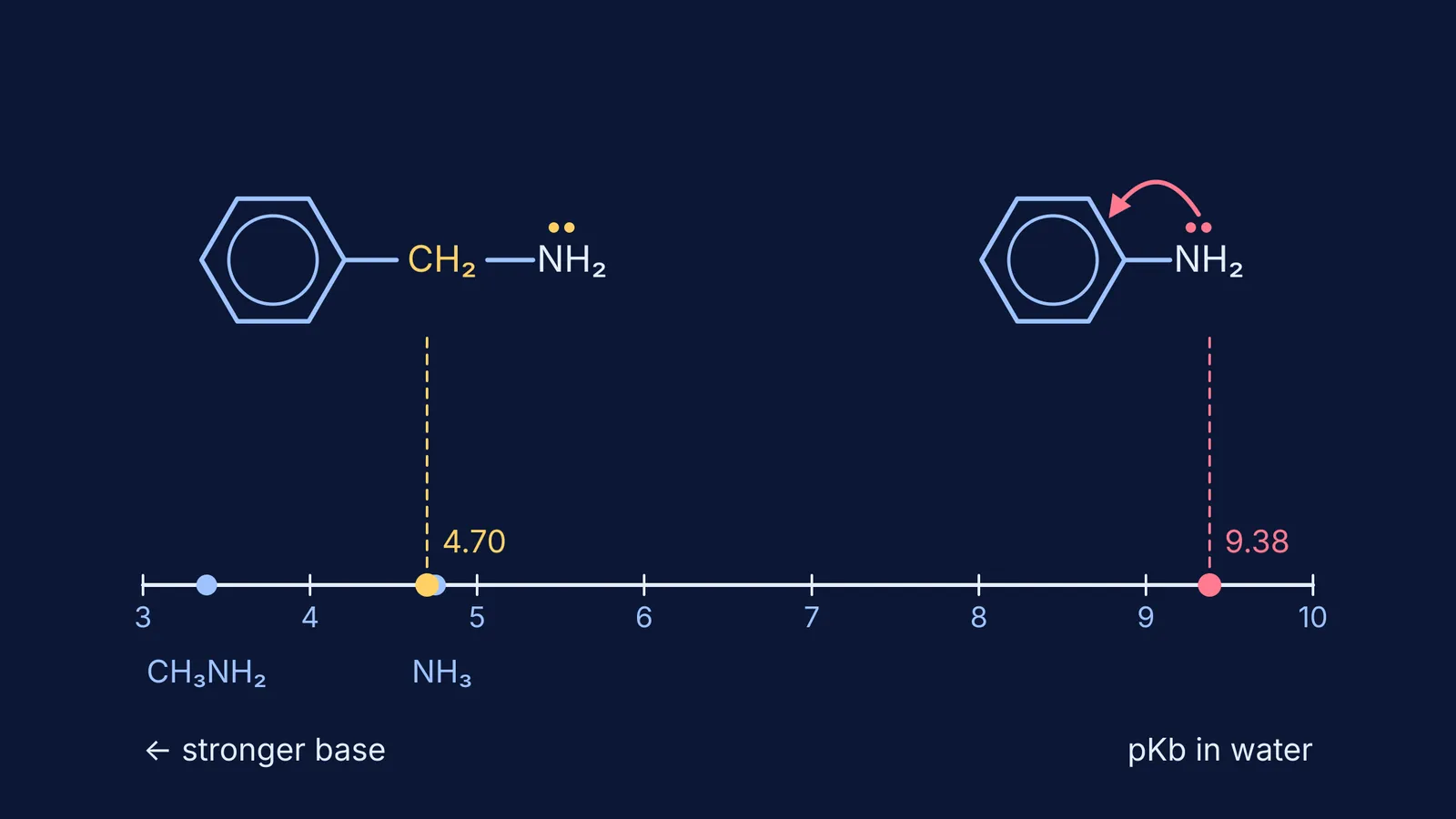
In benzylamine a CH2 group sits between the ring and the nitrogen. That CH2 carbon is sp3, with no p orbital to pass electrons along, so it cuts the nitrogen off from the ring's pi system. The lone pair cannot be delocalised into the ring. It stays on nitrogen, free to take a proton, and nothing is lost when it does.
NCERT's Table 9.3 lists pKb 9.38 for benzenamine (aniline) and pKb 4.70 for phenylmethanamine (benzylamine) in water (NCERT Chemistry Part II, Unit 9).
The gap is 9.38 minus 4.70, which is 4.68 pKb units. Since each unit is a factor of 10, benzylamine's Kb is about 10^4.68, or roughly 48,000 times larger than aniline's.
Independent data agree. PubChem records a pKa of 9.33 for the conjugate acid of benzylamine and 4.6 for the conjugate acid of aniline. With pKa + pKb = 14 at 25 °C, these give pKb values of about 4.7 and 9.4, matching the textbook.
Is benzylamine as basic as methylamine?
No, and this is where many students overshoot. NCERT gives pKb 3.38 for methanamine and 4.75 for ammonia (NCERT Chemistry Part II, Unit 9). Benzylamine, at 4.70, sits almost exactly at ammonia's level, well behind methylamine.
The reason is induction. The phenyl ring is made of sp2 carbons, which pull electron density slightly through sigma bonds. That pull passes through the CH2 to the nitrogen, but it is weak and falls off with distance (see our explainer on why the inductive effect fades with distance). So benzylamine loses a little basicity to induction, while aniline loses a lot to resonance.
How do you rank these bases in an exam?
Use this three-question check on any nitrogen base:
Is the lone pair part of an aromatic ring or in conjugation with a ring, C=C or C=O? If yes, expect a weak base.
Is the lone pair in an sp3, sp2 or sp orbital? More s character holds it tighter; our post on basicity and nitrogen hybridisation walks through this.
Are there electron-donating or electron-withdrawing groups nearby, and how far away are they?
Worked example: rank CH3NH2, C6H5CH2NH2, NH3 and C6H5NH2 from strongest to weakest base in water.
Aniline fails question 1: its lone pair is delocalised. It goes last.
Methylamine has a donating CH3 group and no resonance. It goes first.
Benzylamine and ammonia both have free sp3 lone pairs, and their pKb values are almost equal.
Answer: CH3NH2 > C6H5CH2NH2 ≈ NH3 > C6H5NH2, which matches NCERT's pKb values of 3.38, 4.70, 4.75 and 9.38 from the chapter linked above. If a question forces a choice, the values put benzylamine just ahead of ammonia, but the gap is tiny.
The same idea explains why amines dissolve in dilute HCl and how that separates aniline from neutral compounds.
If resonance and induction still feel like two words for the same thing, the Fermi Concept Library gives each concept in chemistry its own lesson and its place in the map. To test yourself on ranking questions like the one above, the Fermi Problem Library has worked problems with a step-by-step solver that explains the reasoning rather than printing an answer.


