

On this page
Shake aniline with water and you get a cloudy, oily mixture. Add dilute hydrochloric acid and the oil disappears. The aniline has turned into a salt, and you can get it back. That reaction sits behind a classic Class 12 and JEE question: how do you separate aniline from nitrobenzene or phenol?
Why do amines dissolve in dilute hydrochloric acid?
The nitrogen atom in an amine carries an unshared pair of electrons, and that lone pair can accept a proton (H⁺) from an acid. The NCERT Class 12 Chemistry unit on amines states it directly: amines, being basic in nature, react with acids to form salts. With aniline the salt is anilinium chloride:
C₆H₅NH₂ + HCl → C₆H₅NH₃⁺ Cl⁻
Neutral aniline is mostly a water-repelling benzene ring. The salt is made of ions, and water clusters tightly around ions.
Aniline dissolves 3.4 g per 100 mL of water at 20 °C, according to its ILO-WHO International Chemical Safety Card.
Aniline hydrochloride dissolves 107 g per 100 mL of water at 20 °C, according to its own ILO-WHO card.
The same NCERT unit adds the two facts that make separation possible: amine salts are soluble in water but insoluble in organic solvents like ether, and treating them with a base like NaOH regenerates the parent amine.
How completely does aniline turn into its salt?
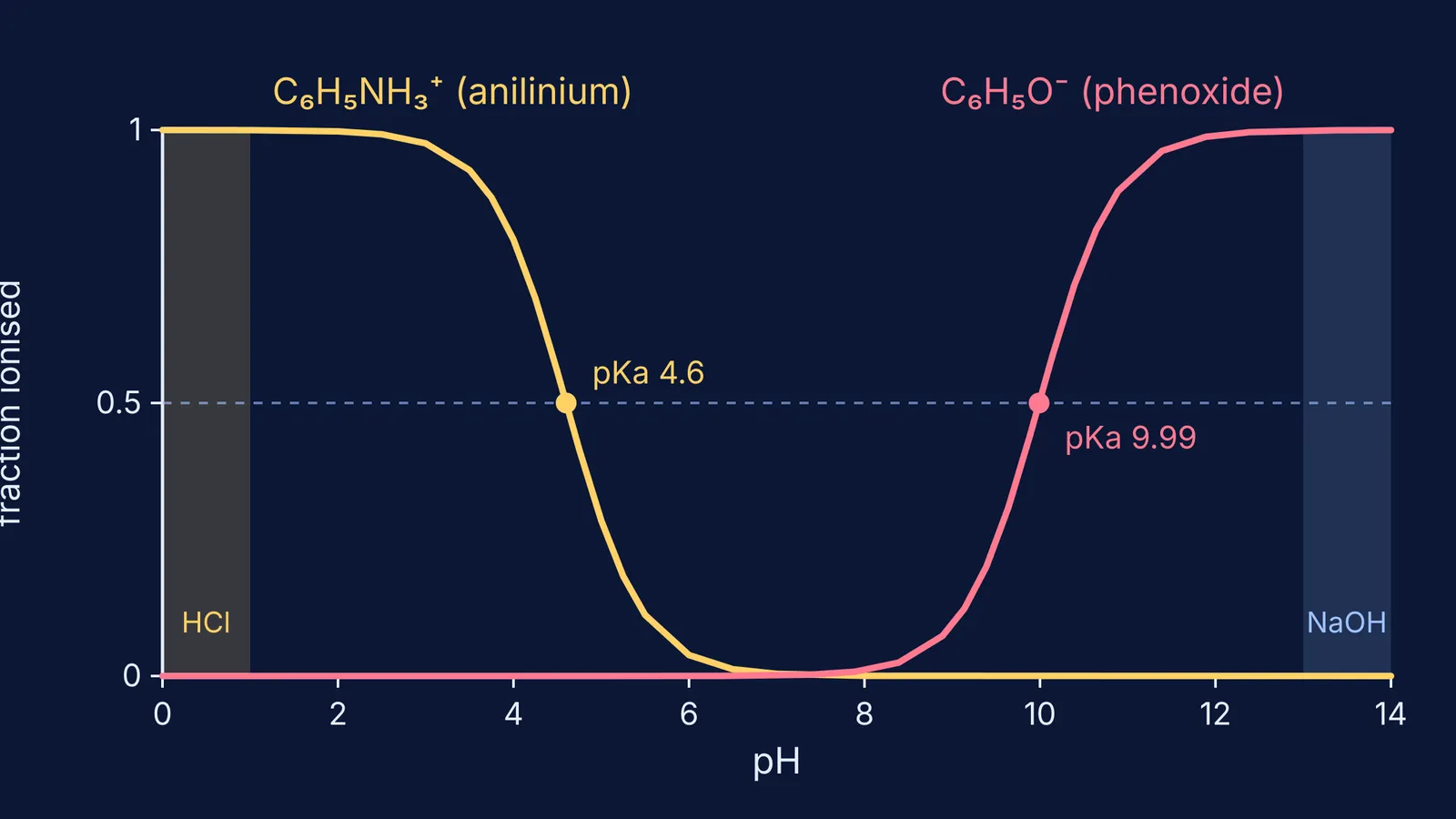
Aniline is a weak base. The pKa of its conjugate acid, the anilinium ion, is 4.6 at 25 °C (PubChem, citing Perrin's tables of dissociation constants). That number tells you how much aniline is protonated at any pH:
anilinium : aniline = 10^(pKa − pH)
In 0.1 M HCl the pH is about 1, so the ratio is 10^(4.6 − 1) = 10^3.6, roughly 4,000 to 1. More than 99.9% of the aniline is in the ionic, water-soluble form.
After you add NaOH to reach pH 13, the ratio is 10^(4.6 − 13) = 10^−8.4. Practically all of it is free aniline again, and it separates as oily drops.
The graph at the top of this post plots that curve.
Why do nitrobenzene and phenol stay behind?
Nitrobenzene also contains nitrogen, but that nitrogen is bonded to two oxygen atoms in the nitro group and has no free lone pair to offer a proton. It forms no salt with dilute HCl and stays a barely soluble liquid: 0.2 g per 100 mL of water, according to its ILO-WHO safety card. If you want the deeper reason some nitrogens are basic and others are not, read why sp³ amines are more basic than imines and nitriles.
Phenol is the opposite of a base. Its –OH group gives up a proton, with a pKa of 9.99 at 25 °C (PubChem, citing the CRC Handbook), so dilute acid has nothing to react with. Phenol dissolves in sodium hydroxide as sodium phenoxide, not in HCl. That is why the graph's two curves rise at opposite ends of the pH scale.
How do you separate aniline from nitrobenzene or phenol, step by step?
The method is the same for both mixtures. Do it only in a supervised school or college lab: aniline, nitrobenzene and phenol are all hazardous, and the safety cards linked above list the precautions.
Dissolve the mixture in ether and pour it into a separating funnel.
Add dilute HCl, stopper, shake gently and vent. Aniline becomes anilinium chloride and moves into the watery layer.
Run off the aqueous layer into a beaker. The ether layer keeps the nitrobenzene or phenol; evaporating the ether recovers it.
Add NaOH solution to the aqueous layer until it is basic. Free aniline separates as oily drops.
Extract the aniline into fresh ether, then evaporate the ether.
With phenol you can also start with NaOH, which pulls phenol out as sodium phenoxide. Our walkthrough on separating benzoic acid, phenol, aniline and toluene by extraction extends the same logic to four compounds. To confirm what you recovered, use the azo dye test for aromatic primary amines.
What should you write in a board or JEE answer?
These four sentences cover the usual marking points:
Aniline is basic because of the lone pair on nitrogen.
With dilute HCl it forms anilinium chloride, C₆H₅NH₃⁺Cl⁻, which is ionic, soluble in water and insoluble in ether.
Nitrobenzene (no available lone pair) or phenol (acidic) does not react and stays in the ether layer.
The aqueous layer is made basic with NaOH to regenerate aniline.
And three slips that cost marks:
Writing chlorobenzene as the product. HCl protonates the nitrogen; it does not replace the –NH₂ group.
Calling nitrobenzene basic because it contains nitrogen.
Stopping before the NaOH step, so the answer never gets aniline back.
If the acid-base idea underneath still feels shaky, the Fermi Concept Library gives every chemistry concept its own lesson and its place in the map, so you can revisit basicity before the next separation question. When you practise, the Fermi Problem Library has worked problems with a step-by-step solver that explains the reasoning rather than printing an answer.


