

On this page
Organic chemistry practicals often ask you to separate a mixture of organic compounds dissolved in a single solvent like ether. If you have benzoic acid, phenol, aniline, and toluene in one beaker, they look like an inseparable soup. But you can pull them apart one by one using a simple rule: converting a water-insoluble compound into a water-soluble salt.
Why do we use acid-base extraction?
Acids react with bases to form salts, and bases react with acids to form salts. While most neutral organic compounds dissolve perfectly in organic solvents (like ether), their ionic salts prefer to dissolve in water.
By controlling the pH of the aqueous washing liquid, we can selectively turn one specific compound into a salt, forcing it to move from the ether layer into the aqueous layer. The success of this separation depends entirely on their pKa values:
Benzoic acid is a strong organic acid (pKa 4.20).
Phenol is a much weaker acid (pKa 9.95).
Aniline is a weak base (the pKa of its conjugate acid is 4.60).
Toluene is a neutral hydrocarbon.
If you are doing equilibrium calculations on your extracts in the lab, you can easily find Ka from the pH of a weak acid solution.
How do you actually perform the extraction?
In the laboratory, this process is done using a piece of glassware called a separatory funnel. You pour the ether mixture into the funnel and add your first aqueous reagent.
When you stopper and shake the funnel, the two layers mix vigorously. This allows the acid-base reaction to happen at the boundary between the water droplets and the ether. (When using sodium bicarbonate, the reaction produces carbon dioxide gas, so you must frequently point the funnel up and open the stopcock to vent the pressure.)
Once mixed, you place the funnel on a ring stand and wait for the two liquids to separate. Ether has a lower density than water, so the organic layer floats on top, while the aqueous layer sinks to the bottom. You then simply open the tap to drain the bottom aqueous layer into a flask, leaving the ether behind for the next step.
Why extract benzoic acid with sodium bicarbonate first?
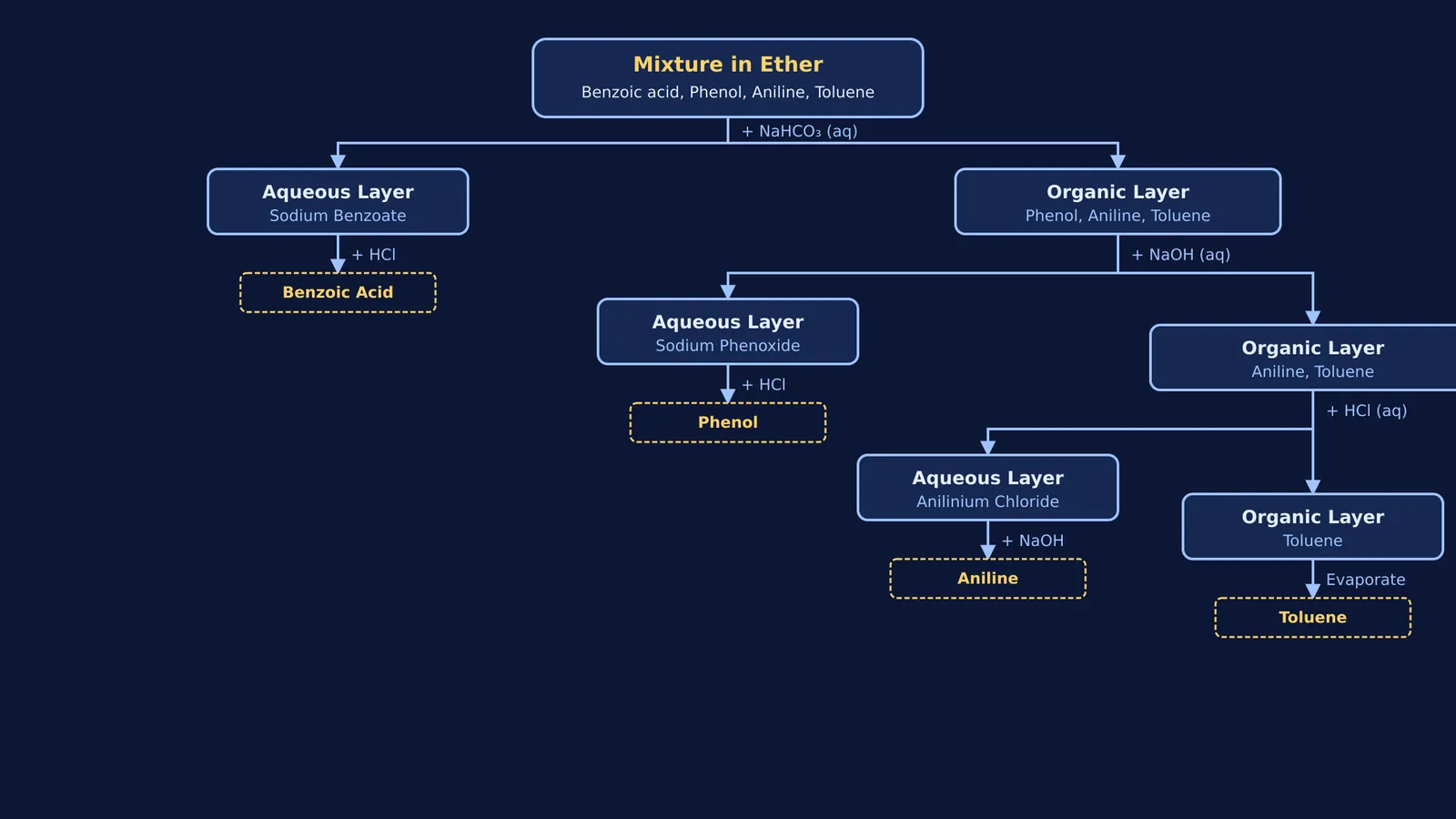
We start the separation with the weakest base: aqueous sodium bicarbonate (NaHCO₃). Carbonic acid has a pKa₁ of 6.35. Because benzoic acid is a stronger acid than carbonic acid, it reacts with sodium bicarbonate to form water-soluble sodium benzoate.
Phenol is too weak to react with bicarbonate, so it stays in the ether layer alongside aniline and toluene.
You drain the aqueous layer. To get your solid benzoic acid back, you simply add a strong acid like hydrochloric acid (HCl) to this aqueous extract until the free benzoic acid precipitates out as a white solid.
How does sodium hydroxide remove phenol?
Next, we treat the remaining organic layer with a strong base: sodium hydroxide (NaOH).
Phenol is a weak acid, but it is acidic enough to react with strong NaOH to form sodium phenoxide, which instantly dissolves into the new aqueous layer. Benzoic acid would also react with NaOH, which is why it was crucial to remove it in Step 1 first.
Aniline (a base) and toluene (neutral) do not react with the base and stay in the ether layer. You separate this aqueous layer and add HCl to it to regenerate the phenol. For a broader view of how these reagents work, see our guide on which compounds react with Na, NaOH and NaHCO3.
How do you isolate the aniline and toluene?
Now the organic layer only contains aniline and toluene. Aniline is a base. If we add a strong acid like dilute hydrochloric acid (HCl), it protonates the aniline to form anilinium chloride, a water-soluble ionic salt.
Toluene, being completely neutral, does not react with acids or bases and stays in the ether.
You drain the acidic aqueous layer containing the aniline salt. To recover the free aniline liquid, you add a strong base like NaOH to deprotonate it. This chemical logic is foundational for laboratory work and also helps when you use an AI to practice organic conversion questions.
Finally, you are left with just toluene in the ether. Because ether is highly volatile, you simply leave it in a fume hood or use a rotary evaporator to boil off the solvent, leaving the pure toluene behind.
If you struggle to remember the difference between strong and weak acids in organic chemistry, the Fermi Concept Library has every concept in physics, chemistry, biology, mathematics and computing, each with its own lesson and its place in the map. And if you regularly make wrong-method mistakes when predicting which layer contains which compound, the Fermi Problem Library has worked problems with a step-by-step solver that explains the reasoning rather than printing an answer.


