

On this page
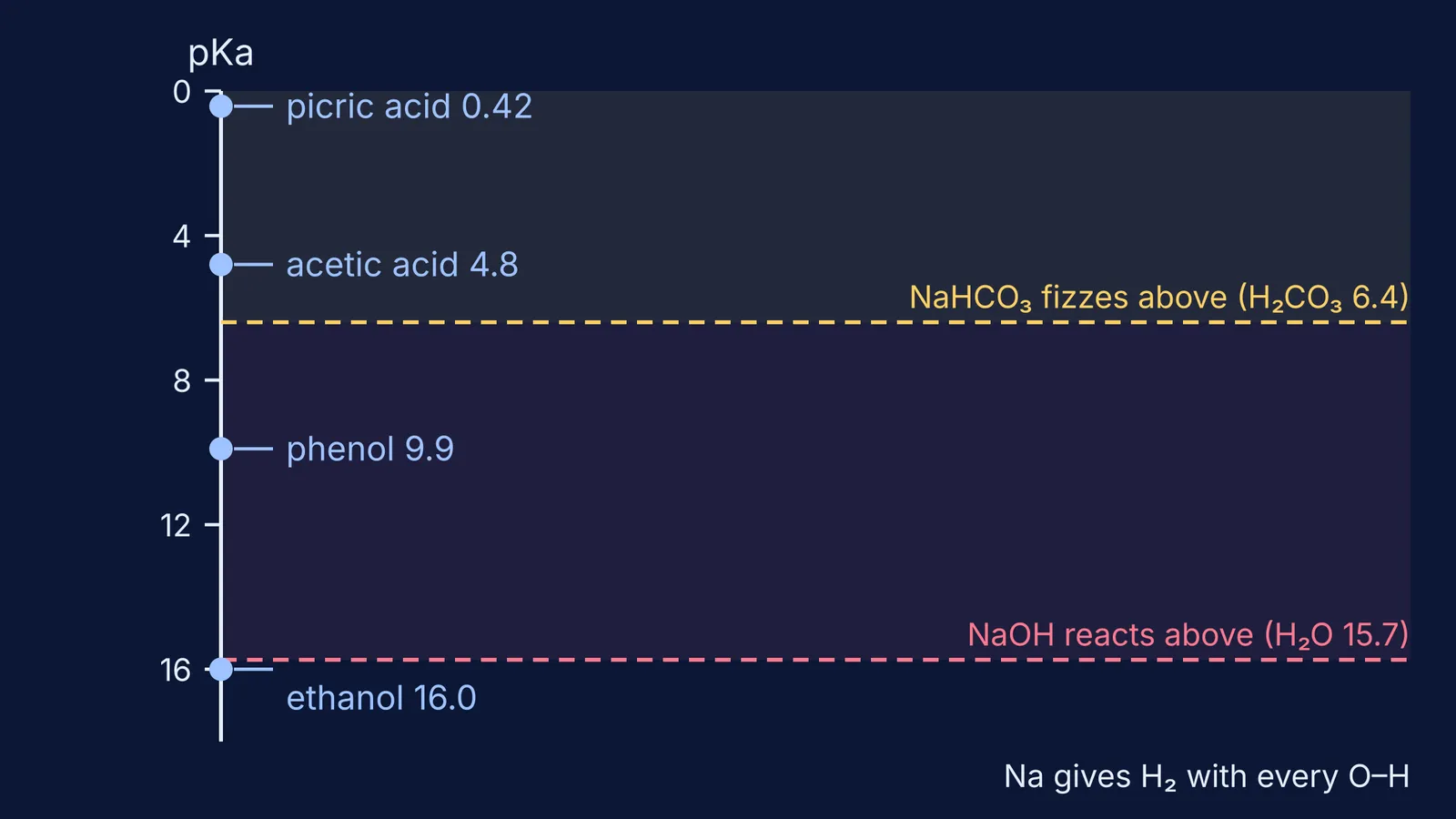
“Which of these reacts with sodium bicarbonate?” is a common Class 12 and JEE Main practice question, in many disguises. Instead of memorising a grid of ticks and crosses, put alcohols, phenols and carboxylic acids on one acidity ladder and read the answer off it.
Which compounds react with Na, NaOH and NaHCO3?
Here is the pattern for the three O–H families in Class 12 organic chemistry:
Sodium metal: alcohols, phenols and carboxylic acids all give hydrogen gas.
NaOH solution: phenols and carboxylic acids react to form sodium salts; simple alcohols do not react to any useful extent.
NaHCO3 solution: only carboxylic acids react, and they fizz as carbon dioxide is released.
Ethanol and sodium give hydrogen and sodium ethoxide (Chemguide on alcohols and sodium). Phenol gives sodium phenoxide with NaOH but no carbon dioxide with carbonate or hydrogencarbonate (Chemguide on phenol). Ethanoic acid fizzes with both (Chemguide on carboxylic acids).
Why does each reagent draw the line where it does?
One rule covers NaOH and NaHCO3: an acid hands its proton to a base when the acid is stronger than the base's own conjugate acid. Hydroxide's conjugate acid is water; bicarbonate's is carbonic acid. A lower pKa means a stronger acid.
These values come from the UMass Amherst table of pKa values at 25 °C:
Acetic acid has a pKa of 4.8.
Carbonic acid (H2CO3) has a pKa of 6.4.
Phenol has a pKa of 9.9.
Water has a pKa of 15.74.
Ethanol has a pKa of 16.0.
Now read the ladder. Acetic acid (4.8) is stronger than carbonic acid (6.4), so it gives its proton to bicarbonate; the carbonic acid formed breaks up into water and CO2, which is the fizz. Phenol (9.9) is weaker than carbonic acid, so no gas, but it is stronger than water (15.74), so hydroxide takes its proton. Ethanol (16.0) sits just on the weak side of water, so in aqueous NaOH the balance stays with ethanol and hydroxide. If “conjugate acid” is the shaky part, our explainer on conjugate acid-base pairs and Ka × Kb = Kw covers it.
Sodium works differently: it is a redox reaction, not a proton swap, so every family on the ladder, ethanol included, gives hydrogen.
Why does phenol react with NaOH but not with NaHCO3?
Chemguide explains that phenol is acidic enough to turn carbonate ions into hydrogencarbonate ions, but not acidic enough for the second step that releases carbon dioxide (Chemguide). The test looks for gas, and phenol gives none.
The ladder also predicts exceptions, because nitro groups make a phenol far more acidic. Picric acid (2,4,6-trinitrophenol) has a pKa of 0.42, according to PubChem's record for picric acid, which cites the CRC Handbook. That sits above carbonic acid on the ladder, so picric acid is expected to release CO2 from bicarbonate despite having no COOH group.
How do you use the ladder to tell compounds apart?
Turn the three reagents into a decision list. For a compound with one kind of O–H:
Reacts with Na, NaOH and NaHCO3: a carboxylic acid (or a strongly nitrated phenol).
Reacts with Na and NaOH, not NaHCO3: a phenol.
Reacts with Na only: an alcohol.
Reacts with none: no acidic O–H, as in an ether.
Worked example. One mole of salicylic acid (2-hydroxybenzoic acid) has a COOH group and a phenolic O–H. How much gas does it give, and how much base does it use?
With excess sodium: both O–H groups react. Two O–H hydrogens make one H2 molecule, so you get 1 mol of H2.
With excess NaOH: both groups are on the strong side of water, so 2 mol of NaOH are used.
With NaHCO3: only the COOH is stronger than carbonic acid, so you get 1 mol of CO2.
So CO2 counts carboxylic acids, NaOH counts acids plus phenols, and H2 counts every O–H, halved. For more of these, the Fermi Problem Library has worked problems with a step-by-step solver that explains the reasoning rather than printing an answer.
In the lab, each family also has its own confirmatory test; see our guide to tests for organic functional groups in the chemistry practical.
Where do exam questions try to trick you?
Water in the sample. Sodium reacts with water the same way, only more vigorously (Chemguide), so hydrogen from a wet sample proves nothing.
Alcohol plus NaOH. Chemguide adds that ethoxide ions take hydrogen ions from water to make hydroxide: the reverse of what the question hopes for.
Phenol plus Na2CO3. A reaction happens, but no gas.
Substituents. Electron-withdrawing groups move phenols and acids up the ladder. Our post on ranking carboxylic acid acidity works through these effects.
If a step still feels loose, the Fermi Concept Library gives every chemistry concept its own lesson and its place in the map, so you can go back one step and come forward again.


