

On this page
When a weak monoprotic acid dissolves in water, only a small fraction of its molecules donate a proton to solvent molecules. Because the reaction does not proceed to completion, it settles into a dynamic equilibrium between unionised acid molecules, hydrogen ions, and conjugate base anions. In laboratory investigations and classroom examinations, you are frequently given the nominal starting concentration of the acid along with the measured pH of the resulting solution, and asked to calculate the acid dissociation constant, Ka.
Calculating Ka from pH follows three logical steps: converting the pH into hydrogen ion concentration, substituting equilibrium values into the mass-action expression, and verifying whether the initial concentration can be treated as unchanged. This systematic approach links directly to foundational principles of conjugate acid-base pair relationships, where equilibrium constants govern how strongly an acid releases protons into aqueous solution.
How do you convert measured pH into hydrogen ion concentration?
The definition of pH provides the direct mathematical route to equilibrium hydrogen ion concentration. By convention, pH represents the negative base-10 logarithm of hydrogen ion activity, which in dilute solutions closely equals molar concentration:
pH = −log₁₀[H⁺]
Inverting this logarithmic relation allows you to solve for the hydrogen ion concentration directly from the experimental pH reading:
[H⁺] = 10^(−pH)
For any weak monoprotic acid HA dissolving in pure water, the dissociation equilibrium is represented by:
HA ⇌ H⁺ + A⁻
Stoichiometry dictates that for every molecule of HA that dissociates, exactly one hydrogen ion and one conjugate base anion A⁻ enter the solution. Unless the acid is exceptionally dilute, the contribution of H⁺ from the self-ionisation of water is negligible, a distinction detailed in our analysis of water autoionisation in very dilute acids. Therefore, the equilibrium concentrations of hydrogen ions and conjugate base anions are equal:
[H⁺] = [A⁻] = 10^(−pH)
Why can equilibrium acid concentration be approximated as c?
The equilibrium constant expression for the dissociation of weak acid HA is given by the law of mass action:
Ka = ([H⁺] · [A⁻]) / [HA]
Substituting the equality [A⁻] = [H⁺] into the numerator yields:
Ka = [H⁺]² / [HA]
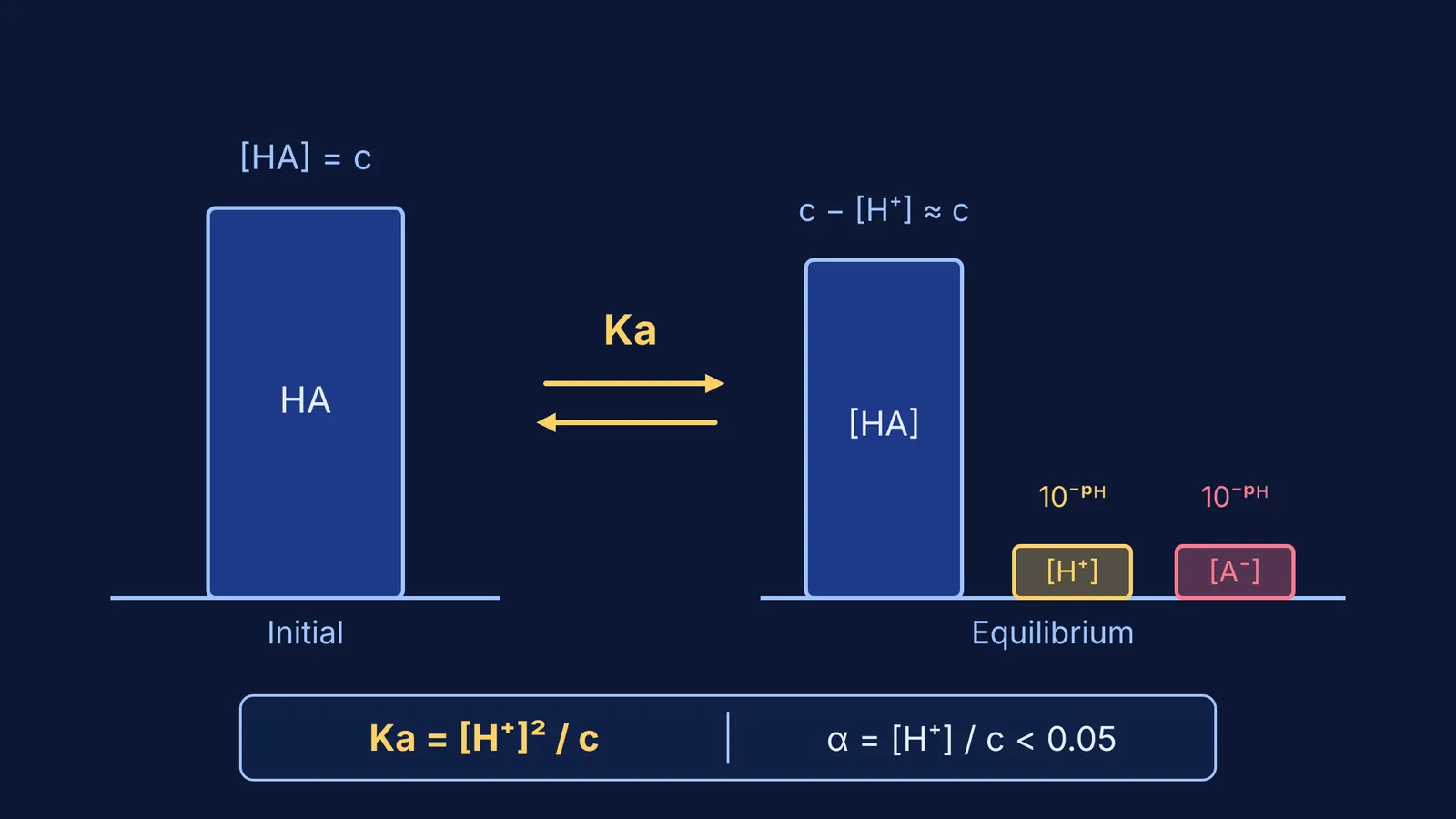
At equilibrium, the concentration of unionised acid remaining in the flask equals the initial concentration, denoted by c, minus the concentration of acid that has ionised:
[HA] = c − [H⁺]
For weak acids with small dissociation constants, the quantity of acid that ionises is minute in comparison to the initial concentration c. When [H⁺] is very small relative to c, subtracting it barely alters the numerical value of the denominator. Under this condition, chemists make the simplifying assumption:
[HA] ≈ c
Substituting this approximation into the equilibrium expression produces the standard shortcut formula:
Ka ≈ [H⁺]² / c
To see how weak acid equilibria fit into the wider map of chemical principles, the Fermi Concept Library maps out every concept in chemistry, each with its own lesson and its place in the map.
How do you use the degree of ionisation as a validity check?
Before accepting an answer derived from the simplified formula, you must always verify that dropping [H⁺] from the denominator was mathematically justified. The metric used to test this assumption is the degree of ionisation, denoted by α, which represents the fraction of initial acid molecules that have dissociated:
α = [H⁺] / c
Multiplying the degree of ionisation by 100 converts it into percent ionisation. According to standard criteria detailed in OpenStax Chemistry 2e, the approximation [HA] ≈ c is considered acceptable if the percent ionisation remains below 5% (meaning α < 0.05). When ionisation is under this 5% boundary, the error introduced by ignoring [H⁺] in the denominator is smaller than the uncertainty inherent in standard laboratory glassware and pH measurements.
How do you calculate Ka for an acetic acid solution?
Consider a typical laboratory problem: an aqueous solution of acetic acid (CH₃COOH) with an initial concentration of 0.10 M has a measured pH of 2.87 at 25 °C. To determine Ka, execute the calculation methodically through the following steps:
Determine [H⁺]: Calculate the hydrogen ion concentration from the pH value: [H⁺] = 10^(−2.87) ≈ 1.35 × 10⁻³ M.
Evaluate the degree of ionisation: Compute α = (1.35 × 10⁻³ M) / (0.10 M) = 0.0135, which corresponds to a percent ionisation of 1.35%.
Check approximation validity: Because 1.35% is substantially lower than the 5% threshold described in OpenStax Chemistry 2e, assuming [HA] ≈ 0.10 M is valid.
Calculate Ka: Substitute the values into the simplified expression: Ka ≈ (1.35 × 10⁻³)² / 0.10 = 1.82 × 10⁻⁵.
The calculated value of 1.82 × 10⁻⁵ aligns with the accepted reference value of 1.8 × 10⁻⁵ at 25 °C tabulated in OpenStax Chemistry 2e. For students working through multi-step numerical calculations, the Fermi Problem Library has worked problems with a step-by-step solver that explains the reasoning rather than printing an answer.
What happens when the 5% approximation fails?
The approximation [HA] ≈ c begins to fail when an acid is moderately strong or when the solution is diluted. Dilution drives the equilibrium forward, increasing the fraction of molecules that ionise and pushing α above the 5% threshold outlined in OpenStax Chemistry 2e.
OpenStax demonstrates this breakdown for a 0.0516 M solution of nitrous acid (HNO₂) with a measured pH of 2.34. Converting pH gives [H⁺] = 10^(−2.34) = 0.0046 M. Checking the degree of ionisation reveals α = 0.0046 / 0.0516 ≈ 0.089, meaning the acid is 8.9% ionised.
Because 8.9% exceeds the 5% limit, dropping [H⁺] from the denominator introduces substantial error: calculating Ka as (0.0046)² / 0.0516 produces 4.1 × 10⁻⁴, understating the true constant. Retaining the exact denominator gives [HA] = 0.0516 − 0.0046 = 0.0470 M, yielding Ka = (0.0046)² / 0.0470 = 4.6 × 10⁻⁴. Checking α ensures you always recognise when exact subtraction is necessary, an awareness equally valuable when calculating pH after mixing acids and bases.


