

On this page
Multi-step synthesis is the hardest part of organic chemistry. You cannot simply memorise the answers; you have to work backwards from a target and choose reagents that do exactly what you want without ruining the rest of the molecule. This requires active practice.
Why are organic conversion questions so hard?
When you read a textbook, each reaction makes sense on its own. You learn that adding hydrogen bromide to an alkene adds bromine to the more substituted carbon. But in an exam, a conversion question demands that you string three or four of these isolated reactions together.
A meta-analysis of 34 studies found that flipped learning—a form of active learning where students solve problems instead of passively listening to lectures—improves chemistry achievement by approximately a third of a standard deviation (Houseknecht et al., 2019). Crucially, the researchers noted that this effect was even stronger in organic chemistry than in general chemistry.
To succeed, you must practice retrosynthesis. This is the art of working backwards. Instead of looking at your starting material and guessing what to add, you look at the final product and ask what immediate precursor could form it. It requires you to simultaneously manage regiochemistry (where a group attaches), stereochemistry (its 3D orientation), and functional group compatibility.
How to practice multi-step synthesis with an AI?
The least effective way to use an AI is to type in "Convert benzene to aniline" and copy the resulting answer into your notebook. This bypasses the cognitive struggle that actually builds memory.
Instead, use an AI to facilitate active recall and test your logic. Ask your AI to act as an examiner. Have it generate a starting material and a target product, and then close your laptop.
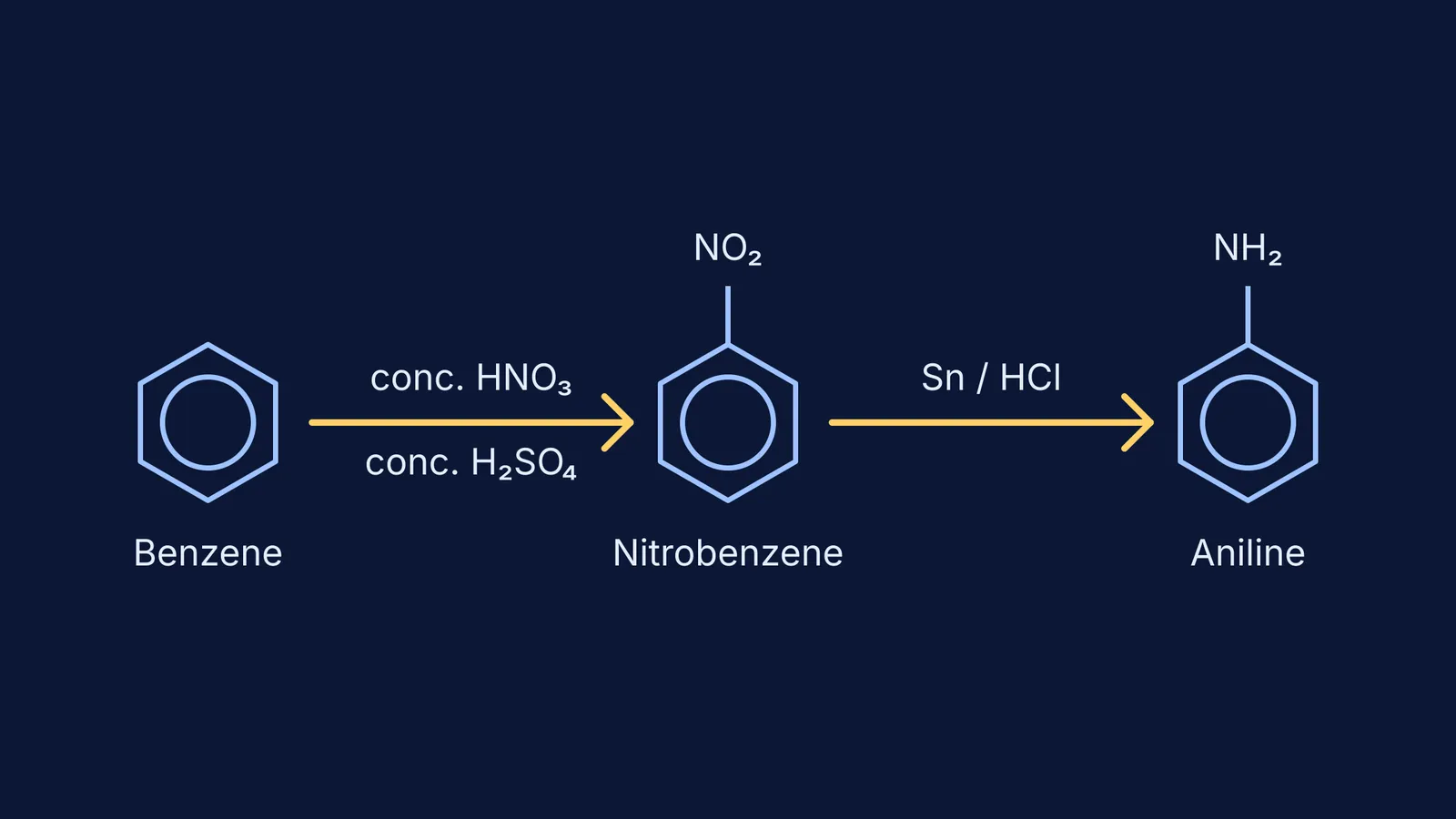
Work out the sequence on paper. When you are finished, do not ask the AI to reveal its own solution. Instead, type your exact sequence into the chat. For instance, you might say, "I plan to nitrate benzene and then reduce nitrobenzene to aniline with Sn/HCl. Is there a flaw in this route?"
Can an AI practice organic conversion questions for me?
You can ask an AI to solve a conversion for you, but general text-based chatbots are notoriously unreliable at complex synthesis. They sometimes hallucinate non-existent reactions or suggest a reagent that successfully transforms one part of your molecule while accidentally destroying another.
This is where a specialised tool like Fermi's AI tutor changes the dynamic. Rather than just printing a complete synthetic route that you might read and forget, Fermi teaches rather than answers. It holds a line of reasoning across a session, noticing where you are stuck.
If you propose using a Clemmensen reduction on a molecule that contains an acid-sensitive group, the tutor will not just silently fix your mistake. It will stop and ask you what happens to that specific group under strongly acidic conditions. It checks your understanding as it goes, forcing you to recognise the boundary conditions of every reagent you use.
A routine for your next study session
To build a reliable habit, use this exact script the next time you sit down to study organic chemistry.
Set the stage: Tell the AI, "Give me a multi-step organic conversion question suitable for the JEE syllabus. Provide only the starting material and the final target molecule. Do not give me any hints, reagents, or intermediate steps."
Find the final step: Look exclusively at the target. If it is an alcohol, can you make it from an alkene? Or do you need a Cannizzaro reaction to form it from an aldehyde? Work backwards one step at a time.
Draft the full route: Write down every intermediate molecule on paper.
Get a targeted critique: Type your proposed route back to the AI. Say, "Here is my route. Step 1: React A with B to form C. Step 2... Please critique my sequence. Do not just rewrite it; tell me if any reagent will react with the wrong functional group, or if the yield would be poor."
By planning the route yourself and letting the AI act as your logic checker, you turn passive reading into the active problem-solving that tough exams demand.


