

On this page
The azo dye test is the standard lab method to distinguish aniline from aliphatic amines. In the azo dye test for aromatic primary amines, orange red dye formation is the final, unmistakable proof that your unknown compound contains a benzene ring directly attached to an amino group.
How does the azo dye test work?
The test relies on two distinct reactions: diazotisation and azo coupling. Primary aromatic amines, such as aniline, contain an amino group (-NH₂) attached directly to a benzene ring. Because of the resonance stabilisation provided by the benzene ring, they can form stable diazonium salts at low temperatures.
Primary aliphatic amines, such as ethylamine, do not have this resonance stabilisation. As a result, they cannot hold onto the diazonium group. Their diazonium salts break down immediately upon formation, releasing nitrogen gas.
According to the NCERT Class 12 Chemistry textbook on Amines, this difference in stability is what makes the test reliable. If you see bubbling gas instead of a dye, you have an aliphatic amine.
Why must diazotisation happen at 0–5 °C?
The first step is to convert the amine into a diazonium salt. You dissolve the amine in dilute hydrochloric acid (HCl) and cool it in an ice bath. Then, you slowly add a cold solution of sodium nitrite (NaNO₂).
These reagents generate nitrous acid in the test tube, which reacts with the amine to form benzene diazonium chloride. This reaction must happen between 273 and 278 K (0–5 °C). If the test tube gets warmer, the diazonium salt reacts with water to form phenol and nitrogen gas, ruining the test before you can add the coupling agent.
What happens during azo coupling?
The second step reveals the dye. You prepare an alkaline solution of 2-naphthol (also called β-naphthol) by dissolving it in dilute sodium hydroxide, and cool it in the ice bath.
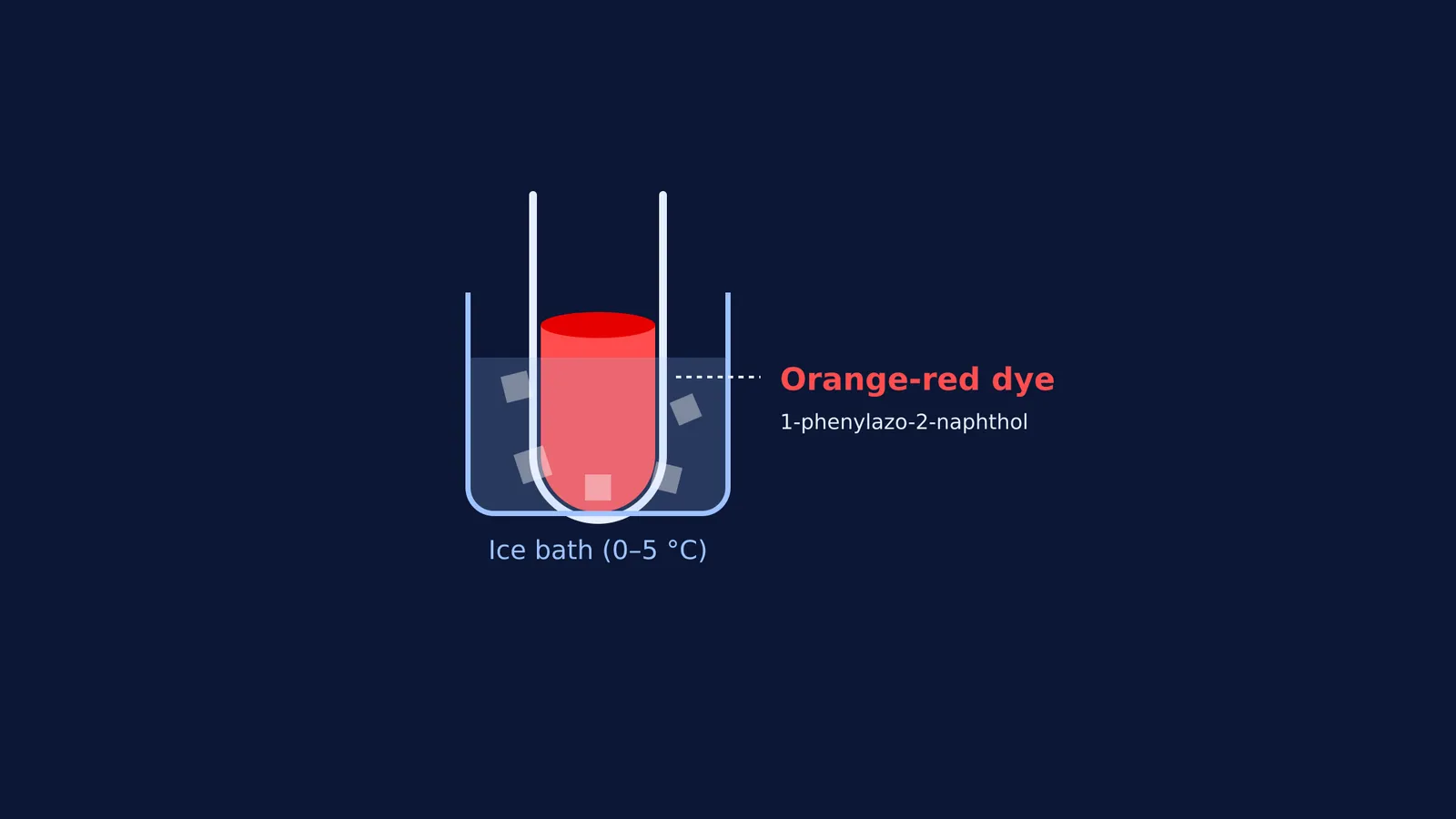
When you pour the cold diazonium salt solution into the alkaline 2-naphthol, an electrophilic aromatic substitution occurs. The positively charged diazonium ion acts as a weak electrophile, attacking the electron-rich 2-naphthol ring. This coupling reaction links the two aromatic rings through a nitrogen-nitrogen double bond (an azo group, -N=N-), yielding a brilliant dye known as 1-phenylazo-2-naphthol.
If you are exploring these reaction mechanisms, the Fermi Concept Library has a lesson on electrophilic aromatic substitution and shows its place in the map.
How do you perform the azo dye test in the lab?
If you are doing this test in your chemistry practical examination, meticulous temperature control is the difference between a successful result and a ruined sample. Use this checklist to avoid common mistakes:
Chill everything: Keep your amine solution, sodium nitrite solution, and 2-naphthol solution in an ice bath for at least five minutes before mixing.
Watch for bubbles: When adding sodium nitrite to the amine, watch closely. Brisk effervescence means nitrogen gas is escaping. You have an aliphatic amine, and the test ends here.
Keep it alkaline: 2-naphthol must be dissolved in sodium hydroxide, not acid. Coupling with phenols only works in a basic medium because it forms the phenoxide ion, which is far more reactive.
Mix slowly: Add the diazonium salt to the 2-naphthol drop by drop, stirring continuously. The orange-red precipitate should form immediately.
Connecting the dots in amine chemistry
This test is part of a larger web of reactions you need to know for organic chemistry. Once you confirm an aromatic amine, you might need to know how it was made, such as by reducing nitrobenzene to aniline: Sn/HCl, Fe/HCl and why.
If you want to confirm a primary amine generally, before checking if it is aromatic, you would use the carbylamine test: detecting primary amines by the isocyanide smell. And to understand how aliphatic primary amines are made cleanly, review the Gabriel phthalimide synthesis: why it gives only primary amines.


