On this page
Olefin is an older name for an alkene, and metathesis means "change places", as the Nobel Prize's public explainer puts it. In olefin metathesis, two alkenes trade the groups on the ends of their double bonds: two propene molecules, for example, become butene and ethene. Yves Chauvin, a French chemist, explained how the catalyst makes that happen.
Who was Yves Chauvin?
Chauvin was born on 10 October 1930 in Menin, Belgium, and died on 27 January 2015 in Tours, France, according to his Nobel Prize facts page. At the time of the award he worked at the Institut Français du Pétrole in Rueil-Malmaison, the French petroleum research institute. He shared the 2005 Nobel Prize in Chemistry with Robert H. Grubbs and Richard R. Schrock "for the development of the metathesis method in organic synthesis", and his share was one third.
What problem did Chauvin solve?
A 1957 patent already turned propene into butene and ethene, the Nobel explainer records, and N. Calderon at Goodyear later named the reaction olefin metathesis. But nobody knew what the catalyst looked like at the molecular level, so the search for better catalysts was, in the explainer's words, "fumbling in the dark".
Chauvin and his student Jean-Louis Hérisson reacted ring-shaped alkenes (cyclopentene and cyclooctene) with open-chain alkenes over tungsten catalysts based on WOCl4. Their paper in Die Makromolekulare Chemie, which appeared in 1971, reported that the chain products carried end groups from the open-chain alkene, the same or different, in a statistical distribution. The Nobel explainer dates the breakthrough to 1970 and notes that these results fitted Chauvin's new mechanism and could not be explained by any mechanism proposed before it.
How does the Chauvin mechanism work?
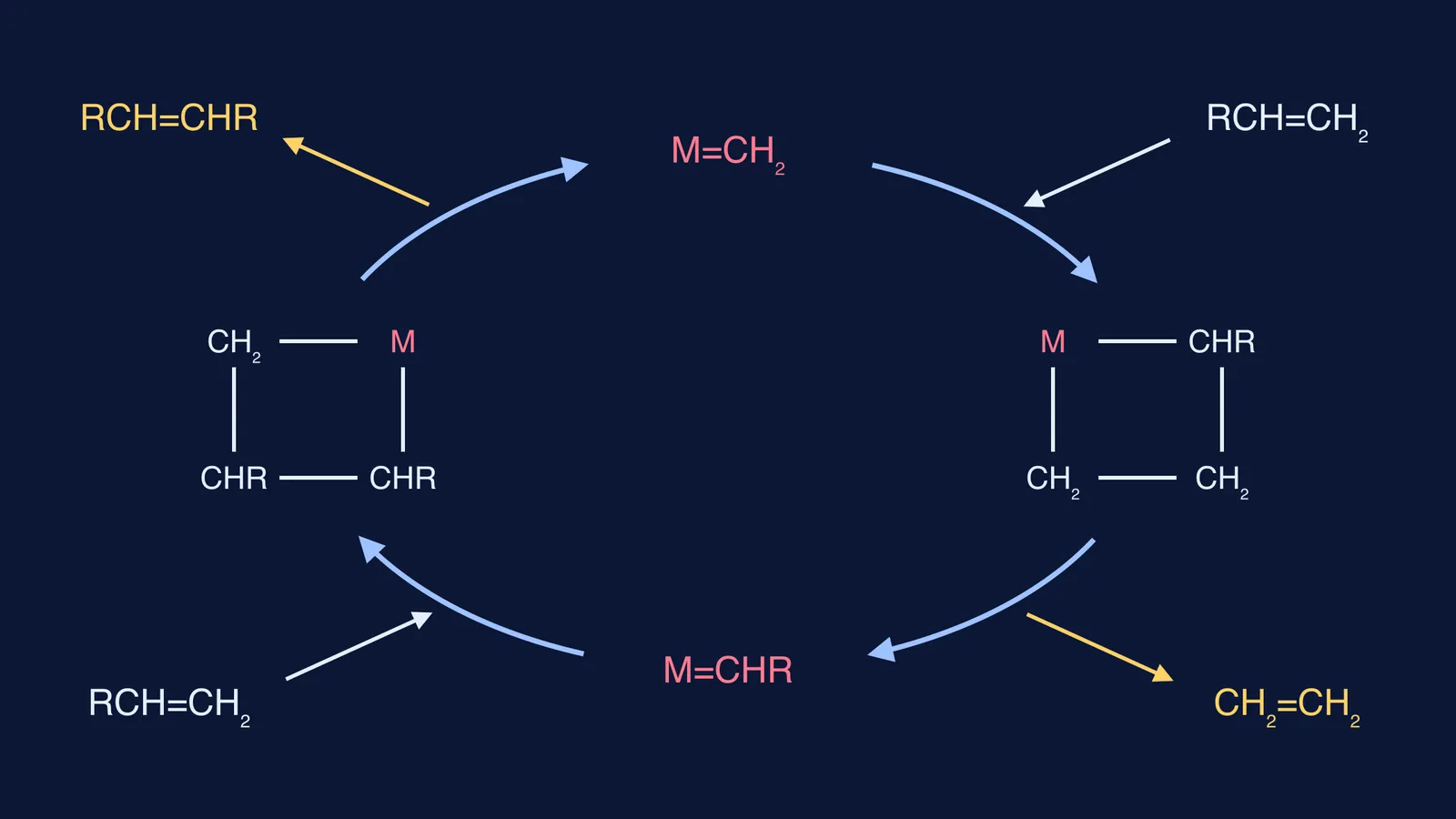
A metal carbene is a compound in which a metal is bound to carbon by a double bond, written M=CH2 (Nobel explainer). Chauvin proposed that this is the real catalyst. The explainer sets out his cycle in four steps:
The metal carbene M=CH2 and an alkene join into a four-membered ring of one metal atom and three carbons, all held by single bonds. This ring is a metallacyclobutane.
The ring breaks along the other two bonds, releasing a new alkene (ethene) and a new metal carbene, M=CHR.
M=CHR meets a second alkene and forms a new metallacyclobutane.
That ring splits to give the metathesis product and M=CH2 again, ready for the next turn.
The explainer pictures this as a dance: the "catalyst pair" and the "alkene pair" join hands in a ring, then let go and leave with new partners. It says Chauvin's mechanism explained all earlier metathesis results at one stroke and was later supported by experiments from Grubbs, Thomas J. Katz and Schrock. It also showed chemists what to build: Schrock reported very active molybdenum catalysts in 1990 and Grubbs an air-stable ruthenium one in 1992.
For background, read how Ziegler and Natta's metal catalysts made plastics and why transition metals make good catalysts.
How do you predict the product of olefin metathesis?
You can predict the products without drawing the catalyst. Use bond bookkeeping:
Cut every C=C down the middle, so each alkene gives two halves, such as CH2= and CH3CH=.
Swap halves between the molecules and join them with new double bonds.
Count carbons on both sides. They must match, because metathesis only moves groups around.
Worked example 1: propene. Each CH3CH=CH2 gives the halves CH3CH= and CH2=. Joining the two CH3CH= halves gives CH3CH=CHCH3 (but-2-ene), and the two CH2= halves give CH2=CH2 (ethene). Carbons: 3 + 3 = 4 + 2. This is the reaction in Figure 1 of the Nobel explainer.
Worked example 2: closing a ring. Hepta-1,6-diene, CH2=CH-CH2CH2CH2-CH=CH2, has a double bond at each end. Cut both: the two CH2= ends leave together as ethene, and the two inner CH= carbons join each other, closing a five-carbon ring with one double bond, cyclopentene. Carbons: 7 = 5 + 2. The Nobel explainer shows the same move turning a long chain into a large ring for a molecule used in cancer research.
Compare this with the Wittig reaction, which builds a C=C from a carbonyl: Wittig makes a new double bond, while metathesis reshuffles the ones already there.
If the ring step still feels hard to picture, Fermi's AI tutor can draw the figure on a board one step at a time and check your understanding as it goes.
Why does olefin metathesis matter today?
With catalytic metathesis, synthesis routes are shorter and give more product with fewer by-products, which makes production cleaner, according to the Nobel explainer. It lists uses including insect pheromones, herbicides, additives for polymers and fuels, and candidate medicines.
If alkenes themselves are shaky, the Fermi Concept Library covers every concept in chemistry, so you can fill that gap first.