On this page
Pick up a silver spoon from hot tea and you feel the heat in your fingers fast. Silver also has the lowest electrical resistivity of the pure metals in standard tables. That is not a coincidence, and two young physicists in Berlin measured the link in 1853. Their result, the Wiedemann–Franz law, later became a key clue that metals contain free electrons, and it came decades before anyone knew electrons existed.
What is the Wiedemann–Franz law?
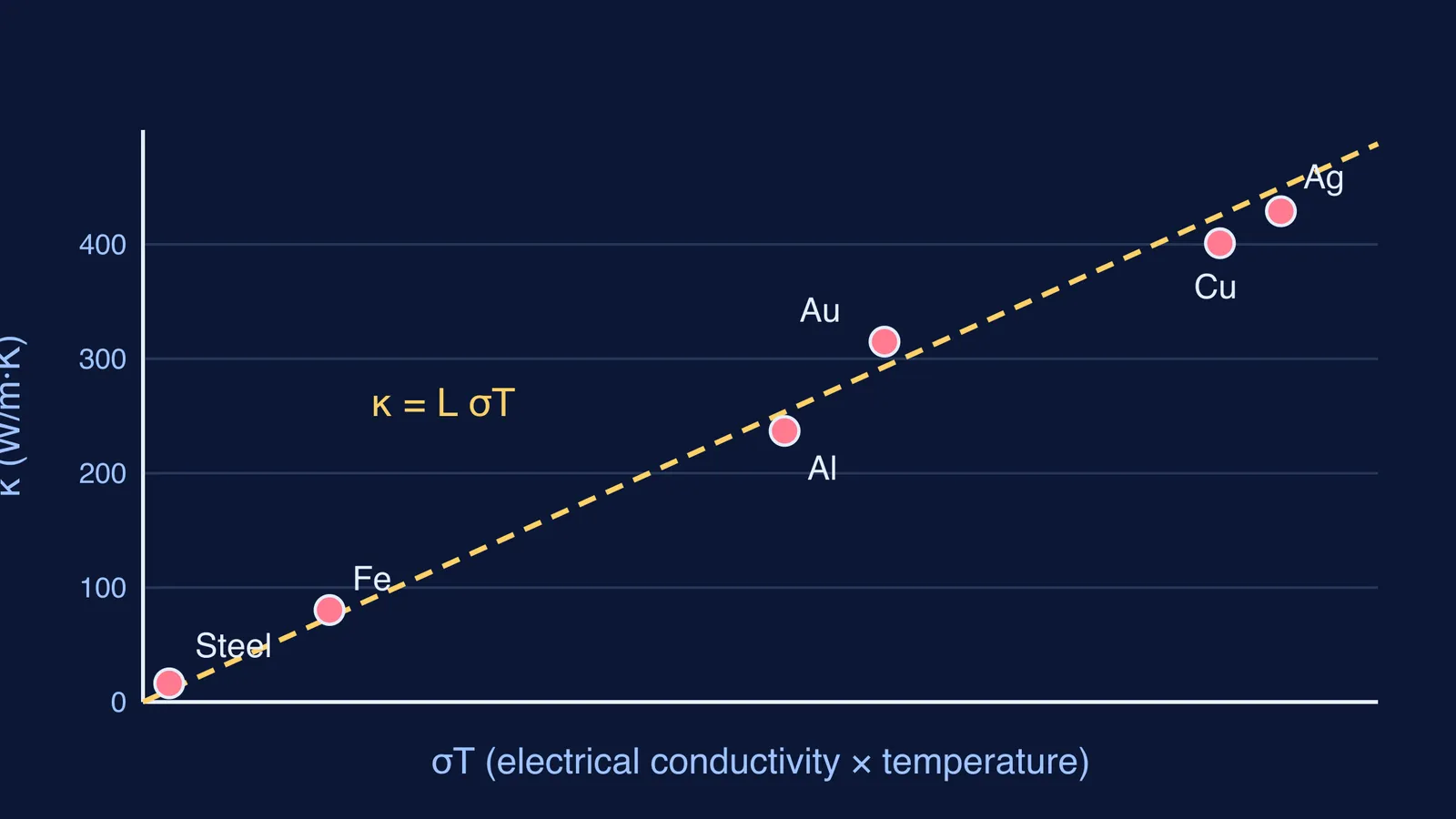
The law says that for a metal, κ/σ = LT, where κ is the electronic part of the thermal conductivity, σ is electrical conductivity, T is the absolute temperature and L is a constant called the Lorenz number (Wikipedia: Wiedemann–Franz law).
The theoretical value of the Lorenz number is L = (π²/3)(k_B/e)² = 2.44 × 10⁻⁸ W·Ω/K² (Wikipedia: Wiedemann–Franz law).
In plain words: at a given temperature, a metal that conducts electricity twice as well should conduct heat about twice as well too. If the symbol κ and its unit W/(m·K) are new to you, our explainer on what thermal conductivity k means and its SI unit covers them first.
Who were Wiedemann and Franz, and what did they find in 1853?
Gustav Wiedemann was born in Berlin in 1826 and later held professorships in Basel, Braunschweig, Karlsruhe and Leipzig (Wikipedia: Gustav Wiedemann). Rudolph Franz, also born in Berlin in 1826, taught physical sciences at the University of Berlin until 1865 (Wikipedia: Rudolph Franz).
Their joint paper, "Ueber die Wärme-Leitungsfähigkeit der Metalle" (On the heat conductivity of metals), appeared in Annalen der Physik, volume 165, pages 497–531, in 1853 (Crossref record, DOI 10.1002/andp.18531650802). They reported that κ/σ has approximately the same value for different metals at the same temperature (Wikipedia: Wiedemann–Franz law).
The Danish physicist Ludvig Lorenz found in 1872 that this ratio grows in proportion to temperature, which is why the constant carries his name (Wikipedia: Wiedemann–Franz law).
Why do good electrical conductors also conduct heat well?
In a metal, the same free electrons do both jobs. Push them with a voltage and they carry charge. Let one end be hotter and the faster electrons there drift toward the cold end, carrying energy. Anything that scatters electrons, such as impurities or vibrating atoms, slows both flows together, so the two conductivities rise and fall as a pair.
Paul Drude derived the law from an electron-gas model around 1900; his constant came out close to experiment partly because several errors cancelled (Wikipedia: Wiedemann–Franz law). Our post on Paul Drude's free electron model tells that part of the story.
This is also why a steel spoon feels colder than a wooden one: free electrons pull heat out of your hand quickly, and wood has none to offer.
How do you use the Wiedemann–Franz law with copper?
Copper's resistivity at 20 °C is 1.68 × 10⁻⁸ Ω·m (Wikipedia: Electrical resistivity and conductivity). Its thermal conductivity near room temperature is listed as 385 to 401 W/(m·K) (Wikipedia: List of thermal conductivities). Let us predict κ from the electrical value alone.
Convert resistivity to conductivity: σ = 1/ρ = 1/(1.68 × 10⁻⁸) ≈ 5.95 × 10⁷ S/m.
Use T = 293 K (20 °C), not 20. The law needs kelvin.
Multiply: κ = LσT = 2.44 × 10⁻⁸ × 5.95 × 10⁷ × 293 ≈ 425 W/(m·K).
Compare: 425 is about 6% above the listed 401 and about 10% above 385. A rule from 1853, fed one electrical number, lands close.
The same steps with the resistivities and thermal conductivities in the two sources above give:
Aluminium: predicted about 254, listed 205 to 237 W/(m·K)
Iron: predicted about 74, listed 71.8 to 80.4 W/(m·K)
Stainless steel: predicted about 10, listed 16.3 to 24 W/(m·K)
Steel is the outlier. The law counts only heat carried by electrons, so a measured value well above the prediction suggests the vibrating atoms (phonons) are carrying a real share too.
Where does the Wiedemann–Franz law break down?
The law is generally valid at high temperatures and at low temperatures of a few kelvin, but may not hold in between; in the purest silver at very low temperatures, L can drop by as much as a factor of 10 (Wikipedia: Wiedemann–Franz law).
A 2017 study in Science by Sangwook Lee, Junqiao Wu and colleagues found a large violation near the insulator-metal transition in vanadium dioxide nanobeams: in the metallic phase, the electronic share of thermal conductivity was much smaller than the law predicts (Lee et al., Science 355, 371–374, 2017). The journal's summary explains this as charge and heat travelling independently in a strongly correlated system.
Heat flow and drifting electrons are hard to picture from a formula. The Fermi Simulation Lab has interactive simulations for ideas that are easier to see than to read, and the Fermi Concept Library gives each physics concept its own lesson, so you can check conductivity before you tackle the ratio.