On this page
Up early for a 6 am class, you find the sky already pale blue with no sun in sight. The air high above you is already in sunlight, and it sends some of that light down.
Why is the sky bright before the sun rises?
Earth is round, and its air curves with it. As the astronomer Phil Plait explains in Scientific American, an observer many kilometres up can still see the sun after it has set for someone on the ground, so sunlight is still scattering off the air up there. At dawn it runs in reverse.
Air molecules and fine particles scatter part of that light in all directions, some of it towards you. Your NCERT Class 10 Science textbook makes the point from the other side in section 10.6.2: if Earth had no atmosphere there would be no scattering, and the sky would look dark. Our post on Rayleigh's law and the blue sky explains why short wavelengths scatter the most.
How far below the horizon is the sun when the sky starts to glow?
Twilight is split by how far the sun's centre is below the horizon; the US National Weather Service and Geoscience Australia use the same three angles.
Astronomical twilight begins when the sun's centre is 18° below the horizon; the sky is so faint that most people would call it fully dark.
Nautical twilight begins at 12° below; the horizon becomes visible, which let sailors take star sightings.
Civil twilight begins at 6° below; the brightest stars and planets are still out, the horizon and buildings are clear, and often you need no lamp.
How high is the sunlit air above you? A worked example
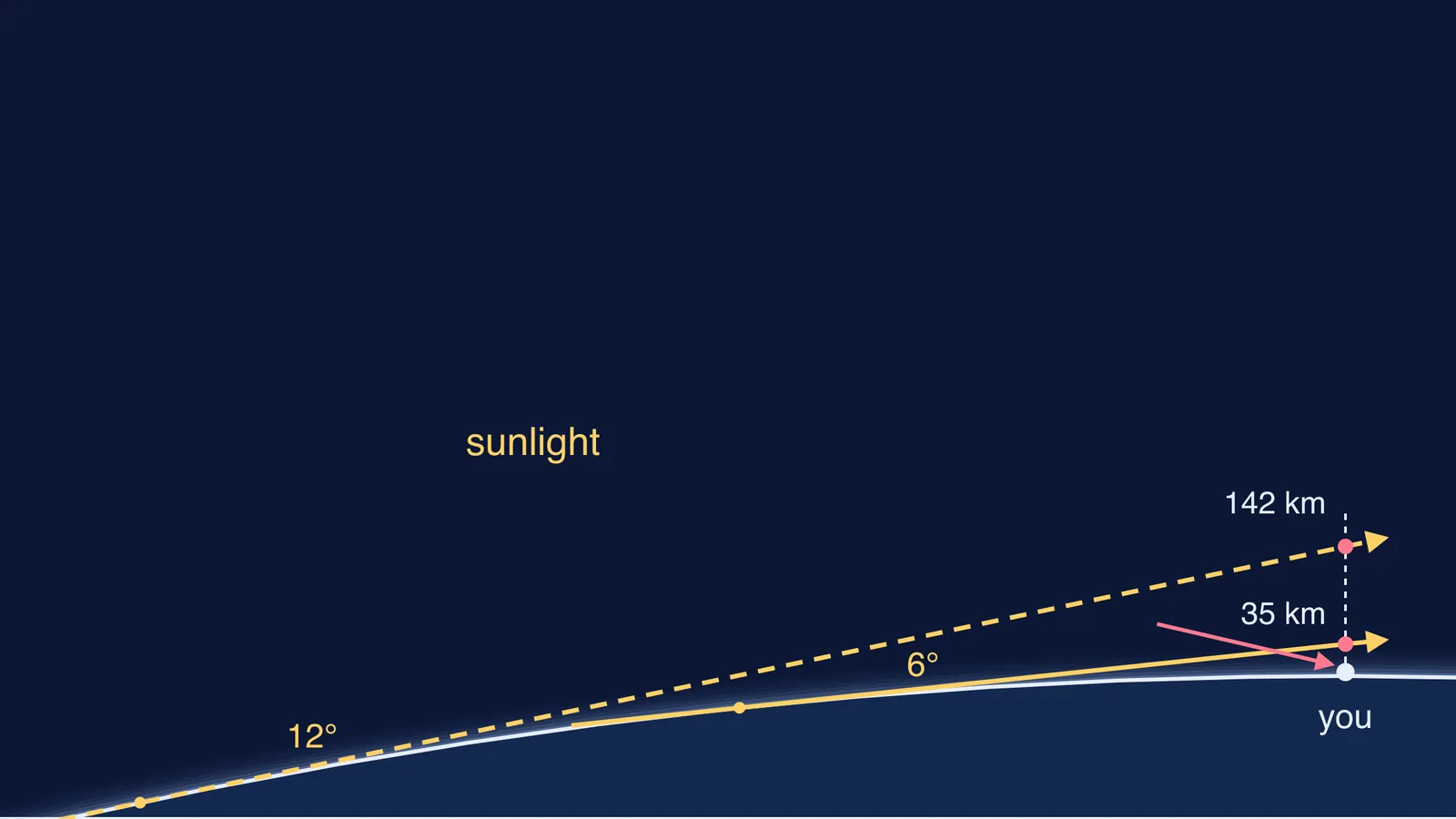
The sunray that just grazes Earth's surface marks the edge of Earth's shadow. If the sun is d degrees below your horizon, that grazing ray touches the ground d degrees of arc away from you, towards the sun. Ignoring the slight bending by refraction, it passes straight above you at a height h = R(1/cos d − 1), where R is Earth's radius.
Earth's mean radius is 6,371 km, according to NASA's Earth fact sheet. Put in the three twilight angles:
Sun 18° below: cos 18° = 0.95106, so h = 6371 × (1.05146 − 1) ≈ 328 km.
Sun 12° below: cos 12° = 0.97815, so h = 6371 × (1.02234 − 1) ≈ 142 km.
Sun 6° below: cos 6° = 0.99452, so h = 6371 × (1.00551 − 1) ≈ 35 km.
The same NASA sheet gives the atmosphere a scale height of 8.5 km: in a simple model, air density falls by a factor of e (about 2.7) for every 8.5 km you climb. On that model, air at 35 km is under 2% as dense as air at the ground, and air at 142 km is almost nothing. Less air in sunlight means less light scattered down, which is why the sky stays dim until the shadow edge sinks into the denser lower air. That is the edge straight overhead; towards the east the sunlit air sits lower, so the eastern sky brightens first.
The sun moves through 360° in 24 hours, which is 15° an hour. Near the equator it climbs almost straight up, so the last 6° take about 24 minutes, matching the less than half an hour that Plait gives in Scientific American for civil twilight there. Across most of India the sun rises at a slant, so twilight lasts a little longer.
The same shadow edge explains why satellites are seen only after sunset. If the geometry is hard to picture, the Fermi Simulation Lab has interactive simulations for ideas that are easier to see than to read.
Why is the dawn sky blue overhead and pink near the horizon?
The overhead sky is blue because air scatters blue more strongly than red. The NCERT textbook notes that red light has a wavelength about 1.8 times that of blue. Light that skims low through the air loses more blue on the way and arrives reddened, as NASA Space Place explains. Try it in our red sunset scattering simulation.
Before dawn, look west, away from the coming sunrise. Atmospheric Optics describes what you may see: a dark band of Earth's own shadow along the horizon, topped by a pink glow called the Belt of Venus, made of reddened sunlight scattered back to you.
Is the dawn glow the same as advance sunrise?
No. In section 10.5 of the NCERT textbook, atmospheric refraction lets you see the sun about 2 minutes before it actually crosses the horizon. The dawn glow is scattering, and it starts much earlier.
A checklist for a three-mark answer:
Name the cause: sunlight scattered by air molecules and fine particles.
Say why sunlight reaches that air: it is high enough to be outside Earth's shadow.
Link to colour: shorter wavelengths scatter more, so the sky overhead looks blue.
If scattering or refraction still feels shaky, the Fermi Concept Library gives every concept in physics its own lesson.