

On this page
If you look up at the sky shortly after sunset on a clear night, you might spot a bright, unblinking "star" gliding steadily across the heavens. This is often a satellite in Low Earth orbit.
But if you look for satellites at midnight, the sky is mostly empty. Satellites do not produce their own visible light; they shine by reflecting sunlight. To see one, two conditions must be met: your location on Earth must be in darkness, and the satellite must be high enough to still be bathed in sunlight.
Why do satellites disappear in the middle of the sky?
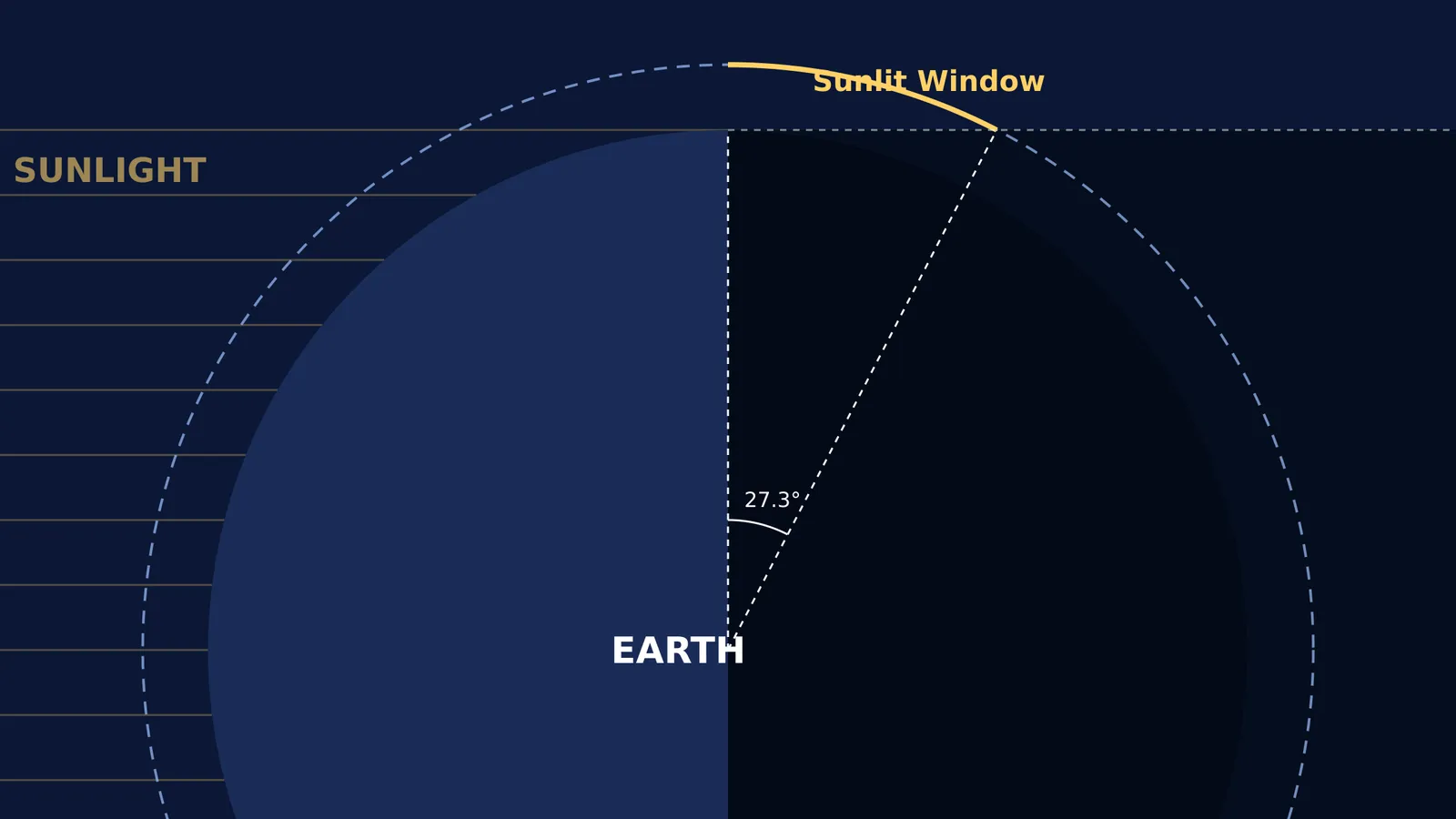
When the sun sets, the ground enters Earth's shadow. However, because Earth is a sphere, the shadow cast into space is essentially a large cone extending away from the Sun. The terminator—the line dividing day and night—does not extend straight up into the atmosphere. Instead, sunlight continues to pass over the darkened surface, illuminating the space high above.
Unlike a horizontal projectile from a cliff that eventually hits the ground, a satellite's tremendous speed keeps it continuously falling around the curvature of the Earth. This means it can fly directly over a darkened observer while still being hit by direct sunlight. Eventually, as the Earth rotates further and the satellite moves deeper into the night side, it will hit the boundary of the shadow. If you are watching a satellite when this happens, it will seem to simply vanish in the middle of the sky, well before it reaches your horizon.
How long after sunset can you see a satellite?
We can use simple trigonometry to calculate how long after sunset a satellite can remain visible. The key numbers are the Earth's average radius of 6,371 km and the satellite's altitude.
For a typical satellite in Low Earth Orbit, which peak in number at an altitude of around 800 km, its distance from the center of the Earth is 7,171 km. By drawing a right-angled triangle from the Earth's center to the edge of the shadow and up to the satellite, we can find the maximum angle the Sun can be below the horizon while still illuminating the orbit. The angle is arccos(6371 / 7171), which equals roughly 27.3 degrees.
Because the Earth rotates at 15 degrees per hour, 27.3 degrees of rotation takes about 109 minutes. This means a satellite at this altitude can remain in sunlight for nearly two hours after the sun sets on the ground directly beneath it.
However, you cannot see the satellite clearly the instant the sun sets because the sky is still too bright. The illumination from the sky drops to nearly zero when the Sun reaches 18° below the horizon. Therefore, the ideal viewing period is while the sky is darkening or fully dark, but before the satellite crosses into the shadow at 27.3 degrees.
How can you spot a satellite in the night sky?
To increase your chances of seeing a satellite, find a dark location away from city lights during the ideal viewing window. You don't need a telescope or binoculars; in fact, their narrow field of view makes it much harder to track a fast-moving object. Satellites look like steadily moving stars that cross the entire sky quickly. They do not flash or blink like airplanes.
The brightest flashes come from satellite flares, which occur when a satellite's flat solar panels or antennas catch the sunlight at just the right angle to reflect a brilliant beam of light down to your exact location on Earth. Some of these flares can briefly become brighter than any star in the sky, before fading back to a dim point of light.
If you understand the equation of trajectory for a projectile, you know that objects in flight follow predictable mathematical curves. Satellites are no different. Their orbits are governed by gravity and are entirely predictable, which is why astronomers and hobbyists can calculate their exact position years in advance.
How do you visualise the sunlit window?
Picturing how spheres, shadows, and horizons intersect in 3D is one of the classic challenges in physics. If you want to explore this hands-on, the Fermi Simulation Lab lets you predict when a satellite can be seen from the ground, then move the Sun and observer to find the exact sunlit window.
If you are working through orbital mechanics problems for an exam and get stuck on the trigonometry, Fermi's AI tutor can help. Instead of just giving you the final angle, the tutor explains the reasoning and works out what you already know, drawing the figure step by step so you can see where the numbers come from.
By understanding the geometry of Earth's shadow, the night sky becomes less of a mystery and more of a predictable, mathematical clockwork. The next time you see a satellite steadily crossing the twilight sky, you will know exactly why it is shining.


