

On this page
The blue above you is sunlight that air has knocked sideways. In 1871 John William Strutt, later Lord Rayleigh, put a number on that, and the number is why blue beats red.
What did Lord Rayleigh show in 1871?
In February 1871 Strutt published "On the light from the sky, its polarization and colour" in the Philosophical Magazine, volume 41, pages 107-120. He built on John Tyndall's light-beam experiments with fine particles, which sent blue light out to the side.
Rayleigh's key point was that "small" means small compared with the wavelength of light. His law, in his own words from the paper as reprinted in his Scientific Papers, volume 1: "When light is scattered by particles which are very small compared with any of the wave-lengths, the ratio of the amplitudes of the vibrations of the scattered and incident light varies inversely as the square of the wave-length, and the intensity of the lights themselves as the inverse fourth power."
He then checked it against the real sky. In the same paper he describes about thirty comparisons between blue light from near the zenith and sunlight diffused through white paper. Between the C (red) and F (blue-green) lines of the spectrum, theory predicted the sky-to-sunlight ratio would rise from 25 to 80; he observed 25 to 90. He judged that the curves "agree very well", the sky being even bluer than theory, and admitted he "was not prepared for so great a difference as the observations show", the ratio for F being more than three times that for C.
How do you derive the 1/λ⁴ law?
Rayleigh got the result from units alone in the 1871 paper, and you can follow his steps:
Let A be the ratio of scattered to incident amplitude, at distance r from a particle of volume V. A ratio of amplitudes has no units.
Amplitude falls as 1/r away from a small source, and twice the volume scatters twice the amplitude, so A ∝ V/r.
V/r has units of length squared. To cancel them, the only other length available is the wavelength, so A ∝ V/(rλ²).
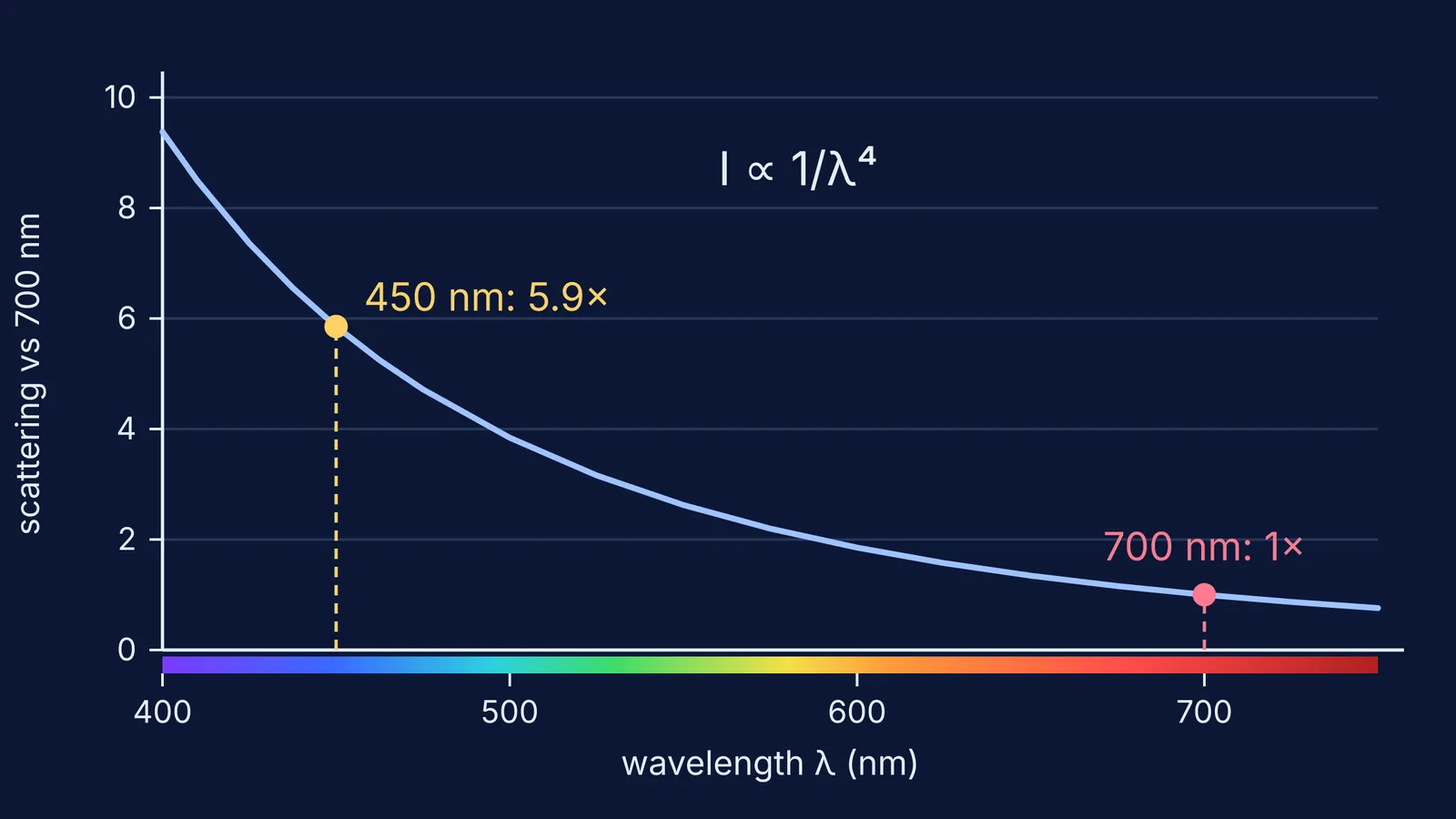
Intensity goes as amplitude squared, so I ∝ V²/(r²λ⁴). Keep the particles fixed and change only the colour: I ∝ 1/λ⁴.
Worked example. Take 450 nm for blue and 700 nm for red. The ratio of scattered intensities is (700/450)⁴ = (1.556)⁴ ≈ 5.9.
Why is the sky blue and not violet?
Violet's wavelength is shorter still, so 1/λ⁴ says it should scatter more. The Physics FAQ entry on sky colour by Philip Gibbs gives the reasons it does not win: sunlight carries less violet to begin with, some violet is absorbed high in the atmosphere, and our eyes are less sensitive to violet.
What does the scattering? Rayleigh came back to that in an 1899 Philosophical Magazine paper and argued that "even in the absence of foreign particles we should still have a blue sky": the molecules of air are enough (reprinted in volume 4 of his Scientific Papers).
Why are sunsets red?
Away from the Sun, you see scattered light, which is rich in blue. Looking towards the Sun, you see what survives. NASA Space Place explains that as the Sun gets lower, its light passes through more atmosphere, so even more blue is scattered away and the reds and yellows pass straight through to you.
Rayleigh's 1871 paper predicted one more thing you can test: light scattered at right angles to the sunbeam should be strongly polarised. Look at the sky roughly 90° from the Sun through polarising sunglasses and tilt your head; it darkens and brightens, though never fully. Rayleigh suggested light scattered more than once is partly to blame.
For rainbows, see scattering of light and how rainbows form. Rayleigh's other classroom result is in Lord Rayleigh and the limit of what a lens can resolve. His 1904 Nobel Prize in Physics was for gas densities and the discovery of argon, not for the sky.
How do you write this answer in an exam?
Five steps to write from memory:
State the law with its condition: for particles much smaller than λ, scattered intensity I ∝ 1/λ⁴.
Name the scatterers: the molecules of air.
Sky: scattered light reaches your eye from every direction, and blue is scattered most.
Sunset: the longer path through air strips blue from the direct beam.
Not violet: less violet in sunlight, and eyes less sensitive to it.
Avoid saying the sky "reflects" blue. Rayleigh argued in his 1871 paper that reflection only applies to surfaces many wavelengths across, not to particles smaller than one.
If the curve is hard to picture, the Fermi Simulation Lab has interactive simulations for ideas that are easier to see than to read. If the units argument felt shaky, the Fermi Concept Library gives each physics concept its own lesson and its place in the map.


