On this page
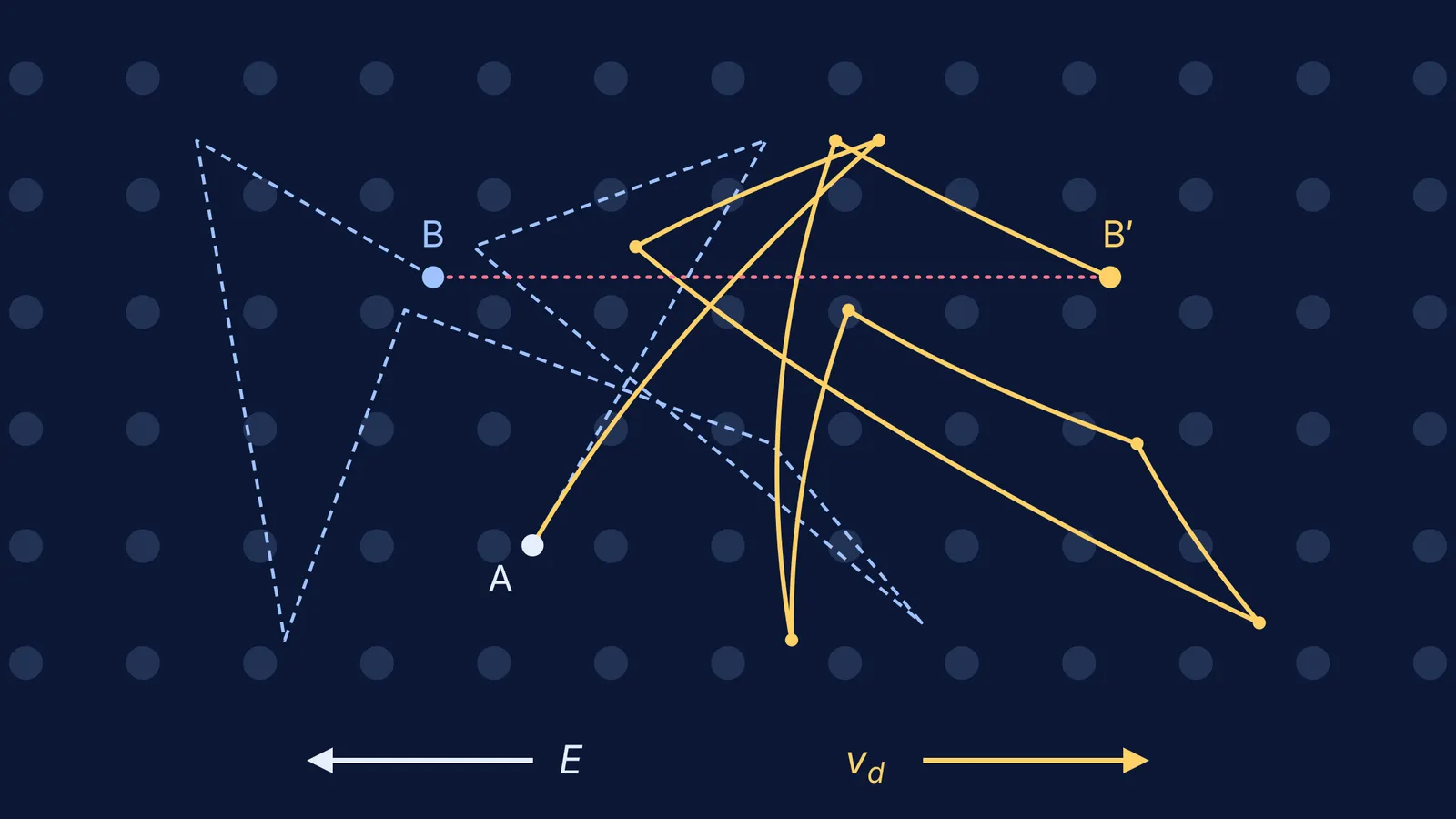
NCERT's Class 12 chapter on current electricity derives Ohm's law from one picture: electrons racing about in a wire, crashing into ions, slowly drifting along. That picture belongs to the German physicist Paul Drude.
Who was Paul Drude?
Paul Drude was born in Braunschweig, Germany, on 12 July 1863 and died in Berlin in 1906 (biography on Wikipedia). In 1900 he became editor of Annalen der Physik and, in the same journal, published "Zur Elektronentheorie der Metalle" (On the electron theory of metals), volume 306, pages 566 to 613 (Crossref record of Drude's paper).
His step was to apply the kinetic theory of gases to electrons inside a metal. A 2024 review by Miguel Kiwi and Jaime Rössler explains that Drude treated the valence electrons as a non-interacting gas and used a mean collision time rather than a mean free path, which lets Ohm's law drop out of his equations (Kiwi and Rössler, Revista Brasileira de Ensino de Física).
What is the Drude model of electrical conduction?
The Drude model treats the free electrons in a metal as a gas of particles that fly freely between collisions with the heavy, fixed positive ions (NCERT Class 12 Physics, Chapter 3). In NCERT's Section 3.5:
After a collision an electron leaves in a random direction, so with no field the average velocity is zero.
A field E accelerates each electron at a = −eE/m between collisions.
The average time between collisions, τ, is the relaxation time.
Averaging gives the drift velocity, v_d = −eEτ/m.
With n free electrons per unit volume, the current density is j = (ne²τ/m)E. That is Ohm's law, with conductivity σ = ne²τ/m and resistivity ρ = m/(ne²τ) (NCERT, Eqs. 3.22, 3.23 and 3.27).
How small is the drift velocity, and what is τ for copper?
NCERT's Example 3.1 takes a copper wire of cross-section 1.0 × 10⁻⁷ m² carrying 1.5 A, with n = 8.5 × 10²⁸ conduction electrons per m³, and finds a drift speed of about 1.1 mm/s (NCERT, Example 3.1). The same example notes this is about 10⁻⁵ times the typical thermal speed of copper atoms at ordinary temperatures.
Now use the same numbers to estimate τ, a step the textbook skips. Copper's resistivity at 20 °C is 1.68 × 10⁻⁸ Ω m (resistivity table), and the electron mass is 9.109 × 10⁻³¹ kg (NIST CODATA value).
Rearrange ρ = m/(ne²τ) to get τ = m/(ne²ρ).
Substitute: τ = 9.11 × 10⁻³¹ / (8.5 × 10²⁸ × (1.6 × 10⁻¹⁹)² × 1.68 × 10⁻⁸) ≈ 2.5 × 10⁻¹⁴ s.
Take the reciprocal: each electron is knocked off course roughly 4 × 10¹³ times every second.
Find the mobility: μ = eτ/m ≈ 4.4 × 10⁻³ m²/V s.
Find the field in NCERT's wire: E = ρI/A = 1.68 × 10⁻⁸ × 1.5 / 1.0 × 10⁻⁷ ≈ 0.25 V/m.
Check: v_d = μE ≈ 1.1 × 10⁻³ m/s, the same 1.1 mm/s NCERT got by counting charges.
The two routes must agree, because both come from the same model, so a match is a good check on your arithmetic and units.
Why does a metal's resistance rise with temperature?
Look again at ρ = m/(ne²τ). NCERT explains that in a metal n hardly changes with temperature, but hotter electrons collide more often, so τ falls and ρ rises; in semiconductors n grows fast enough to win, so ρ falls (NCERT, Section 3.8). For the numbers, see our post on the temperature coefficient of resistance with worked examples.
Where did the Drude model go wrong?
The model also predicted the Wiedemann-Franz law, which links a metal's thermal and electrical conductivity, and its predicted ratio came within a factor of about 2 to 3 of measured values (Kiwi and Rössler, 2024). Part of that success came from a lucky cancellation of errors, and the model greatly overestimates the heat capacity of the electrons (Drude model overview). Hendrik Lorentz refined it in 1905 (see Hendrik Lorentz and the electron theory of matter), and Arnold Sommerfeld fixed the heat-capacity problem in 1927 by giving the electrons Fermi-Dirac statistics.
The derivation also assumes τ and n do not depend on E; devices where that fails are covered in the limitations of Ohm's law and non-ohmic devices.
How do you write the derivation in a Class 12 exam?
Use this order:
No field: average velocity is zero.
With field: a = −eE/m, so V_i = v_i − (eE/m)t_i.
Average both sides: the v_i average to zero and the t_i average to τ, giving v_d = −eEτ/m.
Charge crossing area A in time Δt is neA|v_d|Δt, so I = neA|v_d|.
Substitute v_d to get j = (ne²τ/m)E, then σ = ne²τ/m.
State the assumptions: τ and n are independent of E.
If the zigzag is hard to picture, the Fermi Simulation Lab has interactive simulations for ideas that are easier to see than to read. For practice, the Fermi Problem Library has a step-by-step solver that explains the reasoning.
Every time you write v_d = eEτ/m, you are using Drude's 1900 electron gas.