On this page
Leave a steel ladle and a wooden spoon in a pot of hot dal. Soon the steel handle is too hot to hold, while the wooden one stays comfortable. The difference is one property of the material: its thermal conductivity, k.
What does thermal conductivity measure?
Thermal conductivity tells you how readily heat flows through a material by conduction. The NCERT Class 11 Physics chapter on thermal properties of matter sets it up with a bar of length L and cross-section A, its ends held at temperatures T_C and T_D. In the steady state, the rate of heat flow (the heat current) is H = KA(T_C − T_D)/L.
The constant K is the thermal conductivity. In NCERT's words, "the greater the value of K for a material, the more rapidly will it conduct heat". Many books write it as a small k.
Rearranged, k = HL / (A ΔT). So k is the number of watts that would flow through a slab 1 m² in area and 1 m thick with a 1 K difference across it. It belongs to the material, not to the shape.
What is the SI unit of thermal conductivity?
Work it out from k = HL / (A ΔT):
H is power, in watts (W).
L is a length, in metres (m).
A is an area, in square metres (m²).
ΔT is a temperature difference, in kelvin (K).
So k has units of W × m / (m² × K) = W m⁻¹ K⁻¹.
The BIPM SI Brochure (Table 6) lists the SI unit of thermal conductivity as the watt per metre kelvin, W m⁻¹ K⁻¹, which is kg m s⁻³ K⁻¹ in base units. That gives the dimensional formula [M L T⁻³ K⁻¹]. NCERT also writes J s⁻¹ m⁻¹ K⁻¹, which is the same unit, because a watt is a joule per second.
The brochure also notes that a temperature difference of 1 K equals one of 1 °C. So W m⁻¹ °C⁻¹ gives exactly the same number.
Why do metals conduct heat better than wood or air?
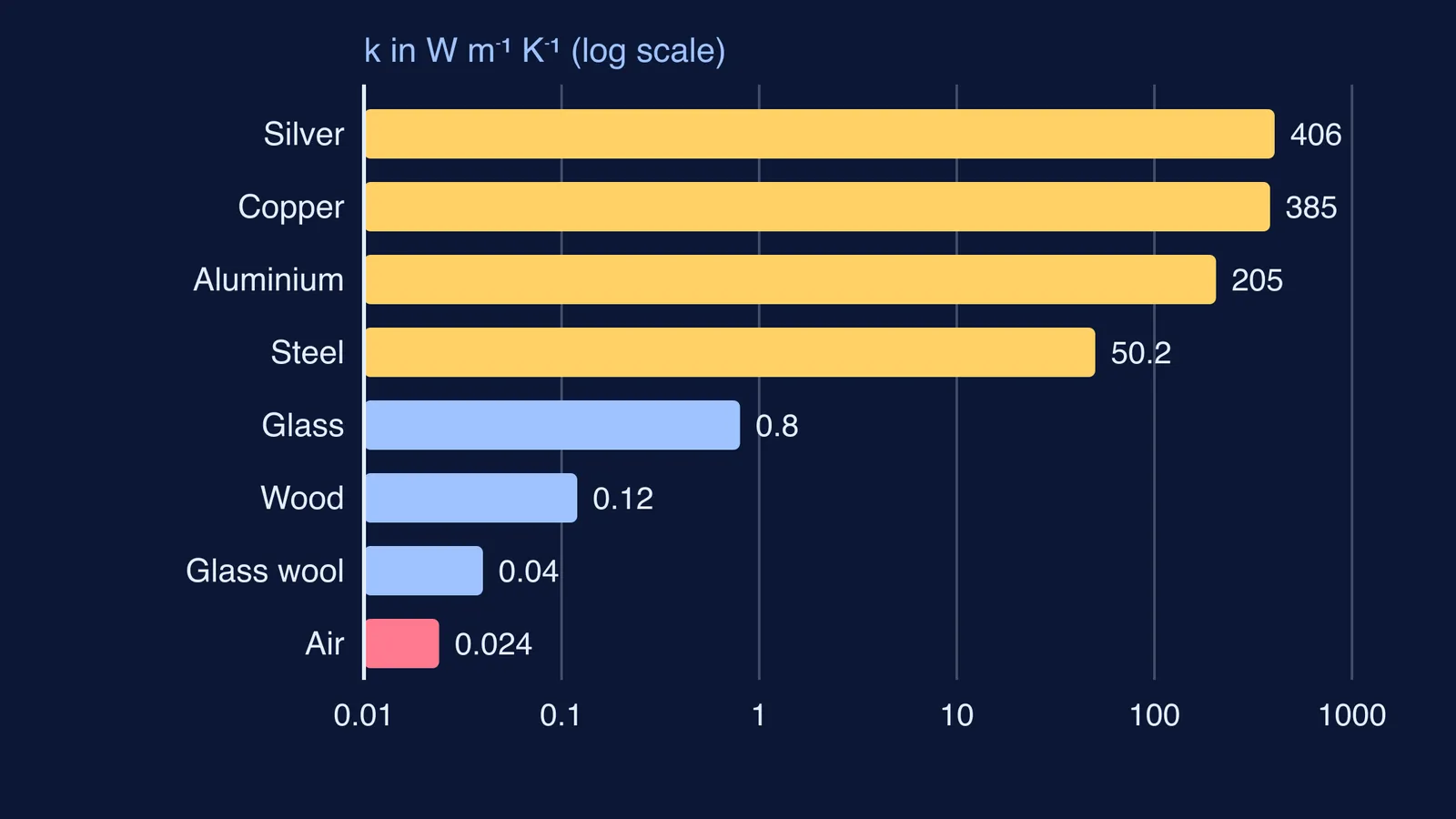
NCERT's Table 10.6 gives these values in W m⁻¹ K⁻¹: silver 406, copper 385, aluminium 205, steel 50.2, wood 0.12, glass wool 0.04 and air 0.024 (NCERT, Chapter 10). Divide them and you find that copper conducts about 3,200 times better than wood and about 16,000 times better than still air.
The reason is free electrons. HyperPhysics explains: "Metals are much better thermal conductors than non-metals because the same mobile electrons which participate in electrical conduction also take part in the transfer of heat."
Wood has practically no free electrons to carry heat. According to OpenStax College Physics, conduction is otherwise a chain of collisions, with each faster particle passing energy to a slower neighbour. Air is a gas, and NCERT calls gases poor conductors. OpenStax notes that Styrofoam, fibreglass, wool and goose-down "incorporate many small pockets of air", and NCERT says the same about plastic foams.
Tables differ a little (OpenStax lists copper at 390), so in an exam use the value the question gives you.
Worked example: how much heat flows up a spoon handle?
Take a handle 20 cm long with a cross-section of 1 cm². One end is at 100 °C and the other at 30 °C. As in NCERT's worked examples, assume a steady state and no heat lost from the sides.
Convert to SI units: L = 0.20 m, A = 1 × 10⁻⁴ m², ΔT = 70 K.
Work out the geometry part first: A ΔT / L = (10⁻⁴ × 70) / 0.20 = 0.035 m K.
Copper (k = 385): H = 385 × 0.035 ≈ 13.5 W.
Steel (k = 50.2): H = 50.2 × 0.035 ≈ 1.76 W.
Wood (k = 0.12): H = 0.12 × 0.035 ≈ 0.0042 W, about 4 milliwatts.
Only k changed, yet the answer swings by a factor of thousands. For how length and area change H, see the rate of heat flow through a rod.
How do you avoid mistakes in thermal conductivity questions?
Convert to metres and square metres. 1 cm² = 10⁻⁴ m², not 10⁻² m².
A temperature difference in °C needs no conversion to K.
Don't mix k up with specific heat, which is about warming a material, not how fast heat crosses it. See specific heat vs heat capacity.
Sanity check: copper should beat steel, and steel should beat wood. If not, hunt for an unconverted centimetre.
For rods joined end to end, the steady heat current is the same in each rod (NCERT Examples 10.6 and 10.7).
If the idea keeps slipping, the Fermi Concept Library has a lesson for each physics concept. If your answers keep coming out wrong, the Fermi Problem Library has worked problems with a step-by-step solver that explains the reasoning rather than printing an answer.
Next, find out why a steel spoon feels colder than a wooden one. It is the same k, felt with your fingers.