On this page
In many Indian homes, the first answer to a late-night toothache is a clove (laung) pressed against the sore tooth. There is real chemistry behind it, and it also explains why the relief wears off and the problem stays.
What is in clove oil that numbs pain?
Clove oil comes from the flower buds of the clove tree, Syzygium aromaticum, and eugenol makes up at least 50% of it, according to a 2021 review in Molecules. The same review says the remaining 10 to 40% consists of eugenyl acetate, beta-caryophyllene and alpha-humulene.
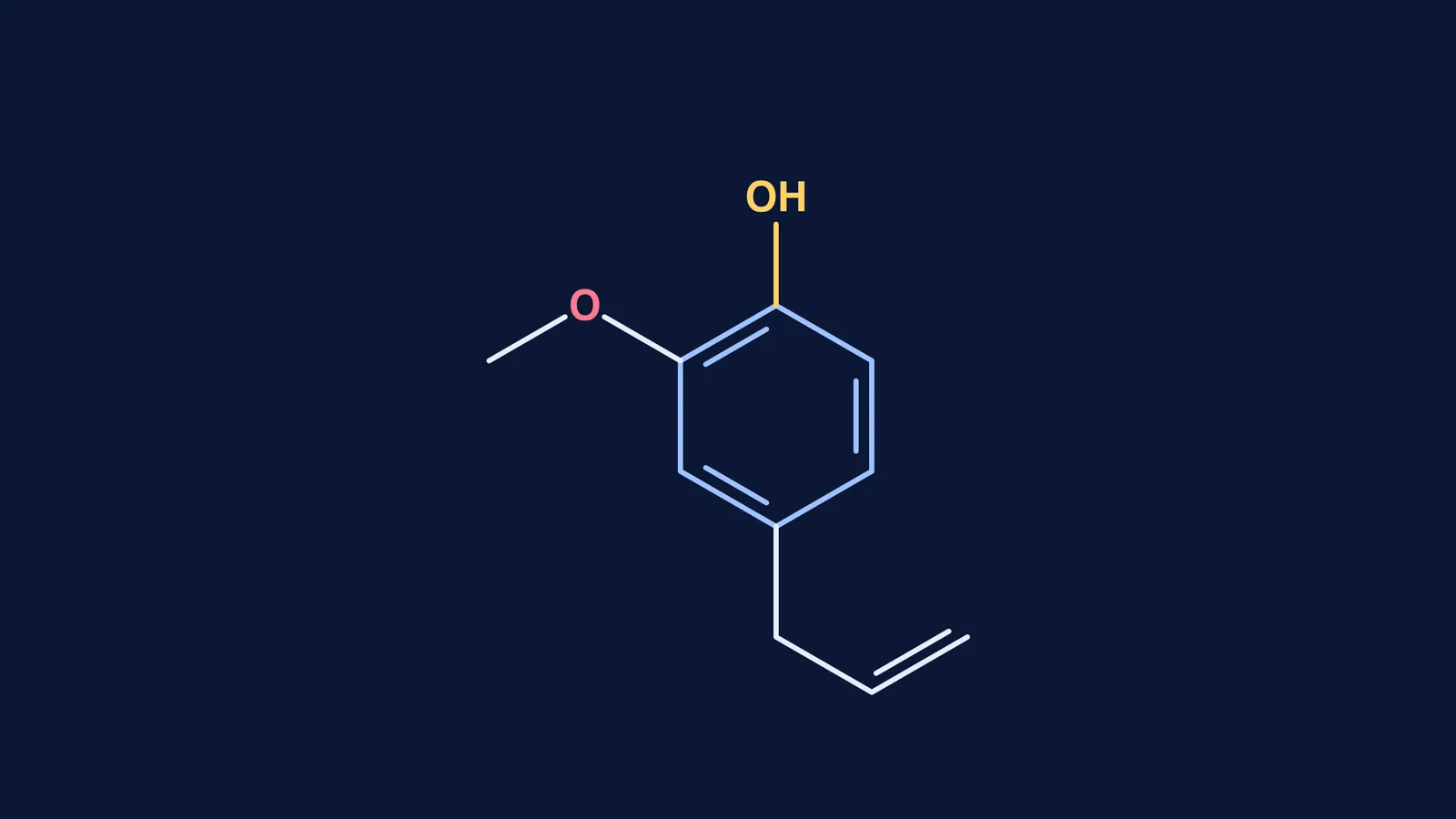
Eugenol is a phenol: PubChem lists it as 2-methoxy-4-prop-2-enylphenol, formula C10H12O2. If you have met phenols in Class 12 chemistry, you will recognise the -OH group on a benzene ring. Plants make many compounds like this, and a single one can explain much of a traditional remedy, as we showed for the medicinal compounds in tulsi and neem.
How does eugenol stop toothache pain?
The nerves of a tooth sit in the pulp, its soft core, along with the blood vessels (see the structure of a tooth: enamel, dentine, pulp and cementum). A nerve sends a pain signal as an action potential, and that signal depends on sodium ions rushing in through channels in the nerve membrane.
In a 2006 study in the Journal of Dental Research, C.-K. Park and colleagues recorded from rat nerve cells that supply the upper molar teeth. Eugenol inhibited both the action potentials and the sodium currents in these neurons, and the authors suggest this sodium-current inhibition contributes to its pain-relieving effect. In plain words: weaken the sodium current and the pain message becomes harder to fire.
There is human evidence too, with a catch. In a 2006 trial in the Journal of Dentistry, researchers tested a homemade clove gel, a 20% benzocaine gel and two placebo gels on the inside of the cheek of 73 adult volunteers, then gave needle sticks. Both clove and benzocaine gave lower pain scores than the placebos, with no significant difference between the two. That trial measured a needle prick, not a decayed tooth, so it shows clove can numb tissue, not that it treats toothache.
Does clove oil kill the germs that cause tooth decay?
Partly, and mainly in lab studies. The Molecules review reports that clove oil can inhibit Gram-positive bacteria such as Streptococcus, Gram-negative bacteria, and fungi such as Candida albicans.
But a cavity is a hole, not just an infection. The WHO oral health fact sheet explains that decay develops when plaque turns free sugars into acids that destroy the tooth over time, and that untreated decay in permanent teeth is the most common health condition, according to the Global Burden of Disease 2021 study. You can see why acid matters in our explainer on why tooth decay starts when mouth pH falls below 5.5. No oil puts lost enamel back. Treating the decay itself is a dentist's job.
What does a clove oil medicine leaflet say?
In the UK, clove oil is sold as a licensed medicine. The patient leaflet for one licensed UK clove oil product describes it as having a local anaesthetic and mild antiseptic effect that can relieve toothache temporarily. The leaflet also says:
Apply a small amount on a cotton bud to the affected tooth only, and avoid the gums.
Repeated use may cause gum damage; listed side effects include blistering and swelling in the mouth.
Do not use it for teething pain; it is not recommended for children under 2.
Anyone who accidentally swallows liquid straight from the bottle should see a doctor straight away.
People taking medicines that prevent blood clotting, such as warfarin, should talk to a doctor or pharmacist first.
See your dentist as soon as possible.
That last line is the point of this whole post. The leaflet itself treats clove oil as a stopgap until a dentist can look at the tooth.
What should you tell the dentist?
A clear description saves time at the clinic. Note three things before you call:
Which tooth hurts (upper or lower, left or right, front or back).
Since when.
What sets it off: hot, cold, sweet or biting.
Put together, that becomes one sentence: "I have pain in my lower right back tooth since Tuesday. It hurts with cold water and when I bite." It tells the dentist where, how long and what kind.
Where can you see this chemistry and biology together?
If a nerve impulse is hard to picture from a textbook paragraph, the Fermi Simulation Lab has interactive simulations for ideas that are easier to see than to read. To revise phenols or how neurons fire, the Fermi Concept Library gives every concept in chemistry and biology its own lesson and its place in the map.
Next time someone reaches for a clove, you can explain exactly what it does, and why the dentist visit still matters.