On this page
If you can balance an equation, you can write its equilibrium constant. The whole skill is three moves: products on top, reactants underneath, and every coefficient becomes a power. Two more rules handle the cases that cost marks in board exams and JEE Main: pure solids and liquids drop out, and gases can be written with partial pressures to give Kp.
What is the rule for writing Kc?
For a general reaction aA + bB ⇌ cC + dD, the equilibrium constant is Kc = [C]^c [D]^d / [A]^a [B]^b, where each square bracket is an equilibrium concentration in mol/L (NCERT Class 11 Chemistry, Unit 6: Equilibrium). NCERT calls this the Law of Chemical Equilibrium and credits Cato Guldberg and Peter Waage, who proposed the relationship in 1864.
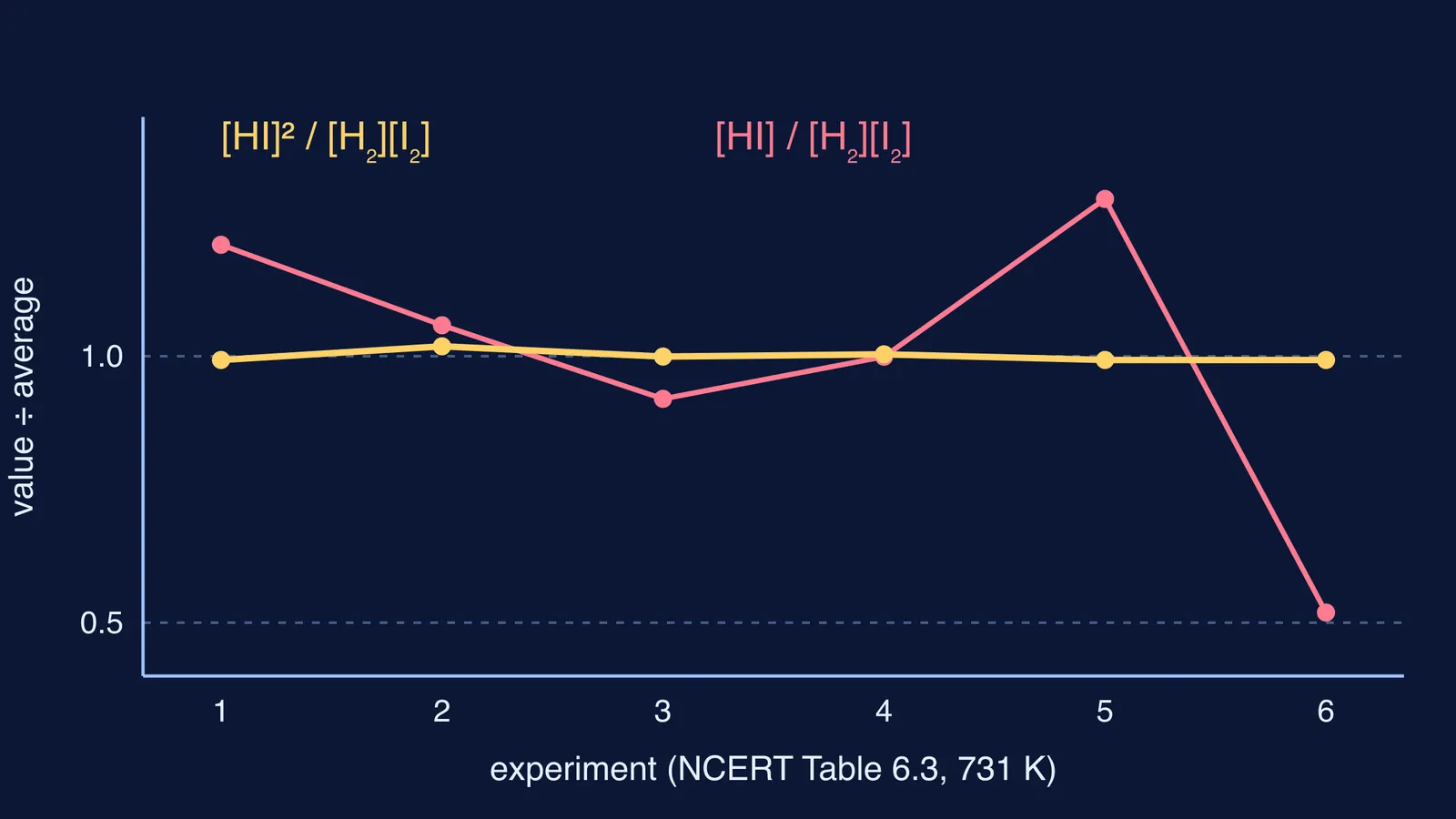
Why powers, and not just the concentrations multiplied together? The same NCERT chapter shows it with real data. In six experiments on H₂(g) + I₂(g) ⇌ 2HI(g) at 731 K, the simple ratio [HI]/[H₂][I₂] ranged from 790 to 1970, while [HI]²/[H₂][I₂] stayed between 46.4 and 47.6 (NCERT, Tables 6.2 and 6.3). The square is the 2 in front of HI. Only the expression with the coefficient as a power stays constant, as the graph above shows.
How do you write Kc step by step?
Balance the equation and keep the state symbols. The powers come from this exact equation.
Cross out every pure solid (s) and pure liquid (l).
Put the products on top and the reactants underneath, each in square brackets.
Raise each bracket to the power of its coefficient.
Check: one bracket per remaining species, and every power matches a coefficient.
NCERT's own example is 4NH₃(g) + 5O₂(g) ⇌ 4NO(g) + 6H₂O(g), which gives Kc = [NO]⁴[H₂O]⁶ / [NH₃]⁴[O₂]⁵ (NCERT, Unit 6). Water stays in here because it is a gas.
Now with numbers. In NCERT's Problem 6.1, at 500 K the equilibrium concentrations are [N₂] = 1.5 × 10⁻² M, [H₂] = 3.0 × 10⁻² M and [NH₃] = 1.2 × 10⁻² M for N₂(g) + 3H₂(g) ⇌ 2NH₃(g). Then Kc = [NH₃]² / [N₂][H₂]³ = (1.2 × 10⁻²)² / (1.5 × 10⁻²)(3.0 × 10⁻²)³ = 3.55 × 10². Forget the cube on H₂ and you get about 0.32, an answer more than a thousand times too small from one missing power.
For more practice, the Fermi Problem Library has worked problems with a step-by-step solver that explains the reasoning rather than printing an answer.
Why are pure solids and liquids left out of Kc?
The molar concentration of a pure solid or pure liquid is constant, whatever amount of it is present, so it is folded into the constant (NCERT, section 6.5). For CaCO₃(s) ⇌ CaO(s) + CO₂(g), that leaves Kc = [CO₂] and Kp = pCO₂. NCERT gives the CO₂ pressure over CaCO₃ and CaO at 1100 K as 2.0 × 10⁵ Pa, so Kp = 2.00 when the pressure is expressed in bar.
The solid still has to be there, however little of it, for the equilibrium to exist. It just does not appear in the expression. The same rule removes a pure liquid: for Ag₂O(s) + 2HNO₃(aq) ⇌ 2AgNO₃(aq) + H₂O(l), NCERT writes Kc = [AgNO₃]² / [HNO₃]².
How do you write Kp with partial pressures?
Keep the same shape and the same powers, but replace each gas concentration with its partial pressure. For N₂(g) + 3H₂(g) ⇌ 2NH₃(g), Kp = (pNH₃)² / (pN₂)(pH₂)³. NCERT links the two constants by Kp = Kc(RT)^Δn, where Δn is the moles of gaseous products minus the moles of gaseous reactants, pressure is in bar and R = 0.0831 bar L/mol K (NCERT, section 6.4.1). Our post on deriving Kp = Kc(RT)^Δn walks through where that comes from.
Try one that mixes both rules: 3Fe(s) + 4H₂O(g) ⇌ Fe₃O₄(s) + 4H₂(g). Cross out the two solids. Kc = [H₂]⁴ / [H₂O]⁴ and Kp = (pH₂)⁴ / (pH₂O)⁴. Count only gases for Δn: 4 − 4 = 0, so here Kp = Kc.
Which mistakes cost the most marks?
Writing reactants over products, which gives 1/Kc.
Multiplying by the coefficient (2[HI]) instead of raising to its power ([HI]²).
Leaving a solid or pure liquid in the expression.
Putting initial concentrations in place of equilibrium ones.
Giving K without its equation. Halve or reverse the equation and K changes, which our post on how Kc changes when a reaction is reversed or multiplied works through.
Putting pressures in pascal into Kp when the question expects bar.
What can change K once the expression is right? Only temperature, as explained in what changes the equilibrium constant. For the concept itself, the Fermi Concept Library gives chemical equilibrium its own lesson and its place in the map of chemistry.