On this page
This is question 22 of Exercise 6.3 in the Application of Derivatives chapter of NCERT's Class 12 Mathematics Part I (NCERT, reprint 2026-27): "A wire of length 28 m is to be cut into two pieces. One of the pieces is to be made into a square and the other into a circle. What should be the length of the two pieces so that the combined area of the square and the circle is minimum?"
It looks like a routine maxima and minima sum, but it has two traps. You start with two unknown shapes and need one variable. Then you get a single stationary point, and it is easy to label it a maximum out of habit. Here is the full working, plus the check that tells you which one you have.
How do you write the total area in one variable?
Let x metres of the 28 m wire in the NCERT question go to the square. The other 28 − x metres go to the circle.
The square's perimeter is x, so its side is x/4 and its area is x²/16.
The circle's circumference is 28 − x = 2πr, so r = (28 − x)/(2π) and its area is πr² = (28 − x)²/(4π).
So the total area is A(x) = x²/16 + (28 − x)²/(4π), with 0 ≤ x ≤ 28.
Write that interval down. It tells you where else to look later, and it is an easy step to skip.
How do you find the cut that gives the minimum area?
Differentiate: A′(x) = x/8 − (28 − x)/(2π).
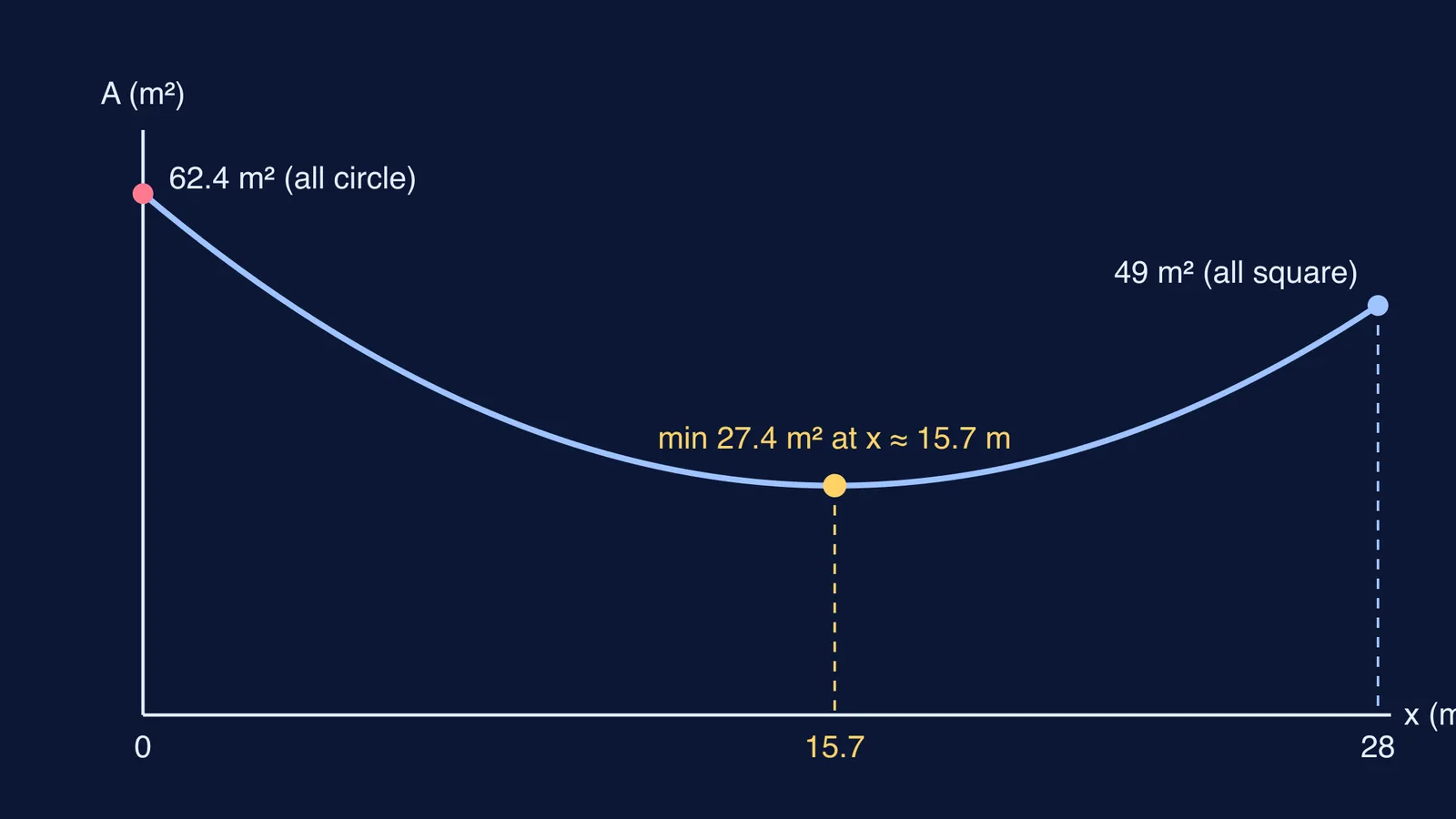
Set A′(x) = 0. Multiplying by 8π gives πx = 4(28 − x), so x = 112/(π + 4) ≈ 15.68 m of the 28 m wire goes to the square. The circle gets 28π/(π + 4) ≈ 12.32 m.
With those lengths, the square's side is 28/(π + 4) ≈ 3.92 m and the circle's radius is 14/(π + 4) ≈ 1.96 m. The smallest total area is 196/(π + 4) ≈ 27.44 m².
Is it a minimum or a maximum?
Differentiate again: A″(x) = 1/8 + 1/(2π). That is positive for every x, so the graph curves upward everywhere and the stationary point is a minimum. This is the second derivative test from the NCERT chapter.
The same fact tells you something easy to miss. A curve that bends upward everywhere has no stationary maximum, so the greatest area must sit at an end of the interval. NCERT's working rule for a closed interval says exactly this: work out f at the critical points and at the end points, then compare (NCERT, section 6.4.1). Doing that here:
x = 0 (all the wire becomes a circle): A = 196/π ≈ 62.39 m²
x = 112/(π + 4) ≈ 15.68 m: A ≈ 27.44 m²
x = 28 (all the wire becomes a square): A = 49 m²
So if a paper asks for the maximum combined area, the answer is to not cut the wire at all and bend all of it into a circle. Writing x = 112/(π + 4) for that version is wrong. For more on why setting f′ = 0 can miss extreme values at the ends of an interval, read stationary vs critical points and corner extrema.
What mistakes cost marks on this question?
Keeping two variables (side a and radius r) and never joining them with 4a + 2πr = 28.
Dropping a factor in the circle's area: r² = (28 − x)²/(4π²), and multiplying by π leaves 4π in the denominator, not 2π.
Stopping at A′(x) = 0 without the A″ check, then writing "maximum".
Ignoring the end points when the question asks for the greatest area.
Giving one length only. The question asks for both pieces.
If you get as far as A(x) and then get stuck, the Fermi Problem Library has worked problems with a step-by-step solver that explains the reasoning rather than printing an answer.
How do you practise this pattern?
The same steps work for every "fixed amount, two uses" problem: name one variable, write the quantity in that variable, state its interval, differentiate, test, then check the end points.
Redo the NCERT wire problem with any length L. You should get x = 4L/(π + 4), so the square always takes 4/(π + 4), about 56%, of the wire.
Swap the square for an equilateral triangle and repeat. Check that the triangle's side is still tied to the circle's radius at the minimum.
Try a one-shape version first if the setup still feels shaky: maximum area rectangle with 40 m of fence.
Then work through the mixed set in applications of derivatives: maxima, minima and rates of change.
If the second derivative test itself is the weak spot, the Fermi Concept Library gives each mathematics concept its own lesson and shows where it fits in the map.
Set up the area function, find the stationary point, then check A″ and the end points before you write "minimum".