On this page
Year after year, photos from Delhi show the Yamuna covered in drifts that look like snow. It is mostly detergent pollution, and the physics behind it is the surface tension you study in school.
What is the white froth on the Yamuna made of?
The most detailed answer is the Study on Yamuna Frothing in Delhi, a report by The Energy and Resources Institute (TERI) for the Delhi government's Department of Environment. Its team sampled 52 locations in each of two rounds, May to June 2024 and November 2024 to January 2025, and tested 33 parameters in each sample.
The report found that froth forms mainly because the river's water quality is poor. Laundry clusters (dhobi ghats) and untreated or poorly treated sewage carry in the detergent chemicals, and the river adds a natural foamer of its own:
Anionic surfactants, the cleaning molecules in detergents. The study measured up to 31.8 mg/L at Hathi Ghat, far above the CPCB limit of less than 1 mg/L.
Phosphate and ammonia, which the report links to industrial-grade detergents used at laundry clusters and to sewage. River phosphate ranged from 2.637 to 8.971 mg/L.
Saponins, natural foaming compounds measured at 400 to 700 mg/L, which the report traces to water hyacinth and algal blooms that thrive on this polluted water.
Why does the foam pile up at Okhla Barrage?
A barrage is a low dam with gates that control how much water flows downstream. The TERI report explains that when the polluted river reaches Okhla Barrage, the sudden opening of the gates and the fall of water from a height disturb the water and the sludge on the bed, creating high turbulence. That is where the study saw the most severe foaming, and it noted the foam becomes more stable as winter sets in.
The detergent is already in the river upstream. The falling water beats air into it, like shaking a bottle of soapy water.
How does surface tension explain the froth?
Surface tension is the energy needed to create a unit area of new liquid surface. Pure water has a surface tension of 71.97 mN/m at 25 °C, according to the International Association for the Properties of Water and Steam.
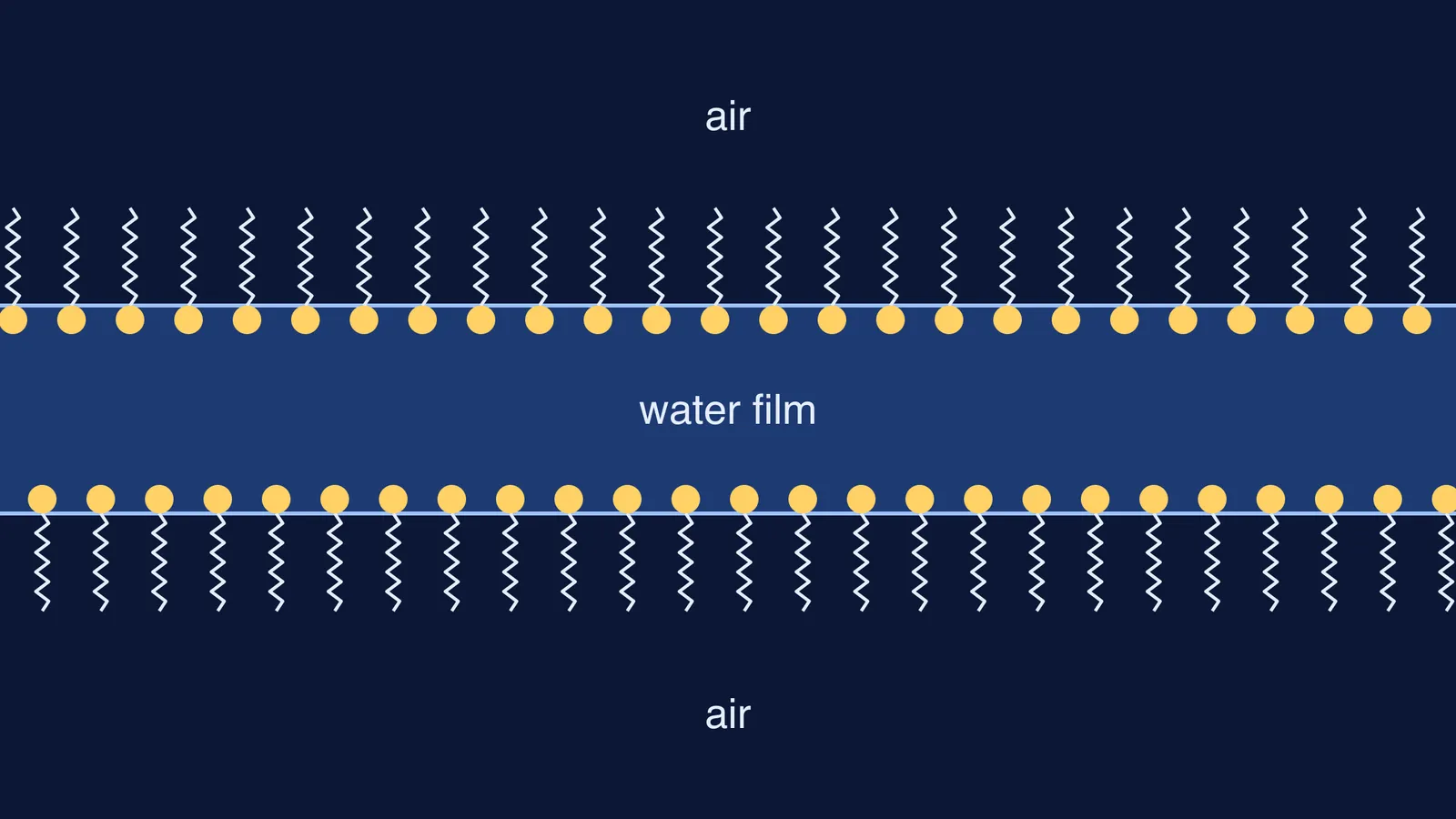
A surfactant molecule has a water-loving head and a water-fearing tail. At a surface, the molecules line up with heads in the water and tails in the air, and this lowers the surface tension. Foam is almost all surface: thin water films wrapped around air, so lower surface tension makes it cheaper to create.
That is only half the story. A film of clean water drains and bursts quickly, while a film coated with surfactant on both sides resists thinning, so the bubbles last long enough to pile up into drifts.
Worked example: what does one bubble cost?
A bubble film has two surfaces, inside and outside. For radius r and surface tension T, the energy to make the film is W = T × 2 × 4πr², and the extra pressure inside is ΔP = 4T/r.
Take r = 1 cm = 0.01 m and T ≈ 0.072 N/m, the IAPWS value for water at 25 °C.
Area of both surfaces: 2 × 4π × (0.01)² ≈ 2.51 × 10⁻³ m².
Energy: W ≈ 0.072 × 2.51 × 10⁻³ ≈ 1.8 × 10⁻⁴ J.
Excess pressure: ΔP = 4 × 0.072 ÷ 0.01 ≈ 28.8 Pa.
If a detergent halved T, both answers would halve: about 0.9 × 10⁻⁴ J and 14.4 Pa.
Each bubble is cheap, falling water supplies plenty of energy, and surfactant stops the films bursting.
If ΔP = 4T/r is hard to picture, the Fermi Simulation Lab has interactive simulations for ideas that are easier to see than to read, and the Fermi Concept Library covers every concept in physics and chemistry, each with its own lesson.
Is the Yamuna froth dangerous?
The foam is the visible sign; the water under it is the bigger problem. The TERI report found faecal coliform around 10⁴ MPN per 100 mL in the river and ammonia from 12.5 to 30.6 mg/L, signs of untreated sewage.
What would reduce the froth?
The TERI report recommends fixing the sources, including:
adding ammonia and phosphate to routine water testing
small sewage treatment plants at dhobi ghats and laundry clusters
zeolite- and enzyme-based detergents over phosphate-heavy ones
aerators upstream of Okhla Barrage and regular removal of water hyacinth
At home, you can do a small part and see the physics yourself:
Use only the detergent dose printed on the pack.
Choose phosphate-free detergents where you can find them.
Try the shake test: half-fill two identical bottles with tap water, add one drop of washing-up liquid to one, cap both and shake for 10 seconds. Time how long the foam lasts in each. That gap is surfactant at work.
Next time you see those photos, you are looking at a city's detergent, whipped into foam by a barrage.