On this page
The power cuts out in the middle of evening revision. For a moment the room is pitch black. Then, slowly, the edge of the table, the door frame and the window come back. Nothing in the room changed in those minutes. Your retina did.
Why can't we see when lights suddenly go off?
Your retina has two kinds of light-detecting cells. Cones handle bright light, fine detail and colour. Rods handle dim light. According to Lancaster University's psychology glossary, the human retina has about 120 million rods and 6 to 7 million cones. The same source says rods are more than a thousand times as sensitive as cones.
But light bleaches the rods' pigment, and the brighter and longer the light, the more is bleached and the less sensitive the rods are left. When the lights go off, your cones are working but are not sensitive enough for the little light that is left, and your rods are sensitive enough but not ready yet. That gap is the blackness you see. For the full comparison, read our explainer on how rods and cones divide the work in the retina.
What is rhodopsin and why does it take time to rebuild?
Rhodopsin is the light-sensitive pigment in rods: a protein called opsin holding a small molecule called 11-cis retinal, which the body makes from vitamin A. When rhodopsin absorbs light, the retinal ends up in a different shape, all-trans retinal, and the pigment is said to be bleached.
A bleached rod cannot simply flip the molecule back. A paper by Miyazono and colleagues in Visual Neuroscience sets out the route: the all-trans retinal is released from opsin, reduced to vitamin A, and carried out of the photoreceptor to the retinal pigment epithelium, a cell layer behind the retina, to be turned back into 11-cis retinal. Only when it returns to the rod do the pigment and the rod's sensitivity recover.
That round trip is the slow step. A review by Lamb and Pugh in Progress in Retinal and Eye Research notes that after very intense light, the eye's threshold takes tens of minutes to return completely to normal, and that after a large bleach the pace is set by how fast 11-cis retinal is delivered to the bleached rod outer segments, the light-sensitive part of the cell.
How long does it take for eyes to adjust to the dark?
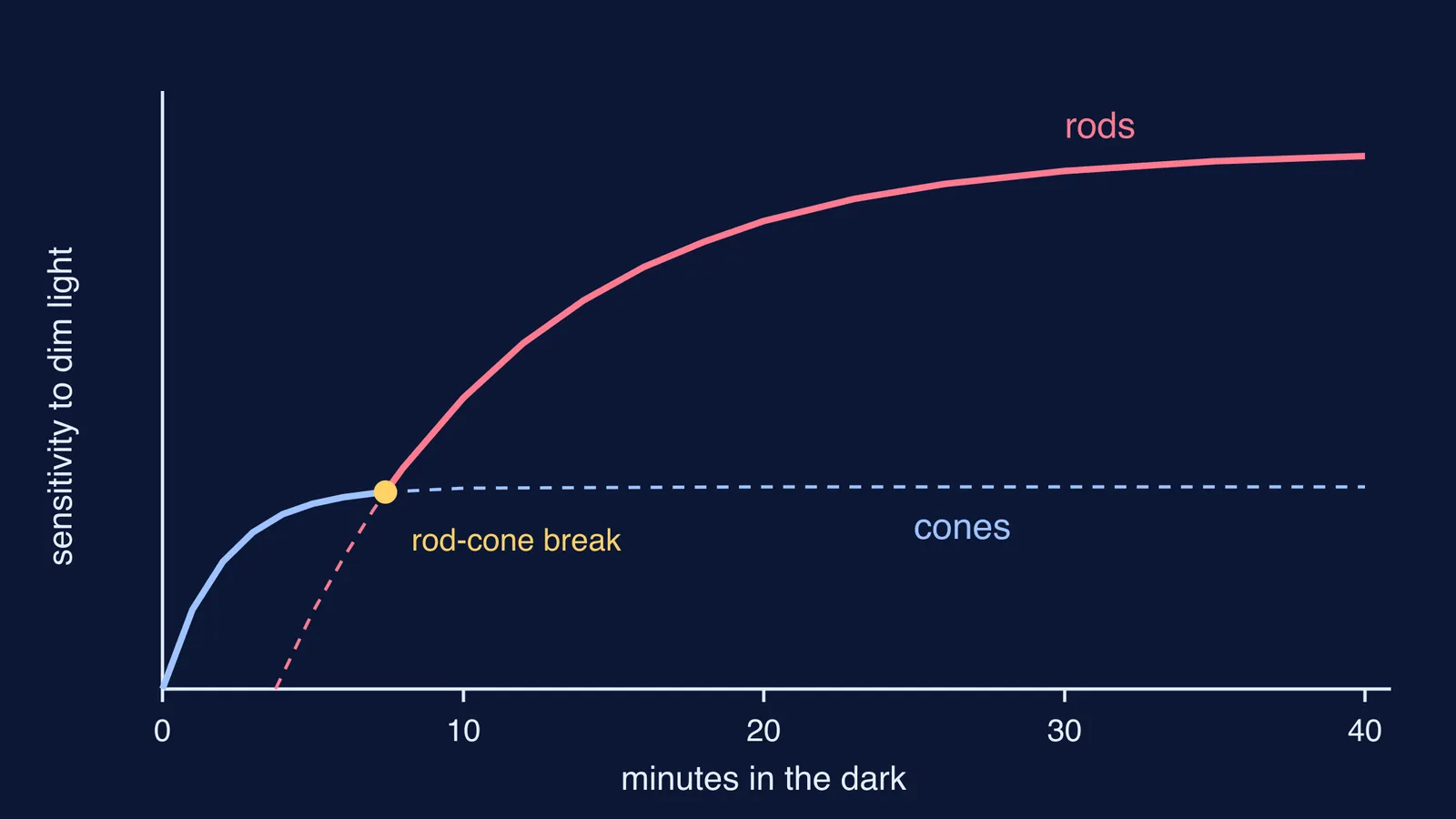
In their chapter for the vision textbook Webvision, Michael Kalloniatis and Charles Luu describe dark adaptation as a curve in two parts. Cones improve first. After 5 to 8 minutes comes the rod-cone break, the point where rods become more sensitive than cones. Rods keep improving until the threshold reaches its minimum after about forty minutes in the dark. The authors also note that measurements of the retina found dark adaptation and rhodopsin regeneration follow the same time course.
Those timings follow a bright pre-adapting light. The chapter notes that the brighter that light, the more the rod branch is delayed, and a shorter exposure speeds adaptation.
How can you test dark adaptation at home?
You need a dark room, a timer set to vibrate, and objects of different brightness, such as a white notebook, a grey bag and a dark blue bottle. Kalloniatis and Luu's lab curves start after a bright light, so after ordinary room light your timings may be quicker.
Sit in a well-lit room for five minutes so your eyes start light-adapted.
Switch the light off and start the timer. Do not look at a phone screen.
At 1, 5, 10, 20 and 30 minutes, note which objects you can make out.
Expect very little at first, then a clearer jump when rods take over (5 to 8 minutes in the lab curves), and slower gains after that.
Notice that what you see has no colour: that is rod vision.
At 20 minutes, switch the light on for a few seconds and off again. The dimmest objects will probably be harder to see for a while, because the light bleached some of the rhodopsin you had rebuilt.
Plot your notes against time and compare them with the curve at the top of this post. The Fermi Simulation Lab has interactive simulations for ideas that are easier to see than read.
Is this linked to vitamin A and night blindness?
Yes. Because rhodopsin is built from vitamin A, a shortage shows up first in dim light. The World Health Organization lists night blindness, difficulty seeing in relatively low light, as one of the first signs of vitamin A deficiency. That does not mean extra carrots give you super night vision; our post on whether carrots really improve eyesight explains why.
Taking a few minutes to see in a dark room is normal. If you or your child regularly struggle to see in dim light, or it is getting worse, see an eye doctor rather than starting supplements on your own.
Next time the power goes, start a timer and watch your rods come back.