On this page
A ripe tomato's taste comes from sugar, acid and smell. The smell comes from small molecules that drift into your nose as you chew, called volatiles. The fridge damages that third part, and it does it by changing which genes the fruit switches on.
Why do tomatoes taste less in the fridge?
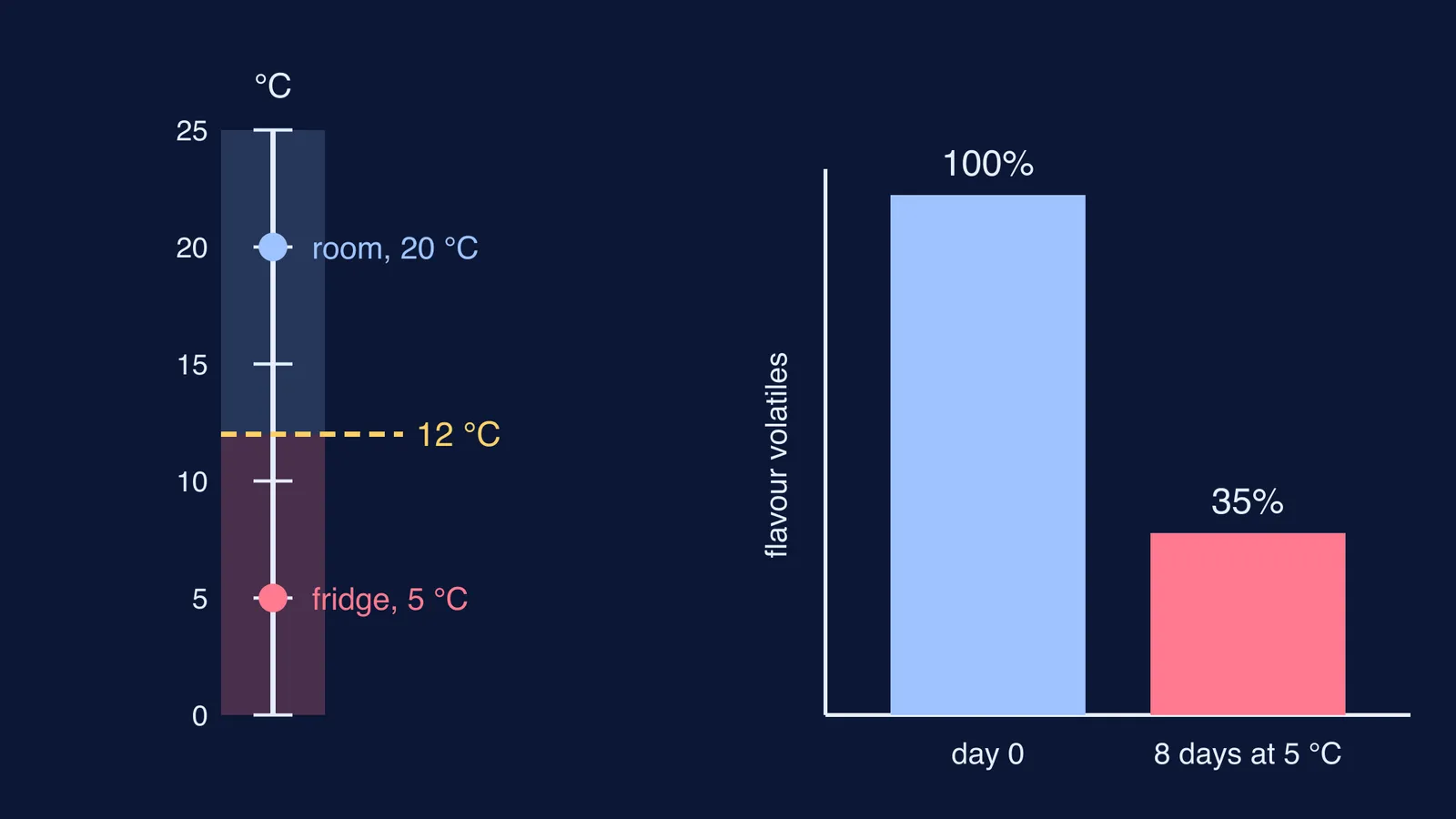
A team including Bo Zhang and Harry Klee stored ripe tomatoes at 5 °C and measured their chemistry, genes and taste in a 2016 study in PNAS. The paper states that tomato flavour volatiles are sensitive to temperatures below 12 °C.
The loss built up over time. After 1 or 3 days in the cold there was no significant drop in flavour volatiles, but after 7 days the levels were significantly lower (Zhang et al., PNAS).
Tomatoes kept at 5 °C for 8 days had 65% lower flavour volatile content than on the day they were picked (Zhang et al., PNAS).
The sweet and sour parts held steady: glucose, fructose, malic acid and citric acid showed no significant difference. What went missing was aroma.
People noticed. In a consumer panel of 76 tasters, tomatoes chilled for 7 days and then rested for a day at 20 °C got significantly lower ratings for overall liking than fruit of the same ripeness picked the day before (Zhang et al., PNAS).
What happens inside a chilled tomato?
Remember the chain from your biology textbook: gene, messenger RNA, enzyme, product. Aroma molecules are made by enzymes.
In the chilled fruit, messages for several aroma enzymes fell, including lipoxygenase (LoxC), hydroperoxide lyase (HPL) and alcohol acetyltransferase (AAT1). LoxC and HPL together turn fats into grassy volatiles such as hexanal and (Z)-3-hexenal, which were lower in the chilled fruit; AAT1 makes esters such as butyl acetate, which fell too (Zhang et al., PNAS).
The cold also lowered RIN, short for RIPENING INHIBITOR, one of the main transcription factors that run ripening. A transcription factor is a protein that switches sets of genes on or off, and genes that RIN controls directly were also lower in the cold (Zhang et al., PNAS).
The team also found methyl tags building up on DNA in the promoters, the stretches near the start of genes. This DNA methylation rose after 8 days of cold and fell back close to its starting level after a day at 20 °C (Zhang et al., PNAS).
So cold does more than slow enzymes down, the way it slows every reaction. It tells the fruit to make fewer of those enzymes in the first place.
Does the cold also spoil the texture?
It can, especially in very cold storage. Tomatoes stored below 12 °C lose quality and can develop chilling injury once back at 20 °C, according to a 2021 study in Frontiers in Plant Science by Donald Hunter, David Brummell and colleagues.
Red-ripe 'Angelle' cherry tomatoes kept at 4 °C for 27 days, then 6 days at 20 °C, softened faster and turned mealy; fruit kept at 10 °C did not (Hunter et al., Frontiers).
Genes for cell-wall enzymes were turned down at both 4 °C and 10 °C, and after severe chilling that drop was mostly irreversible. The authors suggest the 4 °C softening came from something else, such as lost water pressure in the cells. Stress-protection genes rose sharply at 4 °C, not at 10 °C, and returned to normal once the fruit warmed up (Hunter et al., Frontiers).
Can a fridge tomato get its flavour back?
Partly. A day at 20 °C after chilling raised volatile levels, but they stayed significantly lower than on the day of harvest (Zhang et al., PNAS).
How should you store tomatoes at home?
Cold storage is used because it slows ripening and reduces decay (Zhang et al., PNAS); the cost is flavour. Use this decision list:
Not fully red yet? Keep it on the counter, out of direct sun, to finish ripening.
Ripe and eating it within a few days? Counter.
Ripe but not using it soon? The fridge slows decay; accept some flavour loss and cook with it.
Going into a salad after the fridge? Take it out a day ahead so it recovers some aroma.
Try it: a blind taste test
This is a small version of the PNAS consumer panel, and a good school biology project.
Buy six tomatoes of the same kind and ripeness.
Put three in the fridge and three on the counter for 7 days.
Bring the fridge ones to room temperature before tasting.
Number the slices so tasters don't know which is which.
Ask tasters to rate smell and taste from 1 to 5, then compare averages and explain the result using gene expression.
If the gene-to-enzyme chain is still blurry, the Fermi Concept Library has a lesson for every concept in biology and chemistry, and the Fermi Simulation Lab has interactive simulations for ideas that are easier to see than to read.
Ripening chemistry shows up in other Indian kitchens too: read why calcium carbide ripening of mangoes is banned, or see what a flavour and fragrance chemist does for a living.