On this page
In March 2023 the Food Safety and Standards Authority of India (FSSAI) reminded traders that calcium carbide, sold in mandis as "masala", is banned for ripening fruit, and that "serious action will be taken" against anyone found using it (FSSAI press release, 10 March 2023). The reason is a reaction you meet in Class 11 chemistry: what carbide gives off, and what comes along with it.
Why is calcium carbide banned for ripening mangoes?
The ban sits in sub-regulation 2.3.5 of the Food Safety and Standards (Prohibition and Restrictions on Sales) Regulations, 2011 (FSSAI press release). The same release gives three reasons:
Calcium carbide contains traces of arsenic and phosphorus, which can cause dizziness, frequent thirst, irritation, weakness, difficulty in swallowing, vomiting and skin ulcers.
The acetylene gas it releases is "equally harmful to handlers".
Carbide can touch the fruit while it is being used and leave arsenic and phosphorus residues on it.
What is allowed instead is ethylene gas at up to 100 ppm (100 µL per litre of air), from sources such as ethephon, and the source must never touch the fruit (FSSAI guidance note on artificial ripening).
What happens when calcium carbide reacts with water?
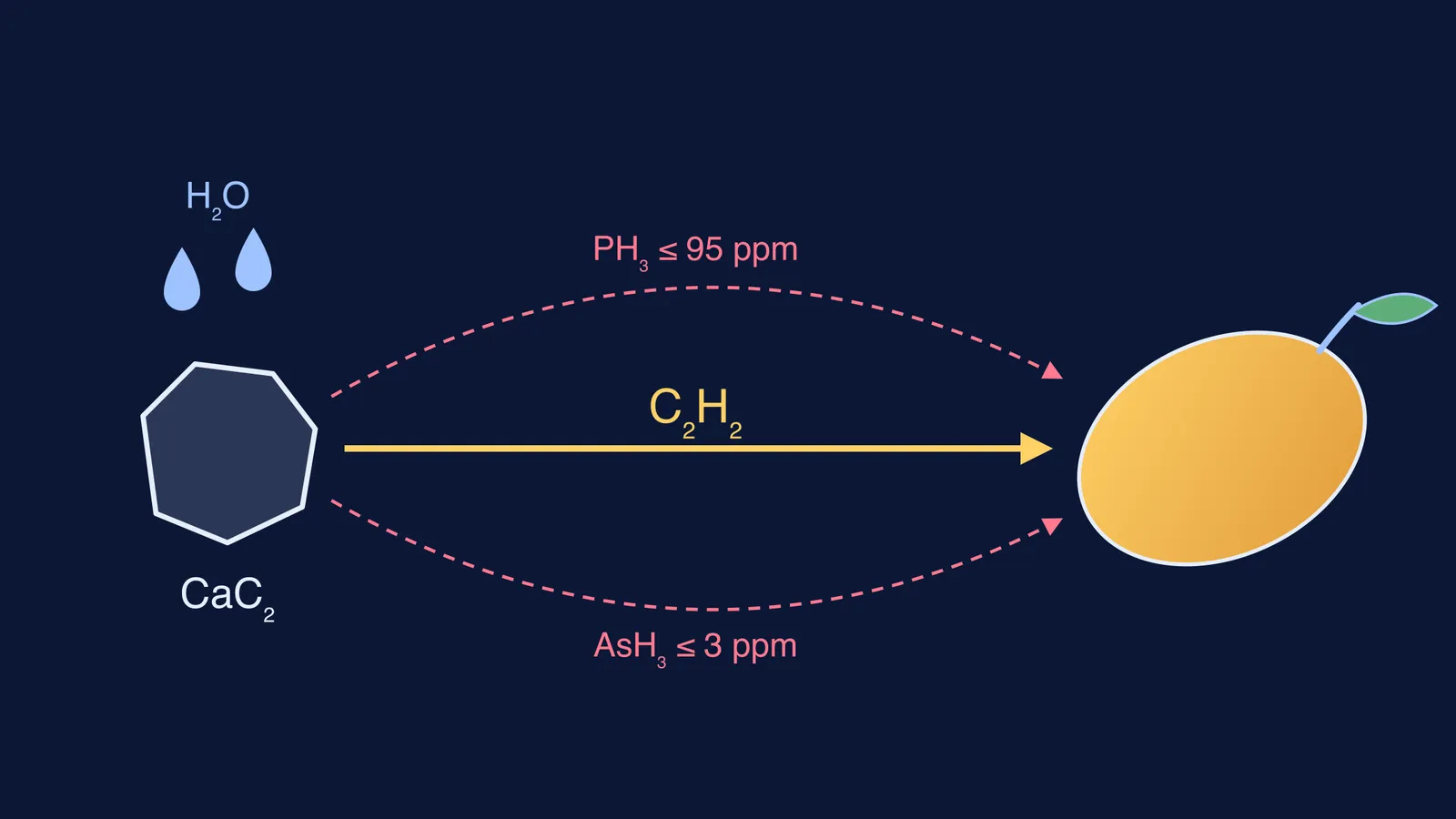
Moisture from the fruit is enough to start this reaction (Siddiqui and Dhua, Current Science, 2010):
CaC₂ + 2H₂O → Ca(OH)₂ + C₂H₂
C₂H₂ is acetylene (ethyne), the gas from our post on preparing ethyne from calcium carbide. The carbide sold as masala is industrial grade (FSSAI guidance note), and the same Current Science article reports that acetylene prepared from carbide can contain phosphine up to 95 ppm and arsine up to 3 ppm. Phosphine (PH₃) is the toxic hydride of phosphorus covered in our phosphine preparation and properties explainer; arsine (AsH₃) is the matching hydride of arsenic. A 2024 review in Food Chemistry states that carbide and carbide-ripened fruits contain inorganic arsenic and phosphorus hydrides, "posing considerable health risks" (Deshi et al., 2024).
How much gas does one gram of carbide give off?
Treat the carbide as pure CaC₂ (molar mass 64.1 g/mol) and use the upper impurity level from the Current Science article.
Moles in 1 g: 1 ÷ 64.1 = 0.0156 mol of CaC₂.
The equation is 1 : 1, so you get 0.0156 mol of C₂H₂.
At 25 °C and 1 atm a mole of gas takes up about 24.5 L, so that is roughly 0.38 L of acetylene.
If phosphine is up to 95 ppm of that gas by volume: 0.38 × 95 ÷ 1,000,000 L, or about 36 µL of phosphine per gram.
The amount is tiny, but FSSAI's concern is handlers breathing the gas and residue where carbide sits among the fruit.
How is acetylene different from ethylene, the ripening hormone?
Ethylene (C₂H₄) is a hormone that fruits make themselves, and in climacteric fruits such as mango, banana and papaya it controls ripening (FSSAI guidance note). A small outside dose starts the process, and then the fruit produces its own ethylene in large quantities. Our post on how ethylene and ethephon ripen fruit covers the hormone side.
Acetylene, with its C≡C triple bond, ripens fruit because it acts as an analogue of ethylene and its C=C double bond (Current Science, 2010), but it does so weakly. A 2019 paper in Scientific Reports notes that bananas began to ripen with 0.01 mL of ethylene per litre of air for 24 hours at 18 °C, while about 1.0 mL of acetylene per litre was needed for a similar effect, around 100 times as much (Nascimento et al., 2019). Siddiqui and Dhua add that carbide changes the skin colour while the fruit can stay raw inside, and that rawer fruit needs even more carbide.
If the two-carbon molecules blur together, the Fermi Simulation Lab has interactive simulations for ideas that are easier to see than to read, and the Fermi Concept Library gives each concept, from hydrocarbons to plant hormones, its own lesson.
How can you tell if mangoes were ripened with carbide?
No sign you can see at home is proof; suspected samples can be tested in a laboratory for arsenic and phosphorus residues (Siddiqui and Dhua, 2010). These signs and habits help:
Black blotches on the skin: FSSAI says fruits with them are likely to have been ripened by acetylene from carbide (FSSAI guidance note).
A whole pile of the same bright yellow: naturally ripened fruit is not uniformly yellow but a mix of green and yellow (Current Science).
Yellow outside but raw inside when cut, as the same article describes.
Buy from sellers you know and wash fruit under running water, as FSSAI advises.
Ripen mature but unripe mangoes at home: wrap them in paper, keep them in an airtight rice bin, or lay them on paddy husk or straw. FSSAI says this takes 4 to 6 days at room temperature (FSSAI guidance note).
One equation from your hydrocarbons chapter decides what is legal in your fruit bowl.