

On this page
Phosphine (PH₃) is a crucial p-block compound in the Class 12 chemistry syllabus. While it shares a group with ammonia, it behaves very differently in the laboratory.
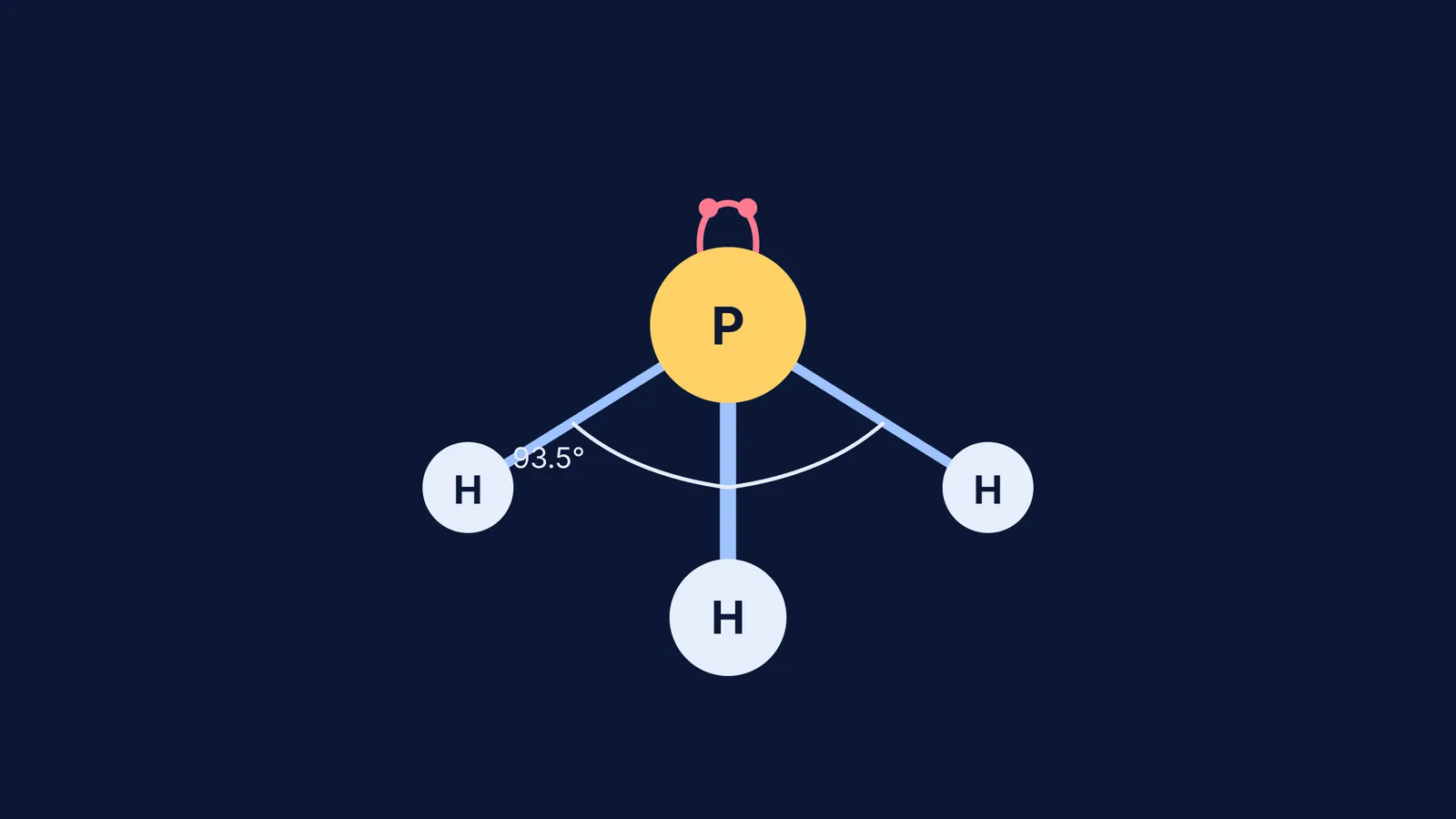
Because of its lower electronegativity and larger size, the phosphorus atom creates a molecule with a smaller bond angle than ammonia. If you are preparing for your board exams or competitive tests like JEE and NEET, knowing the preparation and properties of phosphine is helpful.
How is phosphine prepared?
You can prepare phosphine using two main methods depending on the starting material.
The first method uses calcium phosphide. When calcium phosphide reacts with water or dilute hydrochloric acid, it yields phosphine gas [[1]](https://unacademy.com/content/jee/study-material/chemistry/preparation-and-properties-of-phosphine/). Ca₃P₂ + 6H₂O → 3Ca(OH)₂ + 2PH₃ Ca₃P₂ + 6HCl → 3CaCl₂ + 2PH₃
The second method is the standard laboratory preparation. You heat white phosphorus (P₄) with a concentrated sodium hydroxide (NaOH) solution in an inert atmosphere of carbon dioxide [[2]](https://www.vedantu.com/chemistry/phosphine). P₄ + 3NaOH + 3H₂O → PH₃ + 3NaH₂PO₂
This reaction produces phosphine along with sodium hypophosphite. Pure phosphine is not spontaneously flammable, but the gas produced here often catches fire because it contains trace amounts of diphosphine (P₂H₄) or phosphorus vapours [[2]](https://www.vedantu.com/chemistry/phosphine). To purify it, the impure gas is first passed through hydroiodic acid. It reacts to form phosphonium iodide (PH₄I) crystals. These solid crystals are then separated and treated with an aqueous solution of potassium hydroxide (KOH), which releases the pure phosphine gas without the flammable impurities.
If you have a concept gap with disproportionation reactions, the Fermi Concept Library has a lesson on oxidation states.
What are the chemical properties of phosphine?
Phosphine is a weak base, significantly weaker than ammonia [[3]](https://brainkart.com/article/Phosphine-(PH3)_39869/). This happens because the lone pair on the larger phosphorus atom is housed in an orbital with more s-character, making it less available for donation. Additionally, the lower electronegativity of phosphorus compared to nitrogen reduces its ability to attract protons.
Despite its weak basicity, it acts as a Lewis base and reacts with strong acids like hydroiodic acid to form phosphonium salts. It is also known to be a strong reducing agent. PH₃ + HI → PH₄I
When bubbled through solutions of metal salts, phosphine acts as a precipitating agent. For example, it reacts with copper sulphate to form a black precipitate of copper phosphide [[1]](https://unacademy.com/content/jee/study-material/chemistry/preparation-and-properties-of-phosphine/). 3CuSO₄ + 2PH₃ → Cu₃P₂ + 3H₂SO₄
If you need to calculate the exact volume of gas produced in these reactions, the step-by-step solver in the Fermi Problem Library will walk you through the stoichiometry.
Why is phosphine highly toxic?
Phosphine is an extremely poisonous gas [[4]](https://www.cdc.gov/niosh/npg/npgd0505.html). It attacks the respiratory system, and inhalation can lead to symptoms like chest tightness, dyspnea and pulmonary edema. Even minimal contact can trigger neurological issues like dizziness, convulsions and fatigue, along with gastrointestinal distress such as nausea and vomiting. Severe cases can result in kidney and liver damage or systemic shock.
Because of this extreme danger, the Occupational Safety and Health Administration (OSHA) sets the Permissible Exposure Limit (PEL) for phosphine at just 0.3 ppm over an 8-hour shift [[4]](https://www.cdc.gov/niosh/npg/npgd0505.html). The concentration that is Immediately Dangerous to Life or Health (IDLH) is 50 ppm [[4]](https://www.cdc.gov/niosh/npg/npgd0505.html).
In addition to its toxicity, phosphine is a colourless gas known for a distinct, highly unpleasant rotten fish or garlic smell [[2]](https://www.vedantu.com/chemistry/phosphine).
What to check in phosphine questions?
When you face a question about the preparation and properties of phosphine in an exam, check these common traps:
Check the starting material: Is it white phosphorus or red phosphorus? Only white phosphorus reacts with NaOH to give PH₃.
Look at the basicity: If asked to compare basic strength, always rank PH₃ below NH₃.
Identify the impurity: If the question mentions phosphine catching fire spontaneously, the impurity is diphosphine (P₂H₄).
Confirm the bond angle: The H-P-H angle is approximately 93.5°, which is close to 90° because phosphorus uses almost pure p-orbitals for bonding.
Visualising the lone pair repulsions that cause this 93.5° angle—or the complex geometries seen in interhalogen compounds—is much easier when you can rotate the molecule; you can do exactly this in the Fermi Simulation Lab.


