

On this page
Ethylene is unique among plant hormones: it is a simple two-carbon gas (C₂H₄) that coordinates fruit ripening, leaf abscission, and stress adaptation. While auxins and gibberellins promote elongation, ethylene directs developmental transitions and tissue senescence. For Class 11 biology and NEET-UG students, mastering ethylene means linking its cellular triggers with practical agricultural chemistry.
What is the respiratory climacteric in fruit ripening?
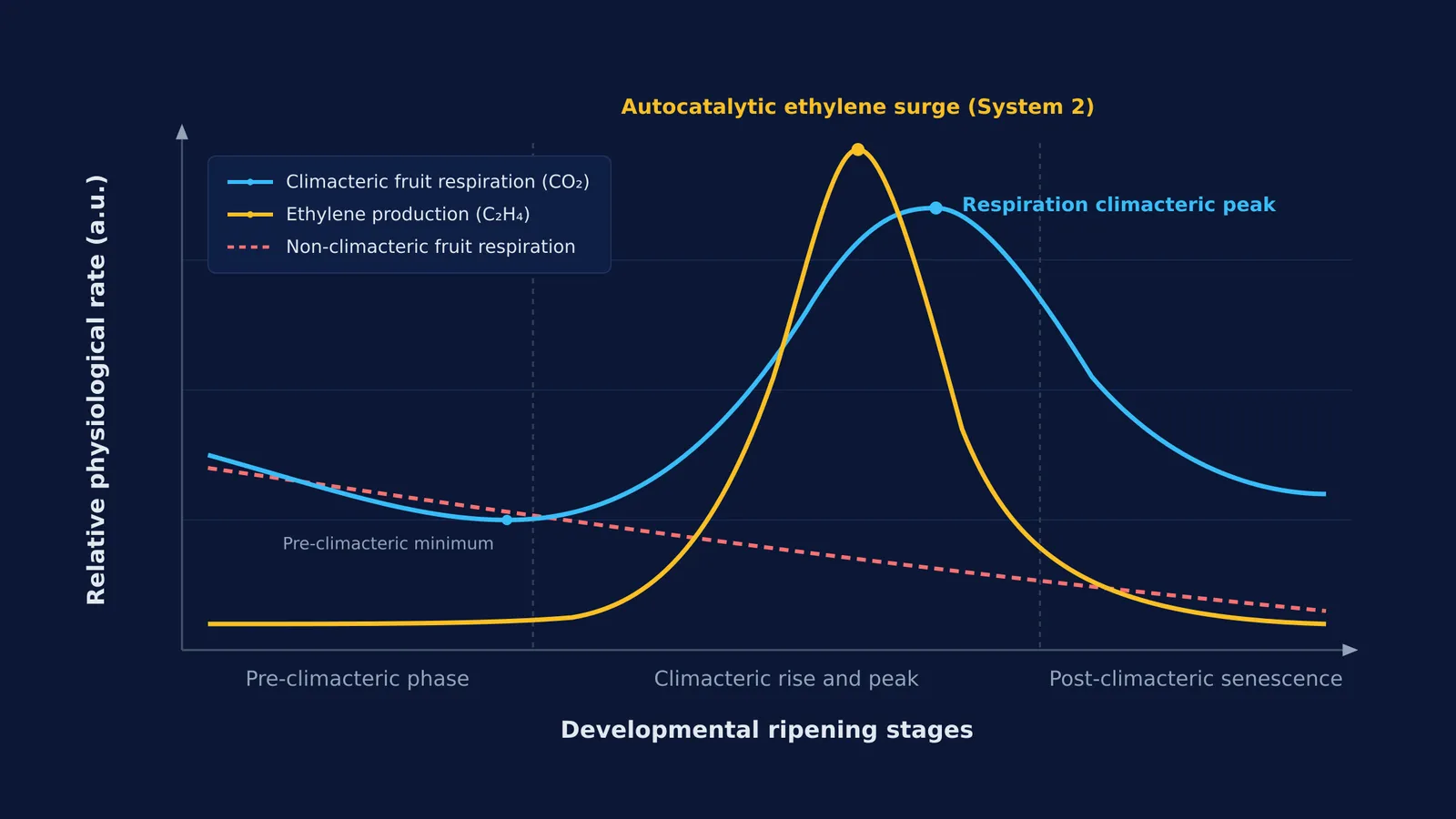
In many ripening fruits, maturity triggers a sharp, temporary rise in cellular respiration known as the respiratory climacteric. First measured by Franklin Kidd and Cyril West in 1930 in the *Proceedings of the Royal Society of London* (Kidd & West, 1930), this surge involves elevated oxygen uptake and carbon dioxide release as tissues ripen.
This metabolic burst powers the enzymatic breakdown of pectins to soften pulp, hydrolyses starch into simple sugars, and degrades chlorophyll. As detailed in our guide to cellular respiration pathways in plants, respiration supplies the necessary ATP for these biosynthetic changes. In climacteric fruits, ethylene acts autocatalytically: exposure to minute amounts stimulates the fruit to synthesize massive amounts of its own hormone.
What is the triple response of seedlings to ethylene?
When a germinating dicot seedling encounters mechanical resistance from compacted soil or stones, it activates a protective survival response. Discovered by Dimitry Neljubow in 1901 and reviewed by Bakshi and colleagues in 2015 in the *Journal of Plant Growth Regulation* (Bakshi et al., 2015), the classical triple response consists of three morphological adjustments:
Reduced stem elongation, halting upward growth against an unyielding obstruction.
Radial swelling of the stem axis, thickening the hypocotyl for mechanical strength.
Horizontal growth with an exaggerated apical hook, shielding the delicate apical meristem as the shoot navigates around obstacles.
Once the seedling emerges into open air, ethylene levels decline and normal upward growth resumes, contrasting with the directional tropisms described in our overview of plant growth regulators.
How does ethylene induce flowering in pineapples?
While ethylene generally promotes organ shedding and senescence, it acts as a floral inducer in select crops. In pineapple (*Ananas comosus*), natural flowering occurs unevenly across several months, complicating commercial harvesting schedules.
Antonio G. Rodriguez demonstrated in 1932 that ethylene in smoke triggers floral initiation in pineapples. Later research by Turnbull and co-authors in 1999 in the *Journal of Plant Growth Regulation* (Turnbull et al., 1999) revealed that applying ethylene synchronises flowering across entire fields. This uniform floral induction allows commercial growers to harvest composite fruits simultaneously, a physiological role distinct from the hormone mechanisms examined in botany of fruit development and parthenocarpy. Ethylene promotes a similar floral response in commercial mango cultivation.
How does ethephon release ethylene inside plant tissues?
Because ethylene is a gas, dispersing it evenly across open orchards is impractical. Commercial agriculture instead relies on ethephon (2-chloroethylphosphonic acid), a water-soluble compound that serves as an aqueous source of ethylene.
In 1969, Warner and Leopold in *Plant Physiology* (Warner & Leopold, 1969) and Yang in *Plant Physiology* (Yang, 1969) demonstrated that ethephon decomposes by base-catalysed hydrolysis:
At pH below 3.5, ethephon remains chemically stable, enabling safe aqueous storage and transport.
Inside plant tissues, where cytoplasmic pH is near neutral (pH 7.0), ethephon fragments into ethylene gas, inorganic phosphate, and chloride ions: Cl–CH₂–CH₂–PO₃²⁻ + H₂O → CH₂=CH₂ + H₂PO₄⁻ + Cl⁻.
This reaction enables systemic absorption through foliage followed by localized ethylene release. Growers spray ethephon to accelerate ripening in apples and tomatoes, promote fruit thinning in cherries and walnuts, and increase female flower formation in cucumbers.
How do you solve exam questions on ethylene and ethephon?
Exam questions frequently test ethylene mechanisms through matching items and assertion-reason problems. Use this four-step diagnostic checklist to analyze each question:
Identify the developmental stage: distinguish between seedling emergence (triple response), vegetative elongation (internode growth in deep-water rice), and maturation (climacteric ripening).
Separate climacteric types: remember that only climacteric fruits undergo an autocatalytic respiratory burst, while non-climacteric fruits decline steadily in respiration.
Check seedling markers: look for the three hallmarks of dark-grown dicot responses: stunted elongation, stem thickening, and horizontal growth with an apical hook.
Verify the chemical delivery: associate aqueous formulations, neutral pH decomposition, and female flower induction in cucumbers directly to ethephon.
If you need to untangle overlapping plant hormone pathways, the Fermi Concept Library covers every concept in biology, each with its own lesson and its place in the map. When working through tricky classification problems, the Fermi Problem Library offers worked problems with a step-by-step solver that explains the reasoning rather than printing an answer.


