

On this page
"Apple is a false fruit" and "banana is a parthenocarpic fruit" are two of the most repeated lines in plant reproduction, and they are easy to blur together. One is about which part of the flower became the fruit. The other is about whether fertilisation happened. This post separates the two ideas, gives you two questions that sort any fruit, and lists the traps examiners use.
Where is this in the syllabus?
The NEET (UG) 2026 syllabus lists "Development of seed and formation of fruit; Special modes- apomixis, parthenocarpy, polyembryony" under sexual reproduction in flowering plants, and "fruit and seed" under morphology. The CBSE Class XII curriculum for 2026-27 has the same line for its first chapter. In NCERT (2026-27 reprints) the ideas are spread over three chapters:
Class 12, Sexual Reproduction in Flowering Plants, section 1.4: true and false fruits, and parthenocarpy.
Class 11, Morphology of Flowering Plants, section 5.6: the fruit and its pericarp.
Class 11, Plant Growth and Development: auxins inducing parthenocarpy.
Check the syllabus for your exam year when it is notified.
What makes a fruit "true"?
NCERT's Class 11 definition: the fruit is "a mature or ripened ovary, developed after fertilisation". As ovules mature into seeds, the ovary develops into the fruit, and the ovary wall becomes the fruit wall, the pericarp. In a thick, fleshy pericarp NCERT names three layers: epicarp, mesocarp and endocarp, as in mango.
In most plants the other floral parts degenerate and fall off by the time the fruit develops. A fruit that comes only from the ovary is a true fruit, and NCERT says most fruits are of this kind.
Why are apple, strawberry and cashew false fruits?
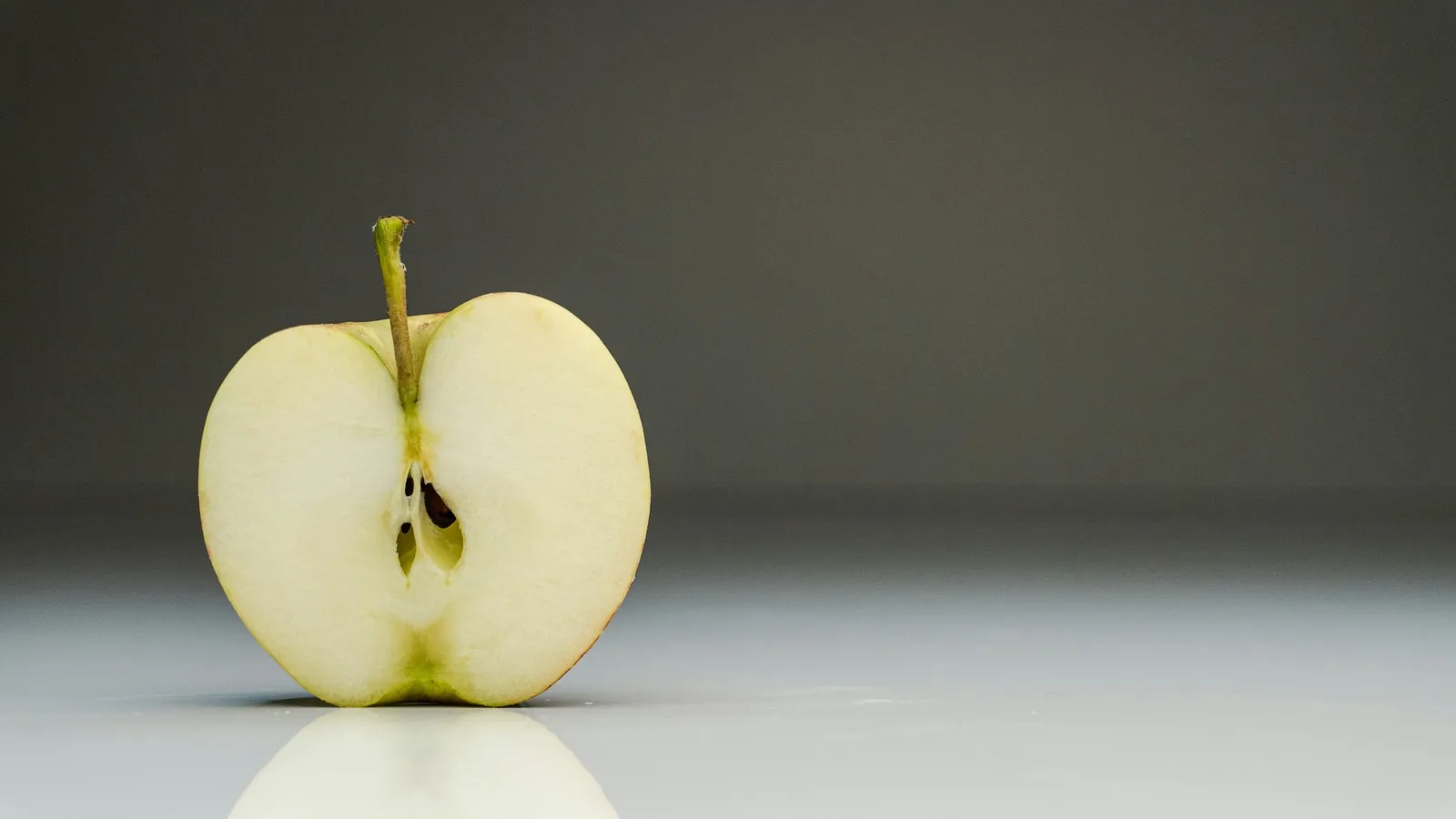
In a few species, NCERT says, "such as apple, strawberry, cashew, etc., the thalamus also contributes to fruit formation". The thalamus (also called the receptacle) is the swollen tip of the flower stalk that carries the floral parts. Fruits with a thalamus contribution are false fruits.
"False" here says nothing about fertilisation. An apple is normally a fertilised fruit with seeds; it is false only because tissue from outside the ovary is part of it. NCERT's exercise question 14 asks exactly this: why apple is called a false fruit, and which parts of the flower form it.
What is parthenocarpy?
NCERT: in a few species "fruits develop without fertilisation. Such fruits are called parthenocarpic fruits. Banana is one such example." It adds that parthenocarpy "can be induced through the application of growth hormones and such fruits are seedless". The plant hormone chapter gives the example: auxins induce parthenocarpy in tomatoes.
A review by Pandolfini (2009) explains why growers care. Seedlessness is valued by consumers and producers because it improves fruit quality and shelf-life, and one route to it is plants that can set fruit without pollination and fertilisation. The review notes that the start of fruit growth is under the control of plant hormones.
Worked example: sort these fruits
For each fruit, ask (1) did anything besides the ovary form the fruit, and (2) did the fruit form without fertilisation? Use only what NCERT states.
Mango. A drupe from a monocarpellary superior ovary, one-seeded (Class 11, section 5.6). Ovary only, fertilised: a true fruit, not parthenocarpic.
Apple. Thalamus contributes: a false fruit. Seeds form after fertilisation, so not parthenocarpic.
Strawberry. Thalamus contributes: a false fruit.
Banana. NCERT's example of a parthenocarpic fruit: formed without fertilisation, so seedless.
Tomato treated with auxin. Fruit induced without fertilisation: parthenocarpic and seedless.
Groundnut and mustard. NCERT's examples of dry fruits from the ovary. The pericarp can be dry or fleshy; that does not change whether a fruit is true.
One more check. In a parthenocarpic fruit the ovary wall still grows into a pericarp, so the fruit wall is the mother plant's own tissue, as in any fruit. What is missing is the product of fertilisation: no zygote, so no embryo and no seed.
How is parthenocarpy different from apomixis?
Both skip fertilisation, but they make different things. NCERT's section 1.5 defines apomixis as a mechanism "to produce seeds without fertilisation", found in some species of Asteraceae and grasses. Parthenocarpy produces a fruit without fertilisation, and that fruit is seedless.
Apomixis: seed without fertilisation.
Parthenocarpy: fruit without fertilisation, no seed.
NCERT even sets this up as a question inside the apomixis section: "What is fruit production without fertilisation called?"
Which mistakes cost marks?
Saying a false fruit forms without fertilisation. That is parthenocarpy, a separate idea.
Saying parthenocarpic fruits contain seeds. NCERT says they are seedless.
Swapping apomixis and parthenocarpy. Seed or fruit: say which one forms.
Confusing pericarp with perisperm. The pericarp is the fruit wall from the ovary wall; perisperm is persistent nucellus inside some seeds, such as black pepper and beet.
Calling the thalamus part of the ovary. It is the tip of the flower stalk that bears all the floral whorls.
A practice routine
A large review of study techniques by Dunlosky and colleagues (2013) gave practice testing and distributed practice its highest utility rating. Build both in:
Write the five NCERT definitions (fruit, pericarp, false fruit, parthenocarpic fruit, apomixis) from memory, then check.
Sort the six fruits above again in two days' time without looking.
Answer NCERT exercise questions 14 and 16 in writing. For 16, choosing fruits for induced parthenocarpy, justify your choice with what the fruit is eaten for.
Draw a flower, label the thalamus and ovary, and shade the parts that become an apple-type false fruit.
If the flower parts themselves are hazy, the Fermi Concept Library covers every concept in physics, chemistry, biology, mathematics and computing, so you can rebuild the flower before the fruit. For the events before the fruit, read our guide to double fertilisation in flowering plants, and for auxins and gibberellins, see plant growth regulators.
Tonight, explain to someone at home why an apple can be a false fruit and still have seeds.


