On this page
In 2006, physicist Xiaowei Zhuang, working with Michael Rust and Mark Bates, published a way to see finer detail than an ordinary light microscope allows. Their method, STORM (stochastic optical reconstruction microscopy), does not use a better lens. It changes what the molecules in the sample do: only a few glow at any moment, so each one can be located on its own (Rust, Bates and Zhuang, Nature Methods, 2006).
Why can't a light microscope see below about 200 nm?
Light spreads out as it passes through a lens, so even a perfect point of light shows up as a blurred spot. Nikon's MicroscopyU gives the Abbe limit as resolution r = λ/(2NA), where λ is the wavelength and NA is the numerical aperture of the objective (MicroscopyU). Magnification is not in the formula, so zooming in on a blur only gives you a bigger blur.
Take a good oil-immersion objective with NA 1.4 and green light of 550 nm: 550 ÷ (2 × 1.4) ≈ 196 nm. That matches the barrier the Harvard Gazette describes: the diffraction limit capped conventional light microscopes at about 200 nanometres. For the Class 12 version, see our explainer on resolving power of microscopes and telescopes.
How does STORM switch molecules on and off?
The trick began with a pair of dyes. In 2005, Mark Bates, Timothy Blosser and Zhuang described a single-molecule optical switch: a Cy5 dye that light of different colours flips between a glowing state and a dark state, with a nearby Cy3 molecule helping the switch (Physical Review Letters, 2005).
STORM uses such switches as labels. (For a glowing label found in nature, see our piece on Osamu Shimomura and green fluorescent protein.) The 2006 paper says: "In each imaging cycle, only a fraction of the fluorophores were turned on, allowing their positions to be determined with nanometer accuracy" (Nature Methods, 2006). The positions from many cycles are then combined into one picture, and that first paper reported a resolution of 20 nm.
As a loop:
Switch almost every dye molecule dark.
Switch on a random few, so that glowing ones are rarely close enough to share a blur spot.
Find the centre of each spot.
Switch those off and repeat.
Plot every centre as a dot. The dots are the image.
Why does finding the centre beat the blur?
When background glow is negligible, MicroscopyU gives the localisation precision as roughly σ ≈ s/√N, where s is the spread (standard deviation) of the blur spot and N is the number of photons collected from the molecule (MicroscopyU, single-molecule imaging). Each photon is one guess at the molecule's position; averaging N guesses shrinks the error by √N, just like averaging repeated readings in a practical.
Work it through with a spread of s = 100 nm:
N = 100 photons: σ ≈ 100/10 = 10 nm.
N = 1,000 photons: σ ≈ 100/31.6 ≈ 3 nm.
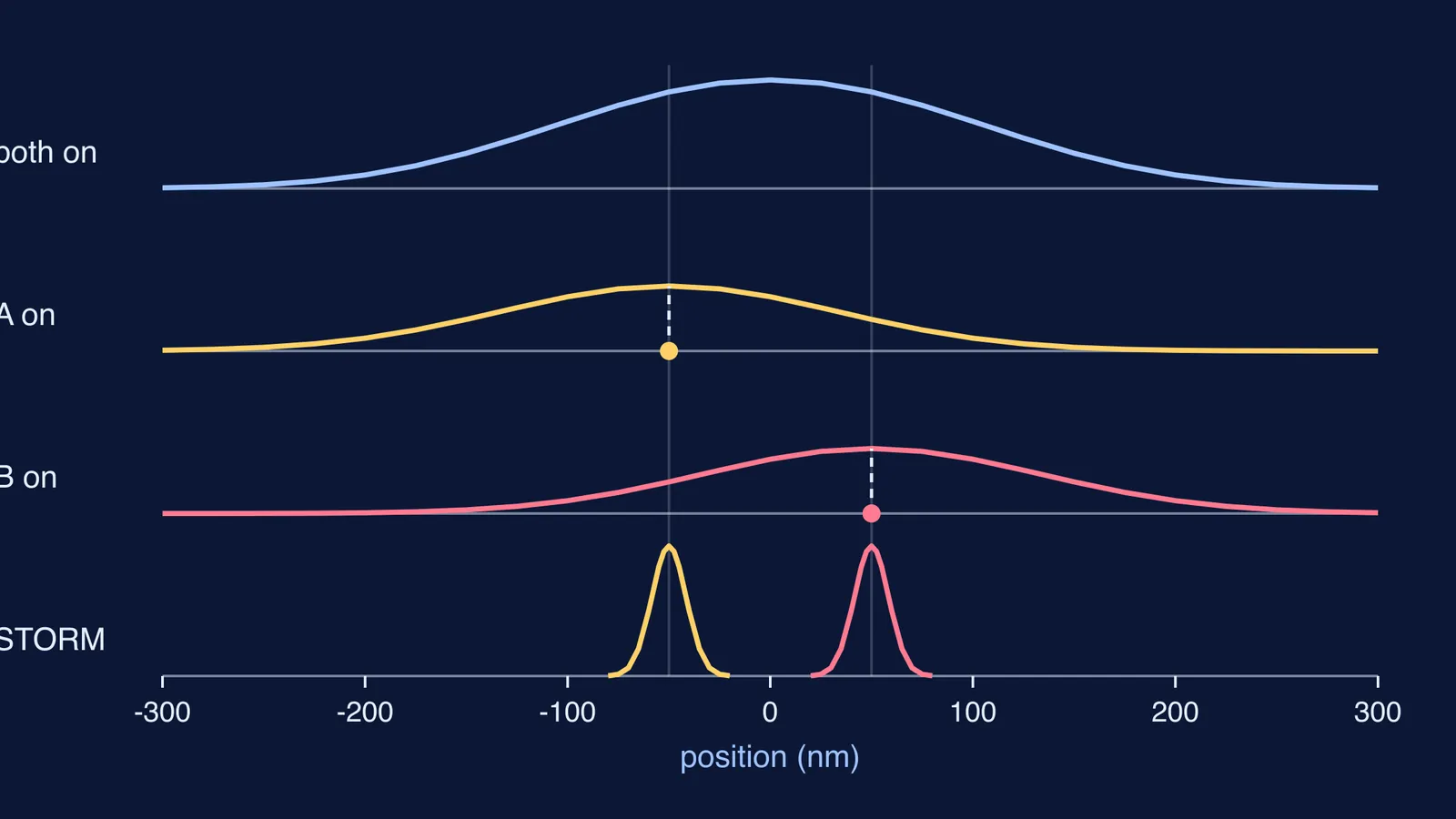
The full formula adds camera pixel size and background, which make σ larger; MicroscopyU quotes about 10 nm for about 1,000 photons. Either way, the centre is known far better than the width of the spot. The diagram at the top shows two molecules 100 nm apart: on together they merge into one hump; on one at a time, each centre is clear.
What has STORM shown inside cells?
In 2008, Bo Huang, Wenqin Wang, Mark Bates and Zhuang added depth. They used optical astigmatism to work out each molecule's height as well as its sideways position, without scanning the sample, and reported 20 to 30 nm resolution sideways and 50 to 60 nm in depth (Science, 2008).
In 2013, Ke Xu, Guisheng Zhong and Zhuang turned STORM on neurons. Actin formed rings wrapped around axons, evenly spaced every 180 to 190 nm, with spectrin alternating between them; dendrites had long actin filaments instead (Science, 2013). That spacing is below the diffraction limit.
Zhuang was born in 1972 in Rugao, Jiangsu, took a physics degree at the University of Science and Technology of China, earned a physics PhD at UC Berkeley in 1996 and joined Harvard in 2001 (National Inventors Hall of Fame). In October 2018 she was named a winner of the 2019 Breakthrough Prize in Life Sciences for developing super-resolution imaging (Harvard Gazette). For a different way past the limit, read about Stefan Hell's route past the diffraction limit.
How can you explain STORM in one minute?
A script for a viva or science club talk, using the numbers from MicroscopyU and the 2006 paper:
"Diffraction blurs every point of light into a spot about 200 nm wide."
"If two molecules are closer than that, their spots merge."
"STORM labels them with dyes that light can switch on and off."
"It switches on only a few at a time, finds the centre of each spot, and repeats."
"The centres, plotted together, make an image with about 20 nm resolution."
If diffraction blur is hard to picture, the Fermi Simulation Lab has interactive simulations for ideas that are easier to see than to read.